What a book title generator does (and does not do)
Key takeaway: A generator is a brainstorming helper. It produces options, but you must judge them.
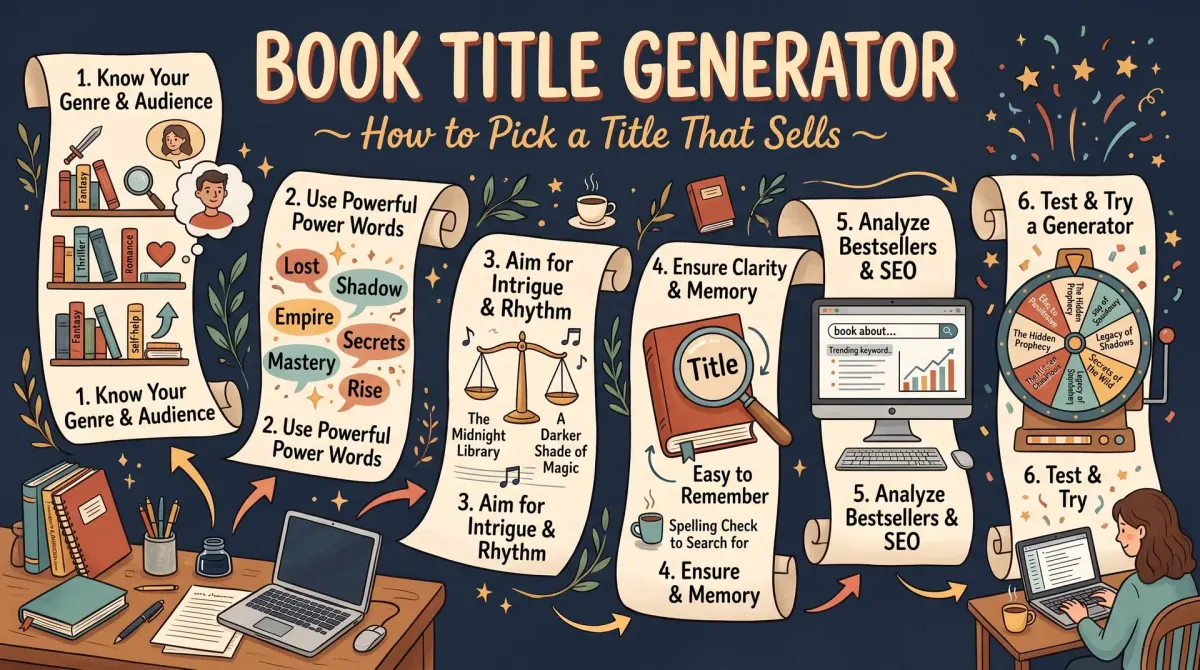
A book title generator is an online tool that creates title ideas. You enter a genre, a keyword or a short plot summary. It mixes words and patterns into many options. It does not judge quality, so you still choose the final title.
Most tools work in one of three ways. Some pick random words from a list. Some fill in templates, such as "The [noun] of [place]". Others use an AI model to turn your description into ideas.
All three have limits. A tool does not know your plot, your tone or your reader. It can also repeat the same patterns that thousands of other writers receive.
So treat the output as raw material. Collect many options, then edit them. A weak idea often contains one strong word you can keep.
Here is a quick comparison:
| Method | Best for | Main limit |
|---|---|---|
| Random word mix | Fresh, odd ideas | Often makes no sense |
| Template fill-in | Non-fiction titles | Sounds generic |
| AI from a summary | Plot-based ideas | Needs careful checking |
Whichever you choose, run every idea through the checks below.
Book title ideas: the combination method
Key takeaway: Build your own list of words, then mix them. You control the quality and avoid generic results.
You can act as your own generator. This takes ten minutes and gives you more control. Make two lists.
List one holds strong, concrete words from your story: places, objects, feelings and symbols. List two holds nouns that fit your genre, such as "house," "secret," "garden," "game" or "road."
Count and multiply. If you list 10 opening words and 8 nouns, you get 10 × 8 = 80 possible pairs. Scan the 80 and mark any that spark interest. Most will be poor. A handful will be good.
Then try these patterns:
- Two nouns: "Salt and Smoke"
- Place plus object: "The Lantern at Harrow Bay"
- A question or promise (non-fiction): "Write Faster, Edit Less"
- A key phrase from the book: a line a character says
For genre fiction, read the titles of recent bestsellers in your category. Notice length, mood and common words. Do not copy them. Instead, match the feel so readers know what to expect.
Keep a spreadsheet of every idea. Add a notes column. You may return to an old idea later.
How to write a book title that readers understand
Key takeaway: A good title is clear first and clever second. A confused reader keeps scrolling.
Many writers ask how to write a book title that stands out. The answer starts with clarity. A title is the name of your book, shown on the cover and in store listings.
Use five checks:
- Clear: Can a stranger guess the genre or topic?
- Short: Shorter titles read well on small thumbnails.
- Easy to say: Can people say it aloud and spell it?
- Fresh: Is it unlike the top results in your category?
- Fit: Does the tone match the story and the cover?
For non-fiction, add a subtitle. The title grabs attention. The subtitle explains the benefit or the audience. For example: "Quiet Mornings: A Simple Routine for Busy Parents."
For fiction, a subtitle is less common. A series name or tagline may do the same work.
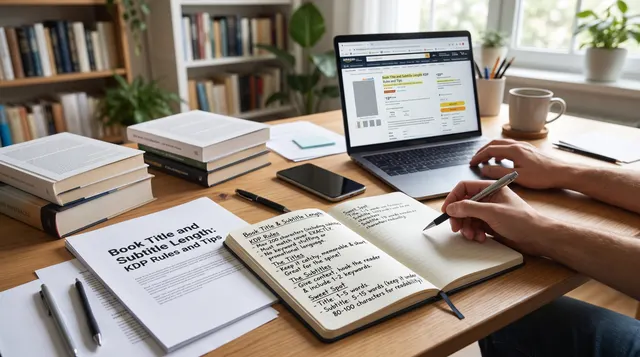
Check store rules before you finalise. Amazon KDP sets limits on the title and subtitle fields. Our guide covers the rules and best practice.
Avoid titles that promise something the book does not deliver. Readers feel misled, and reviews suffer.
Book title generator using keywords
Key takeaway: Keywords help non-fiction books get found. Fiction titles should lean on mood, not search terms.
A keyword is a word or phrase that people type into a search bar. Using a book title generator with keywords works best for non-fiction. A reader who searches "beginner gardening" is more likely to click a title with those words.
Follow this simple process:
- List three to five phrases your reader would search.
- Pick one main phrase and place it in the title or subtitle.
- Write it in natural English, not as a list of terms.
- Check how other books in your category word theirs.
For example, a bare title like "Green Hands" says little. Add a subtitle: "Green Hands: Beginner Gardening for Small Balconies." Now the topic is clear.
However, do not stuff keywords. Store systems and readers both dislike it. A title that reads like a search query looks spammy.
Fiction works differently. A mystery reader does not search for your exact title. They browse categories and covers. So choose a title that fits the mood. You can use search terms in your book description and keyword fields instead.
Find a book title by plot (or find an existing book)
Key takeaway: The phrase has two uses: finding a title for your own story, and finding a book you forgot. Each has a different method.
Many people search find a book title by plot. They usually want to recall a book they read years ago. That is a different task from naming your own book, but the same skills help.
To name your own book from its plot:
- Write a two-sentence summary of the story.
- Underline the strongest nouns and verbs.
- Pull out the central conflict, such as a lost brother or a stolen map.
- Turn that conflict into a short phrase.
An AI tool can help. Paste your summary and ask for 30 title ideas in your genre. Then cut any that sound like existing books.
To find a forgotten book:
- Search the plot in a library catalogue.
- Ask in a reader forum or a book community.
- Add details such as the cover colour, setting and era.
Check that your chosen title is not already a famous work. A quick search of a bookstore and a library catalogue shows overlaps. Titles are not protected by copyright, but a copycat title can confuse buyers.
Score and test your shortlist
Key takeaway: A simple score removes guesswork. Then ask real readers to choose.
Once you have 20 to 50 ideas, cut the list to five. Then score each from 1 to 5 on five checks: clear, short, easy to say, fresh and fit. The maximum is 25.
| Title idea | Scores (C/S/E/F/Fit) | Total |
|---|---|---|
| Salt and Smoke | 3 + 5 + 5 + 4 + 5 | 22 |
| The Long Way to Harrow | 4 + 3 + 4 + 4 + 4 | 19 |
| Ash | 2 + 5 + 5 + 2 + 3 | 17 |
Add each row by hand. 3 + 5 + 5 + 4 + 5 = 22. In this sample, "Salt and Smoke" wins. Your numbers will differ.
Next, test your top three with real people:
- Show the three titles with the cover idea to ten readers of your genre.
- Ask which book they would click first.
- Ask what they think the book is about.
If readers guess the wrong genre, change the title. Their guess is valuable data.
Finally, say the title in a sentence. "Have you read Salt and Smoke?" It should sound natural.
Title patterns by genre
Key takeaway: Each genre has title habits. Match them so readers know what to expect.
Genre cues help buyers decide fast. Look at the top ten books in your category and note what they share.
- Thrillers and mysteries: short, sharp titles, often one to three words.
- Romance: warm or playful titles that hint at the couple or the setting.
- Fantasy: a place, an object or a rank, such as a throne or a blade.
- Memoir: a personal phrase plus a subtitle that names the theme.
- Self-help and business: a clear promise, often with a subtitle that states the benefit.
- Children's books: short, playful titles that are fun to say aloud.
Use these as patterns, not rules. A fresh twist inside a familiar pattern works well. For example, "The Last Train to Harrow" signals a mystery. "Quiet Mornings" signals a gentle guide.
Say the title aloud. Then type it into a store search bar and see what appears. If the results look far from your genre, rethink the title.
Finally, check that the title still works in black and white, in small type and next to your author name. A good title survives all three tests.
People Also Ask
Are book titles italicized?
Yes, in print and most formal writing. Major style guides such as MLA, APA and Chicago italicize full book titles. Short works such as poems, articles and chapters go in quotation marks. Plain text fields such as store listings may not support italics.
Can I copyright a book title?
Titles are usually not protected by copyright. Short phrases and names fall outside it. However, trademark law may apply in some cases, such as a series name. Check a bookstore and trademark database before you commit, and ask a qualified lawyer if you are unsure.
How long should a book title be?
Shorter titles read better as small thumbnails, and many successful ones use one to five words. Non-fiction can add a subtitle for detail. Check the limits for your platform before you finalise. Clarity matters more than word count. Test the title on a phone screen.
Common mistakes
- Trusting the first result. A generator gives raw ideas. Edit and score them.
- Choosing a title that is hard to spell. Readers may not find it again.
- Copying a bestseller. It confuses buyers and may mislead them.
- Ignoring the thumbnail. Check how the title looks small on a phone.
- Skipping reader tests. Your own taste is only one opinion.
Pick your title, then build the listing
Key takeaway: Your title is one part of a listing. The description and categories finish the job.
Once you choose a title, write a strong description that matches it. Our description builder helps you shape the text for Amazon and other stores.
Then check the full set of listing fields before you publish.
Your next step is simple. Use the combination method to write 50 ideas today, then score the best five.