What a novel is and how long it takes
Key takeaway: A novel is a long made-up story. Finishing one is a matter of daily words multiplied by days.
A novel is a long work of fiction told in scenes and chapters. Length changes by genre, so treat any target as a guide. This article uses 80,000 words as a sample goal. It is an example, not a rule.
How to write a novel is a repeatable process for turning a story idea into a finished long fiction draft. You choose a premise, plan the plot and characters, write scenes in order, then revise. Steady daily writing matters more than waiting for inspiration.
Many people ask how long does it take to write a novel. The answer is simple. Divide your target word count by the words you write each day.
Here is the arithmetic for an 80,000-word draft:
- 80,000 ÷ 500 words a day = 160 days
- 80,000 ÷ 1,000 words a day = 80 days
- 80,000 ÷ 2,000 words a day = 40 days
| Words per day | Days to 80,000 words | Months (about) |
|---|---|---|
| 500 | 160 | 5.3 |
| 1,000 | 80 | 2.7 |
| 2,000 | 40 | 1.3 |
That covers the first draft only. Revision takes extra time. Many writers plan a second pass that is nearly as long as the first.
Start with a premise you can say in one sentence
Key takeaway: A premise names a character, a goal and what stands in the way.
A premise is the core idea of your story in one or two sentences. If you cannot say it short, the plot is probably unclear. Write it before you write anything else.
Use this pattern: "A [character] must [goal] before [deadline or cost], but [obstacle]." Fill in each blank. Then read it aloud.
Example: "A retired detective must find a missing teenager before a storm hits, but her only witness lies." That one line gives you a hero, a goal, a clock and a problem.
Test the premise with three questions:
- Does the main character want something badly?
- Is there a real obstacle?
- Would a reader want to know what happens next?
If all three answers are yes, move on. If not, change one part and test again. This step takes ten minutes and saves weeks.
Beginners often start with a world or a scene instead. That can work. However, a premise keeps you from drifting at the midpoint, when most drafts stall.
How to write a novel outline
Key takeaway: An outline is a map. Even a one-page version stops you from getting lost at 30,000 words.
Learning how to write a novel outline is the fastest way to speed up your draft. An outline is a list of the main events in the order they happen. It can be short or detailed. You choose the depth.
Three common methods help beginners:
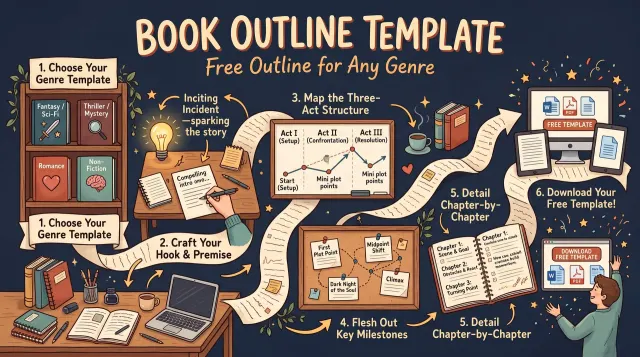
- Three-act structure: Act one sets up the world and problem. Act two raises the stakes. Act three resolves the conflict.
- Snowflake Method: Writer Randy Ingermanson created it. It starts with one sentence and grows it into a full plot.
- Scene list: You write one line per scene, such as "Maya finds the letter."
Start with the three-act structure if you are new. Write five turning points on a card. List the opening, the plot trigger, the midpoint twist, the lowest moment and the ending.
Then fill the gaps. Aim for a list of 30 to 40 scenes for a full-length novel. Each scene needs a goal, a conflict and a change. If nothing changes, cut the scene.
Plan loosely if you like to discover the story as you write. Even so, know your ending. A known destination makes every scene easier.
How to write dialogue in a novel
Key takeaway: Good dialogue sounds natural, reveals character and moves the plot. It does not copy real speech word for word.
Many writers search for how to write dialogue in a novel after a flat scene. Dialogue is the spoken words of your characters. It should do at least one job per exchange: share information, show feeling or raise tension.
Follow these simple rules:
- Keep lines short. Real people rarely talk in paragraphs.
- Give each character a different voice. One may speak in short bursts. Another may ramble.
- Use "said" for most tags. Readers skip over it.
- Cut greetings and small talk unless they matter.
- Let characters talk past each other. People rarely answer every question.
Compare two versions:
- Weak: "As you know, our father died ten years ago."
- Better: "You still keep his chair empty?"
The second line shows history without explaining it.
Format also matters. Start a new paragraph each time the speaker changes. Place the comma inside the quotation marks. Add small actions between lines to ground the scene.
Read your dialogue aloud. If you stumble, rewrite the line.
How to write a novel in 30 days
Key takeaway: A 30-day draft needs about 1,667 words a day. It only works if you plan before day one.
Writers often try how to write a novel in 30 days as a challenge. The goal is a rough draft, not a finished book. Many such challenges set a target of 50,000 words in a month.
Do the math first: 50,000 ÷ 30 = 1,666.67, so aim for about 1,667 words each day. If you skip one day a week, you have 26 writing days. Then 50,000 ÷ 26 = 1,923 words per day.
Prepare before day one:
- Finish your premise and outline.
- Choose a set writing time and place.
- List your main characters and one trait for each.
- Turn off your internet during writing sessions.
During the month, do not edit. Mark weak spots with a note like "fix later" and keep going. Editing slows you down and kills momentum.
A 50,000-word draft is short for many genres. You may need a second round to reach full length. Still, you will have a complete story, which is the hardest part.
How to write a novel for beginners: 7 steps
Key takeaway: Follow the same seven steps in order. Skipping the plan is the most common beginner error.
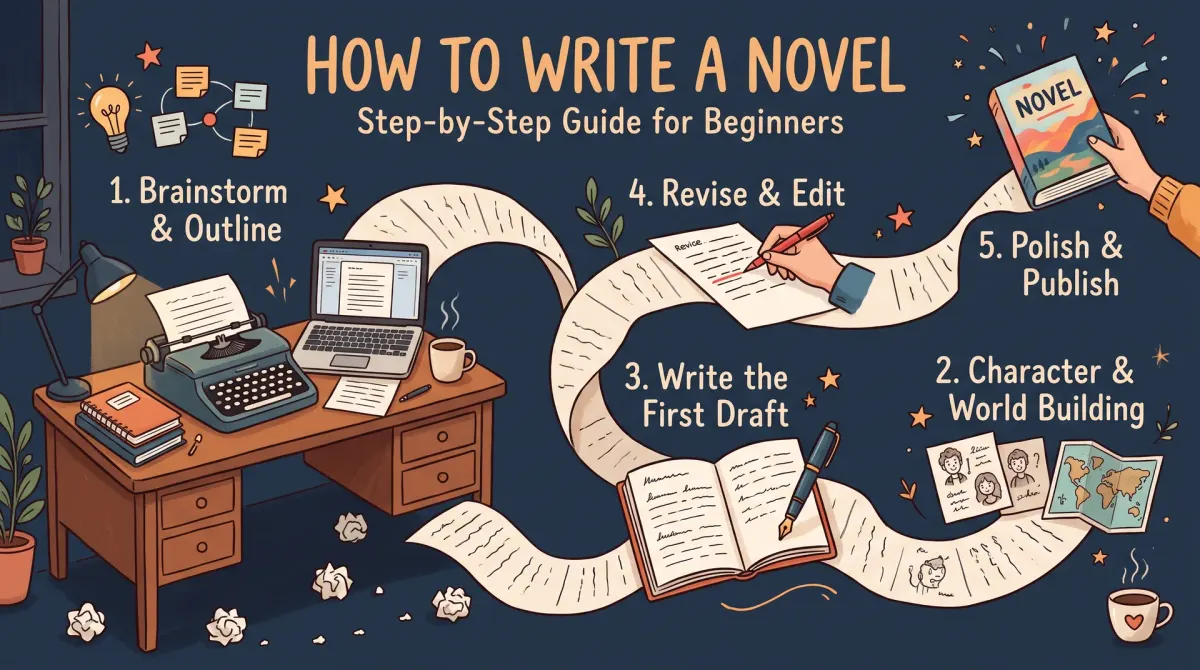
Use this checklist as your working method:
- Write a one-sentence premise.
- Sketch a three-act outline.
- List your main characters and goals.
- Set a daily word count.
- Write the draft without editing.
- Rest for one to two weeks.
- Revise in two passes.
Take the steps one at a time. Revision deserves a closer look. In pass one, fix the big issues: plot holes, weak scenes and unclear motives. In pass two, fix sentences, repeated words and typos.
After revision, ask two or three beta readers to read it. A beta reader is a test reader who tells you what confused or bored them. Choose people who read your genre.
Software can help you organise chapters and track word counts. Read our comparison before you buy anything.
Genre notes: romance, fantasy, mystery and more
Key takeaway: Each genre has reader expectations. Meet them, then add a fresh twist.
Genre shapes your outline. Readers pick a genre because they want a certain experience. Break those expectations and they may stop reading.
- How to write a romance novel: Two people meet, face a barrier and choose each other. Readers expect a satisfying ending. Build chemistry through dialogue and shared scenes.
- How to write a fantasy novel: Create clear rules for your magic or world. Reveal them slowly inside scenes, not in long lectures.
- How to write a mystery novel: Plant clues early. Give the reader a fair chance to solve it. Hide the answer in plain sight.
- How to write a graphic novel: You write a script with panels and captions, and an artist often draws it. Describe each panel in short lines.
- How to write a light novel: These are short, fast-paced stories, often with illustrations. Keep chapters brief and dialogue-heavy.
Read five recent books in your genre before you outline. Note chapter length, pacing and how the story opens. Use what you learn as a rough benchmark.
People Also Ask
How do you start writing a novel?
Start with a one-sentence premise that names your character, goal and obstacle. Then sketch a short outline of five turning points. Set a daily word count and begin the first scene. You can fix the opening after the draft is done.
How many words should a first novel be?
It depends on the genre, so check recent books in yours. Many full-length novels run tens of thousands of words, and an 80,000-word draft is a common sample target. Hitting a perfect number matters less than telling a complete, satisfying story.
Can I write a novel without an outline?
Yes. Some writers discover the story as they write. However, you still need an ending in mind and a few turning points. Without them, many drafts stall in the middle. A short outline of five key events is a good compromise.
Common mistakes
- Editing while drafting. You slow down and may never finish. Draft first and fix later.
- Skipping the plan. A story without a map often stalls near the midpoint.
- Starting too slow. Open with a problem or a choice, not a long description.
- Writing flat dialogue. If a line only passes information, rewrite it to show feeling or conflict.
- Setting no deadline. A daily word count and an end date keep the draft moving.
Finish the draft, then plan your launch
Key takeaway: A finished draft is the start of the next stage, not the end.
Once your novel is revised, you have choices. You can query agents, or you can publish it yourself. Both routes need a description, a cover and the right categories.
Self-publishing on Amazon KDP has no setup fee. Our complete guide walks you through each stage.
Compare both routes before you decide. Then write a strong book description for your listing.
Check the official KDP help pages for current file and content rules.
Your finished draft also raises rights questions. The official copyright office explains how protection works.
Your next step is small. Write your one-sentence premise today and pick a daily word count.