Start with one clear idea
Key takeaway: A book needs one promise. If you cannot say it in one sentence, the book is not clear yet.
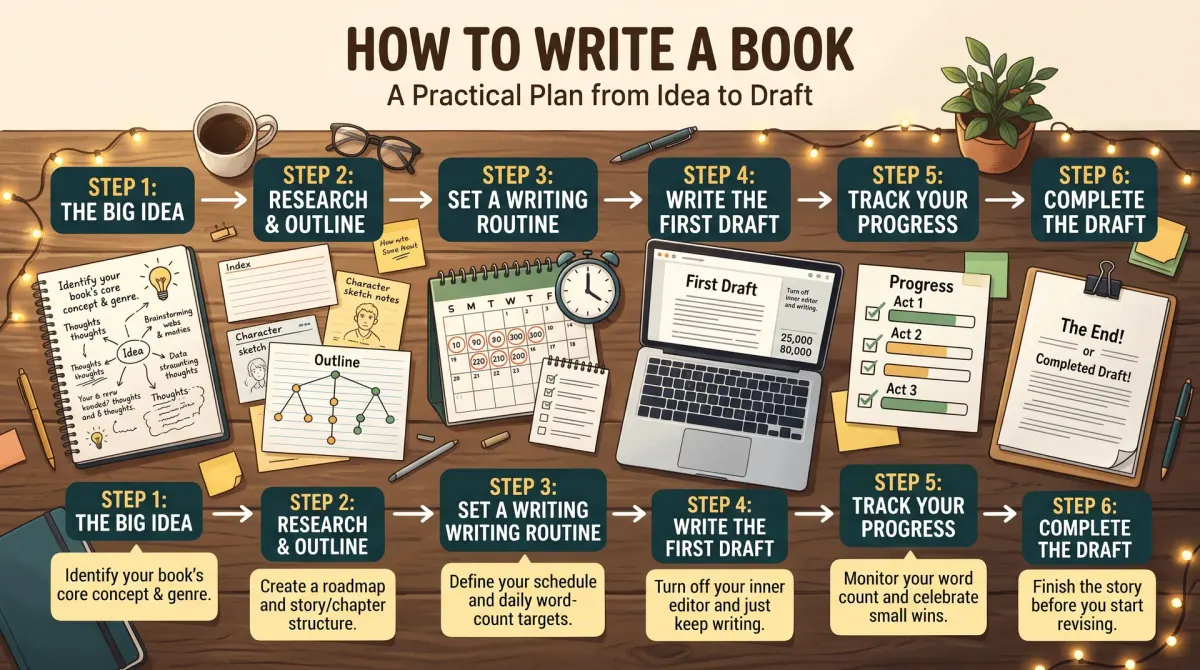
To write a book, you start with one clear idea for one reader, plan the structure, set a daily word goal, write a rough first draft, then revise in passes before you edit, format and publish. A steady routine matters more than inspiration.
Many unfinished books fail at the start. The idea is too wide, so the writer never knows what to leave out. Write one sentence that says who the book is for and what it gives them.
For non-fiction, use this shape: "This book helps [reader] do [result] without [pain]." For fiction, name the main character, the goal, and what stands in the way.
Test the idea. Would you read this book? Does a similar book already exist, and what would yours add? A little research now saves months later.
Plan the structure
Key takeaway: An outline is a map. You can change the route, but you should know where you are going.
Break the book into parts, then chapters, then scenes or sections. A short list is enough to start.
For non-fiction, a simple structure works well:
- A hook chapter that shows the problem.
- Core chapters, each teaching one idea.
- Examples and exercises in each chapter.
- A closing chapter that tells the reader what to do next.
For fiction, outline the beginning, middle and end first. Add the key turning points. You can discover details as you write, but the big shape should be clear.
Set a daily word goal
Key takeaway: Divide the book into small daily targets. A small goal you keep beats a big goal you drop.
Pick a target length. Then divide it by the number of days you can write. This gives a realistic daily goal and a finish date.
Here is a worked example. You want an 60,000-word book. You can write five days a week, 500 words a day.
- Words per week: 500 x 5 = 2,500.
- Weeks needed: 60,000 / 2,500 = 24 weeks.
- That is about six months for the first draft.
If you raise the goal to 1,000 words on five days, the same draft takes 12 weeks. Choose a pace you can keep when work gets busy.
Write the first draft
Key takeaway: The first draft only has to exist. Fix it later.
Rules that help:
- Write at the same time each day.
- Turn off alerts and close other tabs.
- Do not edit while you draft. Mark gaps with a note like "[add example]" and keep going.
- Stop each session in the middle of a thought, so it is easy to start again.
- Track your word count in a simple sheet.
When you get stuck, skip to a part you can write. Chapters do not have to be drafted in order.
Revise in two passes
Key takeaway: Rest first. Then fix structure before you fix sentences.
Leave the draft alone for a week or two. You will see it with fresh eyes.
Pass one: structure. Does every chapter earn its place? Is anything missing, repeated or in the wrong order? Fix large problems first.
Pass two: language. Cut long sentences. Remove filler words. Check names, facts and consistency. Read it aloud to catch awkward lines.
After both passes, send the draft to two or three readers. Ask specific questions, such as "Where did you get bored?" and "What was unclear?"
Use tools wisely
Key takeaway: Tools help with typing, tracking and checking. They do not replace your ideas or your judgement.
A plain word processor is enough to finish a book. Writing apps can help with structure and word counts. Spell checkers catch typos. AI tools can help brainstorm, but you remain responsible for the text, the facts and the rights.
From draft to published book
Key takeaway: Writing is the first step. Editing, formatting, cover design and publishing come next.
Once the revision is done, hire or arrange an edit, format the interior, and design a cover. Then choose a platform, set a price and publish.
Beat the common blocks
Key takeaway: Most writing blocks have a simple cause. Name the cause and the fix becomes clear.
You do not know what to write next. Your outline is probably too thin. Add two or three lines under each chapter heading that say what the reader should learn or what must happen. Then write the easiest part first.
You hate what you wrote. That is normal in a first draft. The job of a draft is to exist. Do not delete it. Mark it and keep going. You will fix it in the revision pass, when you can see the whole book.
You run out of time. Look at your week and find a fixed slot, even twenty minutes. A short slot you keep is worth more than a long session you keep missing. Write down the time and treat it as an appointment.
You lose motivation halfway. The middle of a book is the hardest part. Look back at your word count chart and see how far you have come. Tell one person your finish date. A little outside accountability helps a lot.
You keep researching instead of writing. Set a research limit for each chapter. When time is up, write with what you have and mark the gaps. You can fill them in during revision.
Match the book to the reader
Key takeaway: A book that serves one clear reader beats a book that tries to serve everyone.
Before you write each chapter, ask who is reading it and what they need. A beginner needs simple steps and examples. An expert wants depth and evidence. A reader of fiction wants a reason to turn the page.
Write a short profile of your ideal reader. Give them an age range, a problem and a goal. Keep it beside your desk. When you are unsure whether to include a section, check it against the profile. If the reader does not need it, cut it.
This also helps later. The same profile guides your title, your book description, your cover and your marketing. A book that is clear about its reader is easier to sell.
Test your idea with a sentence
Write: "This book helps [reader] to [result] by [method]." If you cannot fill the blanks, the idea needs work. A clear sentence makes planning, writing and marketing easier.
For fiction, change the form. Write who the main character is, what they want and what stands in the way.
Share the sentence with three people. Ask if they would read it.
Make a map before you write
A map saves time. List the main parts of the book. Break each into chapters. Under each chapter, note two or three points.
Estimate the length of each chapter. Add them up to see the total. Adjust until the shape feels right.
Keep the map flexible. You can change it as you learn.
Build a writing routine
Choose a regular time. Pick a place with few distractions. Set a goal you can reach on a bad day. Write down each session in a log.
Start with 20 or 30 minutes if you are new. Build up when it feels easy.
Plan for missed days. When it happens, restart the next day without guilt.
Write a rough first draft
The first draft is for getting ideas down. Do not stop to edit. Mark gaps with a note, such as [CHECK], and keep going.
If a chapter is hard, write the easy parts first. Return later.
Do not compare your draft to published books. Those went through many rounds.
Revise in two passes
First pass: structure. Does the order work? Are there gaps or repeats? Does each chapter serve the promise?
Second pass: language. Tighten sentences. Cut filler. Replace vague words with specific ones. Check facts.
Then ask others to read. Revise again.
Use tools wisely
Tools can help, but they do not write the book for you. A word processor or writing app keeps text safe. A grammar checker catches slips. AI can offer ideas and feedback, but check every fact and keep your voice.
Plan the move to publishing
When the text is ready, plan editing, formatting, a cover and a platform. Start early, since good editors and designers book ahead.
Beat common blocks
If you are stuck, change the task. Write a different chapter, talk the scene aloud or write the reader a letter. If fear stops you, share a small piece with a trusted friend.
A four-week starter plan
Week one: write the promise, the outline and the schedule. Week two: write the first two chapters and set a steady pace. Week three: continue and mark gaps. Week four: review progress, adjust the plan and continue.
Keep the plan flexible. If you fall behind, adjust the date, not the goal.
Keep a notes system
Keep one place for ideas, research and questions. Tag notes by chapter. Review them weekly.
This habit saves time and keeps you from losing good ideas.
Read like a writer
Reading helps your writing. Pick three books like the one you want to write. Read them with a pencil. Note how chapters begin and end, how the author explains ideas and how long the sections run.
Do not copy. Learn the patterns that readers expect in your genre, then add your own voice and ideas.
Keep a short list of lessons and check it when you revise.
People also ask about writing a book
How do I start writing a book?
Write one sentence that says what the book does for whom. Make a short outline of chapters. Pick a daily time and word goal you can keep. Begin with the part that excites you most, and fix the order later. Starting small and steady beats waiting for a perfect plan.
How many words should my book have?
It depends on the genre and the reader. Check similar books in your category and aim for a similar length. Short practical books are often shorter than novels. Do not pad. Cover what the reader needs, then stop.
Do I need an outline to write a book?
No, but most writers finish faster with one. An outline can be a list of chapters with one line each. Some writers prefer to discover the story as they go, then plan in revision. Choose the method that keeps you writing.
Keep going
A book is built from small sessions. Show up, write, rest and revise.