Copyright starts when you write
Key takeaway: You own copyright the moment your words are saved in a file or on paper. You do not need to file anything for that.
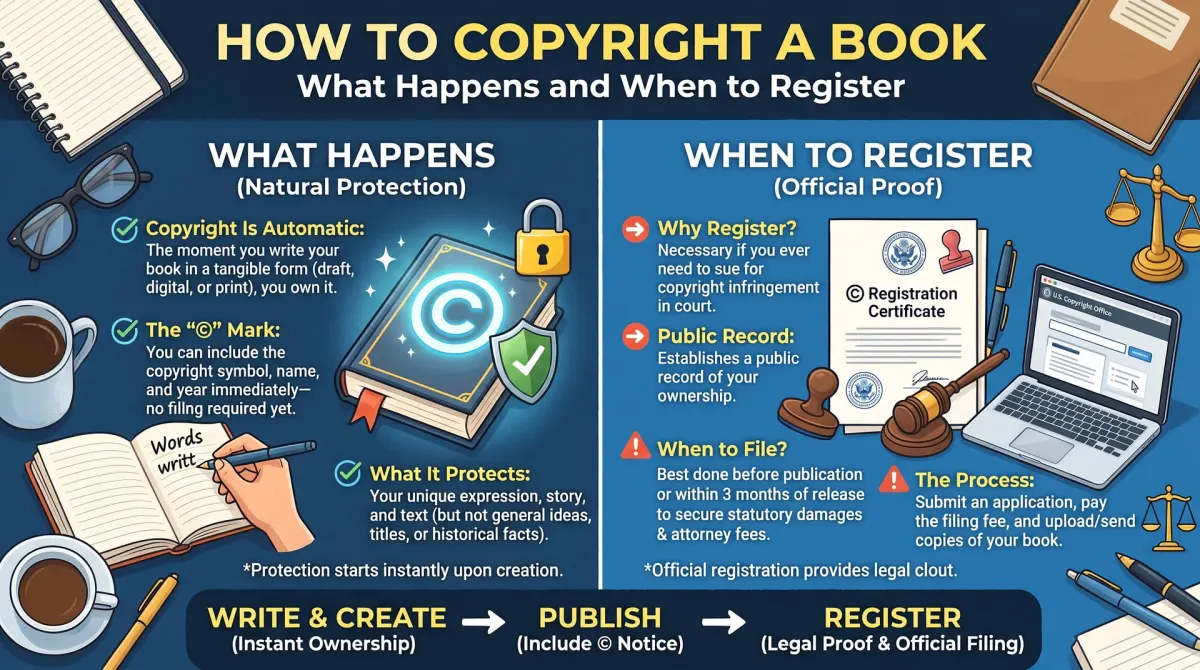
To copyright a book, you write and fix it in a tangible form, such as a file or a printed page. In many countries copyright exists automatically. In the US you can also register the work with the Copyright Office, which gives stronger legal tools.
Copyright protects original creative expression. A book manuscript is a clear example. Once you write it down or save it, the work is protected without any form, fee or notice.
Copyright protects the way you express an idea. It does not protect the idea itself. Two authors may both write about dragons or budgeting. They cannot copy each other's words.
Titles, names and short phrases are not covered by copyright. A trademark can sometimes protect a series title or a brand name, but that is a separate process.
Why register your copyright
Key takeaway: Registration is not needed to own the book, but it makes it much easier to enforce your rights in the US.
In the United States, a registration gives you:
- A public record that you claim ownership.
- The right to file an infringement lawsuit for a US work, in most cases.
- Possible access to statutory damages and attorney fees if you registered in time.
- A certificate that can help in disputes with platforms and websites.
Timing matters. Registering before an infringement, or soon after publication, usually gives you stronger remedies. Read the Copyright Office's guidance for the exact rules.
How to register a book in the US
Key takeaway: Online registration is the fastest route. Prepare your files and details first.
The US Copyright Office runs an online registration system. The process has these parts:
- Create an account on the Copyright Office registration system.
- Choose the type of work. A book is usually a literary work.
- Enter the title, author, year of completion and publication status.
- Pay the fee shown on the Copyright Office site. Fees are set by the office and can change, so check before you apply.
- Upload a copy of the work, or mail the required copies for a published work.
- Wait for the office to review your application and issue a certificate.
The office publishes processing times on its site. They change, so read the current estimate before you plan around them.
What goes on the copyright page
Key takeaway: The copyright page tells readers who owns the book and what they may do with it. It is not a registration.
A normal copyright page has these items:
- The copyright symbol, the year and your name, for example "Copyright © 2026 Your Name".
- A line such as "All rights reserved."
- The ISBN of that edition.
- The publisher or imprint name.
- Credits for the cover designer and editor.
- A disclaimer, for memoirs or non-fiction, if it applies.
You can add these lines even if you have not registered. The notice is not required by law in the US, but it tells readers who to contact and helps against claims that someone copied the work innocently.
Copyright, ISBN and trademark are different
Key takeaway: Each tool protects something different. Do not confuse them.
| Tool | What it protects | Needed to sell a book? |
|---|---|---|
| Copyright | Your original text and images | Exists automatically |
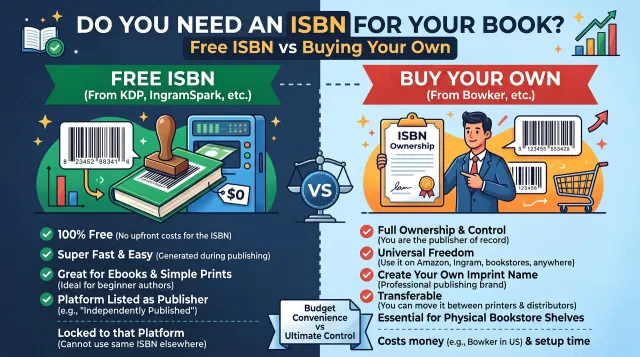
| ISBN | Identifies one edition in the book trade | Print books on KDP, yes |
| Trademark | A brand or series name | No |
| Registration | Your claim, on a public record | No, but helpful |
Copyright and AI-assisted writing
Key takeaway: Copyright rules for AI-generated material are still developing. Keep records of what you wrote yourself.
In the US, the Copyright Office has said that works need human authorship. Material made by an AI tool with no human creative input is generally not protected. Human-written text, and human selection and arrangement of material, can be. If you use AI tools, keep notes on what you wrote and what you changed, and read the Office's current guidance when you register.
Common copyright mistakes
Key takeaway: Most copyright trouble comes from using other people's material or misunderstanding what is protected.
- Using quotes or images without permission. Short quotes may be allowed in some cases, but images, song lyrics and long passages usually need permission.
- Assuming a poor-man's copyright works. Mailing yourself a copy does not replace registration.
- Copying a competitor's book structure too closely. Ideas are free, but their exact expression is protected.
- Forgetting work-for-hire details. If you hire an illustrator or ghostwriter, put in writing who owns the final work.
- Ignoring licence terms for stock images and fonts. Some licences do not allow use on a book cover or in print.
Keep every licence and permission email in a folder. If a platform ever questions your rights, you can show proof quickly.
When to talk to a lawyer
Key takeaway: This guide explains the basics. It is not legal advice. Get professional advice for contracts and disputes.
A lawyer who knows publishing law can help if you:
- receive a takedown notice or claim against your book
- find a copy of your book on sale without your permission
- plan to sell film, translation or audio rights
- sign a contract with a publisher, agent or ghostwriter
- use a large amount of another person's material
Many author organisations also offer contract reviews to members. Ask before you sign, not after.
What copyright protects and what it does not
Copyright protects the expression of your ideas: your words, your structure and your original selection of material. It does not protect ideas, facts, titles or short phrases.
That means another author may write about the same topic. They may not copy your text. They may not copy it by a small rewrite either.
Copyright also does not stop fair use or similar exceptions, which vary by country. Read your local rules if you quote others or others quote you.
Registration in the United States
In the US you register through the Copyright Office, online or by paper. You fill in a form, pay a fee and send a copy of the work. The Office gives a date of registration.
Check the Office's own pages for the current steps, fees and the type of form to use. Rules and costs change.
Keep your registration certificate with your files. Register soon after publication if you want the strongest protection.
What to put on the copyright page
A copyright page usually shows the copyright symbol or word, the year and the owner. Add a rights statement. Add the publisher or imprint, the ISBN and any credits for cover and editing.
Add a short disclaimer if the book contains advice or fictional characters. Add the edition and printing details.
Use your country's guidance for wording. Do not copy another author's text word for word.
Copyright, ISBN and trademark
Copyright protects your writing. An ISBN identifies an edition for the trade. A trademark protects a brand name or logo used in commerce.
They do different jobs. An ISBN does not give you copyright, and copyright does not protect a series name. If you plan a brand around your series, ask about trademark advice.
AI and copyright
AI changes copyright questions. In the US, material made by AI with no human creative input is generally not protected. Your own writing, edits and selection may be.
Keep notes of what you wrote and what AI produced. Follow the Copyright Office guidance on disclosure when you register.
Protect your work in practice
Keep dated drafts. Back up your files. Use contracts when you share your text. Register where it makes sense.
If someone copies your book, keep evidence and seek legal advice. Platforms often have forms to report infringement.
A simple record-keeping routine
Keep every draft with a date. Save emails that show when you shared your work. Keep notes and outlines. Store these in two places.
If you use AI tools, keep notes of what they did. Note which text is yours.
These records help if you ever need to show who wrote what and when.
What to do if someone copies your book
First, gather evidence: screenshots, links and dates. Compare the text with yours. Contact the site or platform through its reporting form. Platforms often have a process for copyright claims.
If the copying is serious, speak to a lawyer. Do not threaten anyone before you know the facts.
A registered work may give you stronger options, so consider registering important books.
Quotes, images and permission
If you use quotes, songs, poems or images made by others, check permission. Short quotes may fall under fair use or a similar exception, but the rules vary and the context matters.
When in doubt, ask for permission in writing or paraphrase.
Keep a list of every permission you receive.
Copyright outside the United States
Copyright law differs by country. Many countries protect a work automatically, and an international treaty helps protect it abroad. Some countries have a registration system, and some do not.
Find your national copyright office and read its guidance. If you sell worldwide, learn the basics for your main markets. A lawyer who works with authors can explain the details.
Whatever the country, the same habits help: keep dated drafts, put a clear notice in your book and be careful with the work of others.
People also ask about copyrighting a book
Is my book automatically copyrighted?
In many countries, yes. Copyright exists as soon as you create original work in a fixed form. Registration is an extra step in some countries, such as the US, and gives benefits when you need to enforce your rights. Check your own country's copyright office for the rules.
Do I need to register my copyright?
Registration is not always required, but it helps. In the US, registration is generally needed before you can sue for infringement of a US work, and it can support stronger remedies. Read the Copyright Office guidance, and ask a lawyer if the book is valuable to you.
Can I copyright a title?
No. Titles, short phrases and names are generally not protected by copyright. Some may be protected as trademarks in certain cases. Choose a title that is clear and original, search for existing books with the same title and consider legal advice if the title matters to your brand.
When to ask a lawyer
If a dispute, a large deal or a licence is involved, ask an intellectual property lawyer. This article is general information, not legal advice.