What an ISBN is
Key takeaway: An ISBN identifies a book edition for sellers, libraries and databases. It does not protect your writing.
An ISBN is a unique number that identifies a specific edition of a book. For ebooks on Amazon KDP you do not need one. For print books on KDP you can use a free KDP ISBN. You can also buy your own for your own imprint or wider sales.
ISBN stands for International Standard Book Number. It is a 13-digit number that tells the book trade exactly which edition of a book is meant. A paperback and a hardcover of the same title have different ISBNs. A new edition with big changes also gets a new one.
An ISBN is not a copyright and does not prove you wrote the book. It is a label, like a barcode number for stock.
When you need one
Key takeaway: Print books need an ISBN. Ebooks on KDP do not. Other stores have their own rules.
| Situation | ISBN needed? |
|---|---|
| Paperback on KDP | Yes (free or your own) |
| Hardcover on KDP | Yes (free or your own) |
| Ebook on KDP | No |
| Print book through IngramSpark | Yes, your own |
| Selling to bookshops and libraries | Yes, so they can order it |
| Ebook on other stores | Check each store's rules |
Libraries and bookshops use ISBNs to find and order books, so a print book without one is hard for them to stock.
The free KDP ISBN
Key takeaway: The free ISBN costs nothing and is easy. The trade-off is that it works only on KDP and shows KDP as the imprint.
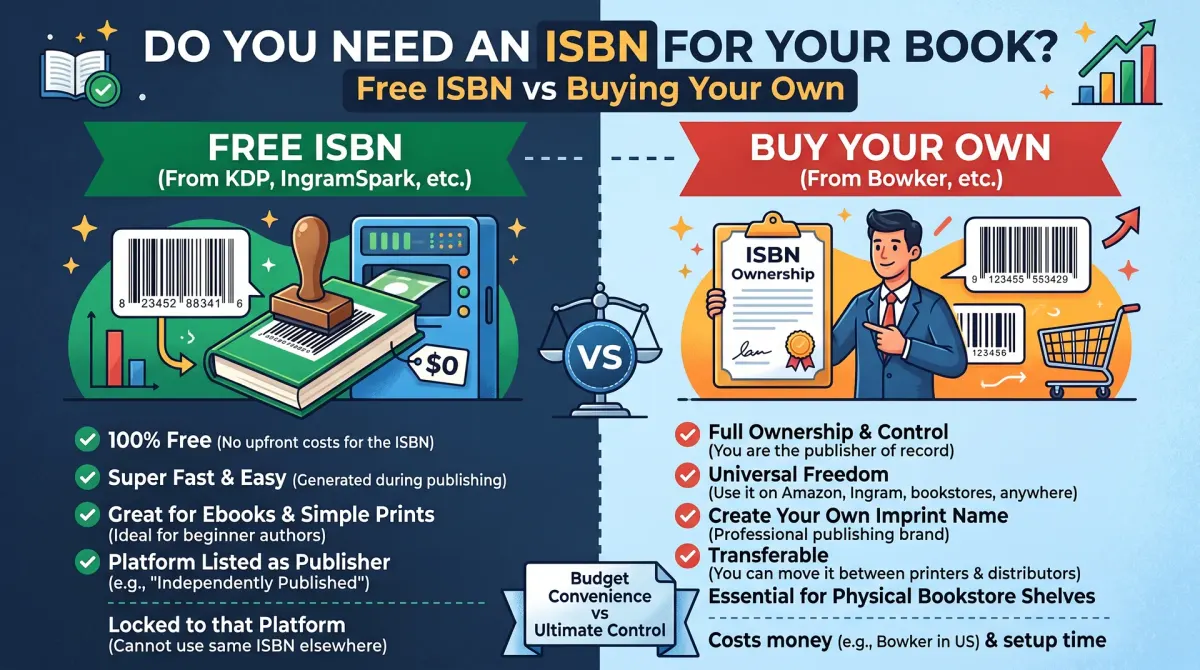
KDP assigns a free ISBN for paperbacks and hardcovers. The imprint then shows as "Independently published". You can sell on KDP and use KDP's tools. You cannot use that number on another platform.
This means you may not be able to sell the same print edition through IngramSpark or another printer using the free number. You would need a different ISBN, which can split your reviews and sales between two editions.
Buying your own ISBN
Key takeaway: Buy your own ISBN when you want your own imprint name, wider distribution or full control of your data.
When you own the ISBN, you are listed as the publisher. You pick the imprint name. You can use the same ISBN across platforms for the same edition.
In the US, ISBNs are sold by Bowker through its MyIdentifiers site. Other countries have national agencies, and some give ISBNs free to local authors. Prices change, so check the agency's own page.
Buy a block of ten if you plan several formats or books. Single numbers usually cost more per number.
Free ISBN or your own?
Key takeaway: Choose by where you will sell. KDP only: free ISBN is fine. Multiple platforms or your own brand: buy.
| Point | Free KDP ISBN | Your own ISBN |
|---|---|---|
| Cost | Free | You pay |
| Imprint shown | Independently published | Your imprint |
| Where it works | KDP only | Anywhere |
| Control of metadata | Limited | Full |
| Good for | KDP-only books, tests | Series, brands, wide sales |
How many ISBNs you need
Key takeaway: One per format and edition. Plan the count before you buy.
Count every format you plan to publish. A paperback, a hardcover and an audiobook each need a separate ISBN where one is used. A revised edition with major changes needs a new one. A small typo fix does not.
Here is an example. You plan a paperback and a hardcover of one book and a second book in the same series with one paperback. That is three ISBNs. Buying a block of ten covers these three and leaves seven for later.
Ebooks on KDP do not need one, but other stores may ask for one. Check the store before you upload.
Putting the ISBN in your book
Key takeaway: The ISBN goes on the copyright page and in a barcode on the back cover.
Print the ISBN on the copyright page. Add a barcode with the ISBN on the back cover. KDP can add a barcode for you when you use its cover tools. If you design your own cover, leave space for it.
Register the ISBN's details with your agency if it requires it, and make sure the title, author name and format on your KDP listing match what you registered.
Common ISBN mistakes
Key takeaway: Most ISBN mistakes happen before publishing, when the numbers are still easy to change.
- Using the free KDP ISBN and then wanting wide distribution. Plan where you will sell before you choose.
- Reusing one ISBN for two formats. Each format needs its own.
- Buying from a reseller. The reseller may be listed as publisher instead of you.
- Mismatched details. The title and author name on the ISBN record, copyright page and listing should match.
- Forgetting the barcode. Print books need the ISBN as a barcode on the back cover for shops.
Make a simple list with each format, its ISBN and where it is used. It saves confusion later.
What an ISBN does not do
Key takeaway: An ISBN will not make your book sell. It only makes it easy to find and order in the book trade.
An ISBN does not give you copyright, a bestseller rank or a review. It also does not guarantee that a bookshop will stock the book. Shops decide by genre, reader demand and the terms you offer, such as discount and returns.
What the ISBN does give you is a clean record. Libraries, wholesalers and retailers can all refer to the same edition by the same number. That makes your book far easier to order, track and report.
What an ISBN actually does
An ISBN identifies one edition of a book in the book trade. Stores, libraries and distributors use it to find the right book and to track sales. Each format needs its own: the paperback, the hardcover and the audiobook have separate ISBNs.
It does not guarantee sales or visibility. It does not prove ownership. It does not protect your text. It is a label that helps systems connect your book to orders.
That is why the choice matters most for print books sold in more than one place.
When the free KDP ISBN is enough
The free KDP ISBN suits an author who sells a print book only on Amazon and does not mind KDP being listed as the imprint. It costs nothing and saves time.
It fits a first book, a test book or a low-content book. It also fits a book you will not sell through other print platforms.
Remember the limit. You cannot take that ISBN to another platform. If you later move, you need a new ISBN for the new edition. You may also lose the link to reviews on the old listing.
When to buy your own ISBN
Buy your own if you want your name or company as the publisher, if you plan to sell the same print edition on several platforms or through bookshops, or if you want full control of the record.
In many countries, ISBNs come from a national agency. In the US this is Bowker. Check the price and the rules on the official site on the day you buy, because they change.
Keep a record of every ISBN, the edition it belongs to and the date you assigned it.
How many you need
You need one ISBN per format and per significant edition. A paperback and a hardcover need two. A revised edition with major changes needs a new one. A small typo fix does not.
Ebooks do not always need an ISBN, but some stores and libraries like them. If you plan to sell ebooks widely, check each store's rules.
Buying in a block can lower the cost per number if you plan many books. Do not buy more than you will use.
Place the ISBN correctly
The ISBN appears on the copyright page and as a barcode on the back cover of a print book. The number on the page must match the one you enter in the platform.
KDP can add the barcode for you in the area you leave clear. If you add your own barcode, make sure it fits the area and scans.
Check both the number and the barcode in your proof copy.
Avoid common ISBN mistakes
Do not use the same ISBN for different formats. Do not resell or share an ISBN. Do not change the title of an edition without checking the rules, since the record may need to be updated.
Do not forget to register your own ISBN with the correct title and author before publication. A wrong record can cause listing problems.
Write everything down. A tidy record saves hours later.
What an ISBN does not do
An ISBN does not give copyright, does not guarantee sales and does not move with the book to another platform if it belongs to the platform. It is a tracking number for editions.
Use it correctly, and keep your records tidy.
Keep an ISBN log
Make a simple table with the ISBN, the title, the format, the edition, the publisher name, the date assigned and where it is used. Update it with each book.
The log helps when a platform asks for a number, when you update a book and when you plan a new edition. It also helps if you hire a formatter or a designer.
Store the log with your other publishing records and back it up.
People also ask about ISBNs
Do I need an ISBN to sell on Amazon?
Not for Kindle ebooks. For print books on KDP, you can use a free ISBN that KDP assigns, or use your own. The free ISBN works only on KDP. If you want to sell the same print edition elsewhere or show your own imprint, you need your own ISBN.
Is a free KDP ISBN as good as a paid one?
It works well for a book sold only on KDP. The imprint shows as KDP's, and you cannot use that ISBN on other platforms. A paid ISBN from your national agency is registered to you. Choose by where you plan to sell and how you want to be listed.
Does an ISBN give me copyright?
No. An ISBN identifies an edition for the book trade. Copyright protects your writing and begins when you create it. They are separate. Read your country's copyright office guidance for registration, and treat the ISBN as a tracking number only.
Decide with your plans in mind
Ask where you want to sell now and in two years. If the answer is only KDP, the free ISBN is fine. If it is wider, buy your own from the start.