How print on demand works
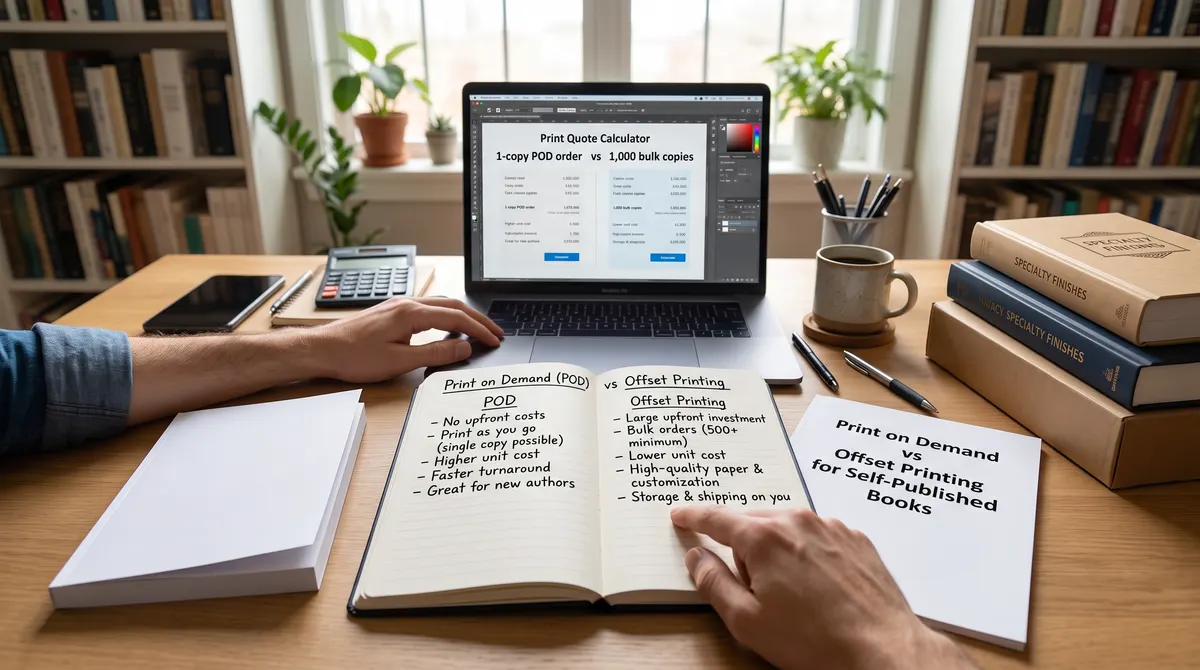
With print on demand (POD), a book is printed only after someone orders it. KDP, IngramSpark and Lulu all work this way. You upload a file, set a price, and the platform prints and ships each order. You pay nothing upfront, and the printing cost comes out of each sale.
How offset printing works
Offset printing runs a large batch on a press. The setup is expensive, so printers ask for a minimum run, and the cost per copy falls as the run gets bigger. You pay for the whole run before you sell a single book, then store and ship it yourself or through a distributor.
Key takeaway: POD trades a higher cost per copy for zero risk. Offset trades upfront money and storage for a lower cost per copy.
Side-by-side
| Question | Print on demand | Offset |
|---|---|---|
| Upfront cost | None | The whole run |
| Cost per copy | Higher | Lower at volume |
| Storage and shipping | Platform handles it | You handle it |
| Formats and finishes | Limited list | Wide choice |
When print on demand fits
- You are publishing your first book and want to test demand.
- You sell mostly through online stores.
- You update the book often, because you can upload a new file at any time.
When offset fits
- You can sell hundreds of copies yourself, at events, schools or to a mailing list.
- You need a finish POD does not offer, such as a special cover or paper.
- You have space to store boxes and time to ship them.
A break-even illustration
These numbers are assumptions to show the logic, not real quotes. Suppose an offset printer quotes $2.50 per copy for 1,000 copies, which is $2,500 upfront. Print on demand costs $4.00 per copy for the same book.
- Offset saves $1.50 on every copy you sell: $1,500 if all 1,000 sell.
- If you sell only 400, you spent $2,500 for 400 sales, or $6.25 per copy sold. POD would have cost $4.00.
The saving only exists on copies you sell. Unsold stock is cost without income.
Hidden costs of offset
- Storage space for boxes of books.
- Packaging materials and postage for every order.
- Your time packing and posting.
- The risk of an error in 1,000 copies instead of one.
Using both
Some authors use POD for online sales and a printed batch for events and direct orders. The two do not conflict, as long as the ISBN and edition details match. Check each platform's rules on ISBNs before you mix them.
How to decide
- Estimate how many copies you can sell in a year without online stores.
- Get an offset quote for that quantity and for double it.
- Work out your cost per sold copy for each scenario.
- Compare with the POD cost for the same book.
- If the saving is small, stay with POD.
A middle path
Many authors start with POD and move to a printed batch only when the numbers justify it. Use the royalty calculator to see what POD pays at your price, then get an offset quote and compare the money per copy. For how POD costs work on KDP, read KDP printing cost and royalty, and to compare platforms see KDP vs B&N Press vs IngramSpark vs Lulu.
Check before you decide
Quote a real offset job from a printer for your exact trim size, paper and quantity. Costs vary by supplier and country, and we do not publish offset prices here.