What a launch is for
Key takeaway: A launch gets your first readers, first reviews and first data. It is a start, not a finish.
A book launch plan is a schedule of tasks that gets your book in front of readers around its release date. For a first-time author it usually covers building an email list, finishing the product page, asking for honest reviews and tracking what works.
For a first-time author, the goal of a launch is modest and useful. You want a group of readers who know the book exists, a few honest reviews and some sales data to learn from. You do not need to become a bestseller.
Set simple goals. For example: collect 50 email subscribers, give copies to 15 early readers and receive 10 honest reviews in the first month. Numbers like these are within reach, and they show real progress.
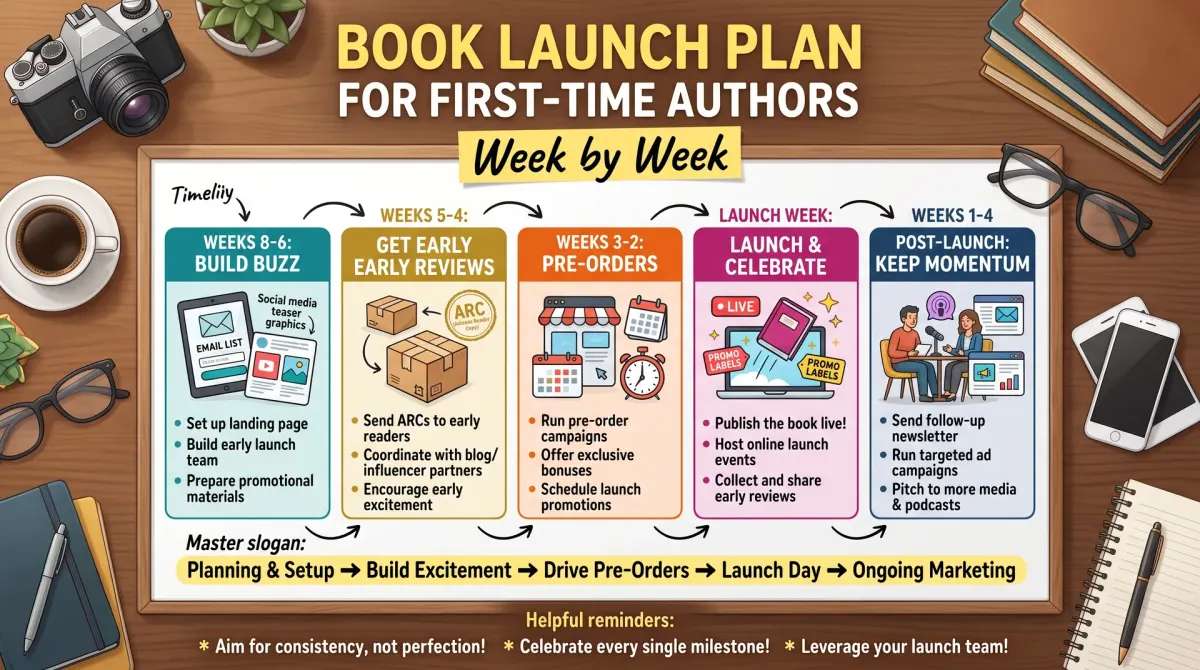
Eight weeks before
Key takeaway: Prepare the foundations while there is still time. These tasks take longer than they look.
- Finish the edits and order a proof copy.
- Fix your cover, title, subtitle and description.
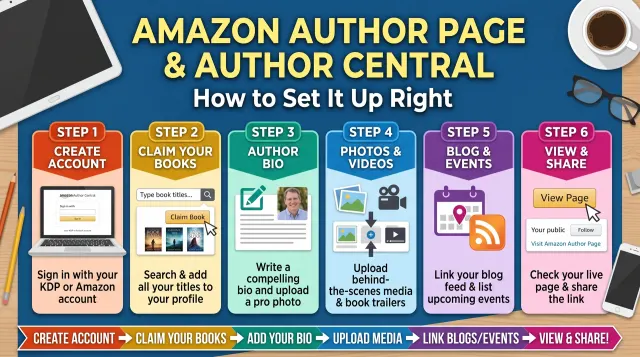
- Set up your Amazon author page.
- Make a simple author website or landing page with an email sign-up.
- Write a gift for subscribers, such as a short guide.
- Start a list of people who may want an early copy.
Choose a launch date that leaves room for delays. KDP says books usually go live within three business days, but first-time print books can take longer.
Four weeks before
Key takeaway: Send early copies and start telling people. Give readers time to finish the book.
Send advance copies to your early readers. Use a digital file or a proof copy. Ask for an honest review when the book goes live. Do not tell them what to write, and do not offer payment.
Write the launch emails and social posts now, so launch week is calm. Plan a few posts that share a quote, a behind-the-scenes note or a useful tip from the book.
If you plan to run a price promotion, check the rules of your platform and note the dates.
Launch week
Key takeaway: Make it easy for friendly readers to act on day one. Keep the message clear and personal.
On release day, publish the book and check the live page. Test the links to your product page. Send the launch email to your list with a direct link. Post on your chosen channels. Message early readers to say the book is live, and remind them politely about reviews.
Reply to comments and messages. Thank people who share the book. Keep a note of what you did and when.
Do not panic if sales are slow on day one. Sales often arrive in small steps over weeks.
The month after
Key takeaway: The work after launch decides how long the book keeps selling.
- Check your KDP reports and record units and royalties.
- Look at reviews and note what readers say.
- Fix any typos readers report and upload a new file.
- Send a thank-you email to your list.
- Try one new action, such as a small ad test.
Plan the next three months. List one action for each month. A steady habit of small actions beats a single big push.
Review rules to follow
Key takeaway: Honest reviews only. Breaking review rules can cost you your listing and account.
Do not buy reviews. Do not pay for positive reviews. Do not review your own book or have family members review it as if they were strangers. Do not swap reviews in exchange for reviews. Do not require a positive review in return for a free copy.
You may give advance copies and ask for an honest review. Be clear that the reader can write what they truly think. Read the review rules of each store before you launch.
A simple launch checklist
Key takeaway: One page of checks prevents day-one mistakes.
Before you press publish, check that the product page shows the right cover, title, subtitle and description. Check that the price is correct in every format and country you sell in. Click every link in your launch email. Test the sign-up form. Make sure the proof copy matches the final files.
On launch day, post the link in the places your readers are. Send the email. Message the early readers who agreed to help. Check the page again in the evening, and keep a note of what you saw.
Mistakes first-time authors make
Key takeaway: The common launch mistakes are about timing and expectations.
- Setting the date too early, then rushing the edit and the proof.
- Waiting for the launch to start building an email list.
- Expecting a flood of sales on day one.
- Asking for reviews in a way that breaks store rules.
- Spending the whole ad budget in the first week.
- Stopping all promotion after launch week.
Plan the first three months, not only the first three days. A calm, steady approach lets the book find readers over time.
Set a goal you can measure
A launch needs a goal. "Sell lots of books" is too vague. Pick a number you can track, such as the size of your email list, the number of early readers or the number of honest reviews in the first month.
Choose a small goal for your first book. A modest goal that you reach teaches you what works. A huge goal that you miss only discourages you.
Write the goal at the top of your plan. After the launch, compare the result with the goal and note what you will change next time.
Build your early reader group
Early readers are people who read your book before launch and tell others about it. Start with friends, colleagues, members of your community and anyone on your email list. Ask them politely, and make it easy to say no.
Send each reader the book in a format they can open. Give a clear date for feedback. Thank them whatever they say.
Ask them to share an honest review after the book is live, if they wish. Do not pressure them, and never ask for only positive reviews. Honest feedback also helps you fix problems.
Finish your product page
Your product page is your main sales tool. Check the title, the subtitle and the cover. Read the description as a stranger would. Does it name the reader's problem? Does it promise a clear benefit? Does it end with a reason to buy?
Add your author page link. Check the categories and the keywords. Look at the page on a phone.
Ask two people who do not know the book to read the page and explain what the book is about. If they cannot, simplify.
Plan your launch week messages
Write your messages before launch week. Prepare one email to your list, a few short social posts and a note for your early readers. Include the cover and a direct link.
Space your messages across the week so you do not overwhelm people. Say something useful in each one, such as a tip from the book or a short story behind it.
Keep a record of where each message went and how many people clicked.
Follow review and promotion rules
Stores and platforms have rules on reviews, giveaways and promotions. Read them before you act. Do not offer payment for reviews. Do not use fake accounts. Do not ask friends to write reviews for a book they have not read.
If you run a free promotion or a price change, check the platform terms on how often and for how long. Breaking the rules can lead to removed reviews or a warning on your account.
When in doubt, choose the safer path.
After launch week
The weeks after launch matter. Keep sharing, keep asking readers for honest reviews and look at your reports. Check which messages brought clicks and which pages sold.
Thank your early readers. Share what you learned. Plan a small promotion for the month after, such as a talk, a guest post or a price change within the platform rules.
Then start writing your next book. A new book often brings readers back to the first.
A launch checklist you can copy
Before launch: final proof checked, product page ready, author page updated, email list message written, early readers briefed, posts drafted and tracking sheet set up.
On launch day: send the email, post your messages, thank early readers and check the page.
After launch: respond to messages, share reviews carefully, update the sheet and plan the next step.
Mistakes first-time authors make
Common mistakes: starting too late, asking for paid reviews, promising too much, ignoring the product page, spreading across too many channels and giving up after a week.
Avoid them by keeping the plan simple and checking the rules of each platform.
Keep your energy for the long run
A launch is a sprint inside a marathon. Plan rest days so that you do not burn out. Batch your tasks. Write several posts at once. Schedule what you can.
Celebrate small wins, such as the first review or the first email reply. Share thanks with the people who helped.
After the launch, return to writing. A second book gives your launch work a longer life, because new readers often move on to your earlier titles.
People also ask about book launches
How far ahead should I plan a book launch?
Start about eight weeks before the release date if you can. That gives you time to build a list, finish the product page and gather early readers. A shorter plan can work for a small book. Do not wait until the book is live to start telling people.
How do I get reviews for my first book?
Ask early readers who have read the book to leave an honest review once it is live. Do not pay for reviews or trade favours in ways the store forbids. Follow the store's review rules. A polite message with a direct link makes it easy for readers to help.
Should a first-time author run ads at launch?
Not necessarily. Ads can help, but they work best when the book has a good cover, a clear description and some reviews. Start small, set a budget you can lose and track results. Many authors build a list and a base of readers first.
Keep the plan simple
You do not need a huge campaign. A clear goal, a good product page, a few readers who care and a steady routine will carry a first launch.