Start with the reader
Key takeaway: A book for everyone is a book for no one. Name your reader before you plan any marketing.
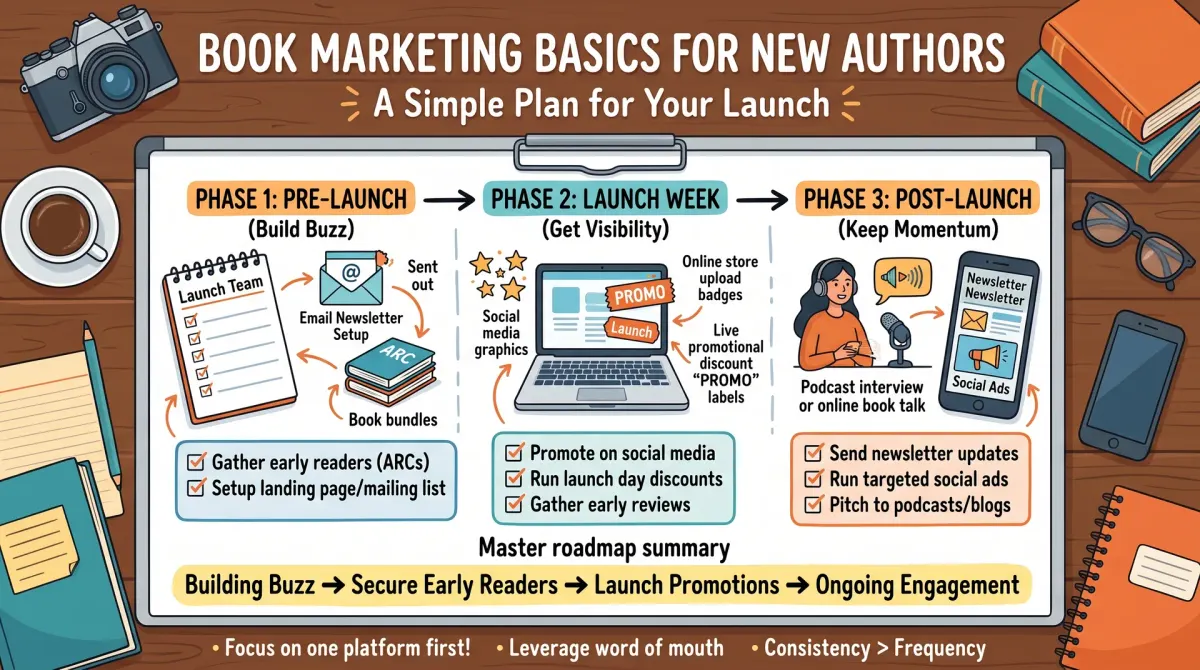
Book marketing basics are the few steps that help readers find and trust your book. For new authors they are to know your reader, fix your product page, build an email list, collect honest reviews, choose one channel at a time and track the results.
Write one paragraph about your ideal reader. Give their age range, what they want, what worries them and where they spend time online. A reader of a cosy mystery lives in a different place from a reader of a small-business guide.
This paragraph guides all later choices: which keywords to use, what the cover should look like, which groups to join and which sites to approach. If you cannot describe your reader, spend time reading reviews of similar books. Reviewers often say exactly what they wanted.
Fix your product page
Key takeaway: Most readers decide on the product page. Make the cover, title and description work before you spend on promotion.
The product page is the page on a store where a reader decides to buy. Its main parts are the cover, the title and subtitle, the description, the price, the reviews and the sample.
Check the cover as a thumbnail. Does it look right for the genre? Check the title and subtitle. Does it say what the book does for the reader? Check the description. Does the first line speak to the reader's problem or desire? Does it use short paragraphs and clear benefits?
Compare your page with the top books in your category. Note what they do better, and improve your page. Bringing readers to a weak page wastes money.
Build an email list
Key takeaway: An email list lets you reach readers without relying on a store. Start it before the book is out.
Social platforms and stores change their rules. An email list is yours. Offer a small gift for signing up, such as a short guide, a checklist or a bonus chapter. Put a sign-up link in the back of your book and on your website.
Send a short email every month or two. Share news, useful tips or a story. When a new book launches, your list is your first and most reliable audience.
Use a proper email service, get permission, and include an unsubscribe link. Follow the privacy laws that apply to your readers.
Collect honest reviews
Key takeaway: Reviews build trust. Ask for them honestly and never pay for positive ones.
Reviews help readers decide. Ask early readers to leave an honest review after they finish the book. Make it easy by adding a polite note and a link at the end of the book.
You can give advance copies to readers in exchange for an honest opinion. Do not require a positive review. Do not pay for reviews, swap reviews with other authors or ask friends who have not read the book to post one. Stores can remove reviews and close accounts for review manipulation.
Respond to criticism calmly, and use it to improve the next book.
Choose one channel at a time
Key takeaway: Pick one channel, give it a fair test, then decide. Doing everything at once helps nobody.
| Channel | Good for | Cost |
|---|---|---|
| Email list | Repeat readers, launches | Low |
| Store ads | Reaching buyers on the store | Pay per click |
| Social media | Building a personal brand | Mostly time |
| Podcasts and talks | Non-fiction and expert topics | Time |
| Book promotion sites | Price promotions | Fee per listing |
| Local events and libraries | Local readers | Time and copies |
Choose the channel your reader uses. Set a small budget or time limit, run it for a month and record the result. Keep it if it works. Drop it if it does not.
Track what works
Key takeaway: Write down what you did and what happened. Memory is a poor guide.
Keep a simple log. Note the date, the action, the cost and the result. Use your sales reports to see changes in units and page reads. After a few months, you will know which actions repay their cost.
A small example: you spend $50 on an ad and sell 15 copies at a $3.00 royalty. Income is $45, so you lost $5, but you may have gained email subscribers or reviews. Count those too. Then decide whether to repeat the ad.
A simple monthly marketing routine
Key takeaway: A short routine you repeat every month beats a burst of activity once.
Pick four small tasks and do them each month. First, send one email to your list. Second, ask one new reader group or blog for a review or guest post. Third, check your product page and update anything that looks old. Fourth, review your numbers and note what changed.
Keep a short list of ideas for the next month, such as a new cover test, a price change, a podcast pitch or a short video. Choose one. Do not try them all.
Know when to ask for help
Key takeaway: Pay for help only when you know what problem it solves.
If your sales are low, find out why before you spend. Is your cover wrong for the genre? Is your description unclear? Are you reaching the wrong readers? Each problem has a different fix.
Hire help for a specific job, with a clear goal and a written scope. Be wary of anyone who promises results or asks for a large payment before they start.
Describe your reader in plain words
Marketing starts with a reader, not a book. Write one paragraph about the person you wrote for. What are they trying to do? What worries them? Where do they spend time online and offline? What do they read now?
Use their words. If readers say "I keep putting off my first draft", use that phrase in your description and posts. It tells them you understand.
If you cannot describe your reader, talk to three. Ask what made them look for a book like yours. Their answers are better than guesses.
Make your product page do the work
Your product page turns visitors into buyers. Check the cover at thumbnail size. Read the first two lines of the description. Are they about the reader? Add a short list of what the book helps them do.
Use a clear title and subtitle that match what readers search for. Choose categories and keywords with care.
Add a look-inside sample if the store allows. A reader who reads the first pages can decide faster. Update the page when you get new reviews or new information.
Grow an email list from day one
Your email list belongs to you. Stores and social sites can change. A list lets you reach readers directly.
Offer a small gift, such as a short guide, a sample chapter or a checklist. Put a sign-up form on your site, in the back of your book and in your bio. Say what you will send and how often.
Send a short, useful email once a month at first. Share a tip, a story or an update. Invite replies. Reply to the people who write back.
Ask for honest reviews the right way
Reviews help new readers decide. Ask readers who have finished the book. Make it simple: send a direct link and a thank-you.
Do not offer payment for reviews, do not write reviews for your own book and do not ask only for five stars. Follow the store rules. Honest reviews, including mixed ones, build trust.
Respond to critical feedback by learning from it. If several readers note the same problem, fix it in the next edition.
Pick one channel and stay with it
You cannot be everywhere. Choose one channel that fits your reader and your skills. It might be a blog, a short video series, a podcast guest spot, a local library talk or a community group.
Commit for three months. Post or show up on a set schedule. Keep notes on what gets replies and clicks.
After three months, review. If the channel works, keep going. If it does not, change the approach or try another.
Track what you do and what happens
Without tracking you are guessing. Make a simple sheet with columns for date, channel, action and result. Record sales, clicks, sign-ups and reviews.
Look at the sheet once a month. Which action brought the most readers for the least effort? Do more of that. Which brought nothing? Drop it or change it.
Track your reports from the store too. Match spikes to your actions.
A simple monthly routine
Week one: update your product page and check reviews. Week two: write and send an email to your list. Week three: work on your chosen channel. Week four: review your tracking sheet and plan next month.
Keep each week to a few tasks. Consistency beats volume.
Learn from other authors
Join a group of authors in your genre. Share what works and what does not. Ask for honest feedback on your cover and description. Read how others describe their readers.
Be generous with your own tips. Authors who help each other often share readers and ideas.
Be careful with paid advice. Check the track record of anyone who sells marketing services, ask for references and avoid promises of guaranteed sales.
People also ask about book marketing
What is the best way to market a new book?
Start with the basics: a clear cover, a strong product page and an email list. Then pick one channel that suits your reader, such as a site, a social account or a local group. Test it for a few months and keep what works. There is no one best channel.
How much should a new author spend on marketing?
Spend only what you can afford to lose. Begin with free steps such as your product page and your email list. If you test ads, start with a small budget and track results. Many authors improve the book and the page before they spend more.
Can I market a book without social media?
Yes. Many authors build an email list, a website and a reader group instead. Choose the channels you can keep up. A steady small effort beats a big burst that stops. Social media is useful but not required.
A last word for new authors
Marketing is a skill you learn by doing. Keep your plan small, repeat what works and be patient. Your next book will make the earlier ones easier to find.