What is a dedication page?
Key takeaway: A dedication names the person or group you wrote the book for, in a line or two.
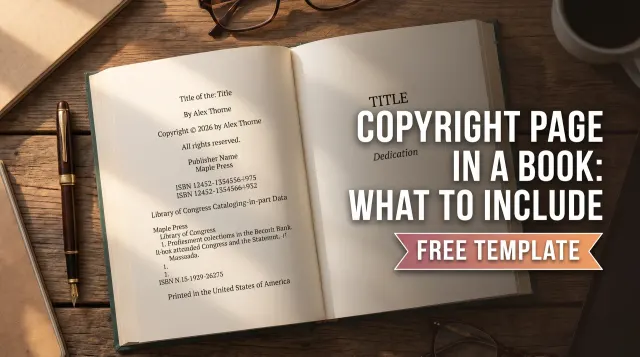
A dedication page in a book is a short page near the start. It names a person, group or memory the author honors. It usually has one to three lines. It sits in the front matter, often after the copyright page.
If you ask what is a dedication page, the key idea is who it is for. A dedication says "this book is for you." It does not explain the book. It does not thank everyone.
That makes it different from the other front pages.
- Acknowledgements thank many people for practical help.
- An epigraph is a short quote that sets the tone of the book.
- A preface explains why the author wrote the book.
The dedication is the shortest of the four. It is also the only one that is purely personal.
Most dedications use plain words. "For my mother." "To Sam, who believed." Plain lines age well.
Where does the dedication page go?
Key takeaway: Place it on a right-facing page after the copyright page and before the table of contents.
Front matter is everything before the main text of the book. Amazon KDP is Amazon's self-publishing service for ebooks and paperbacks. Its guide to front matter lists a suggested order:
- Half title page
- Title page
- Copyright page
- Reviews or praise
- Dedication
- Table of contents
- Preface
- Acknowledgments
- Prologue
- Introduction
KDP says the dedication is usually a right-facing page after the copyright page. Many elements are optional. Include only the pages your book needs.
In a paperback, right-facing means an odd-numbered page, which opens on the right side of a spread. The dedication sits alone on that page with white space around it.
The page normally has no page number. Do not add headers or footers to it.
In an ebook, the dedication appears after the copyright page and before the table of contents. The page can be a simple centered line.
How to write a dedication page: steps
Key takeaway: Choose one person, write one line and read it aloud.
If you wonder how to write a dedication page, use a short method.
- Decide who the book is for.
- Write their name or role.
- Add a short reason or message.
- Trim the line to under 20 words.
- Read it aloud.
- Ask permission if needed.
Step one is the hardest. Many books are written for more than one person. Pick the one who matters most for this book.
Step three is optional. A name alone is a complete dedication. A reason makes it warmer.
Step four keeps it clean. A dedication is not a speech. Long lines lose power.
Step six protects relationships. A private person may not want to be named. A quick message avoids surprise.
Here is a formula you can fill in.
For [name], who [reason].
Fill it in with a verb that fits. "For Mia, who read every draft." "For my father, who loved a good story."
Dedication page examples by tone
Key takeaway: Pick a tone that fits your book. Short and sincere beats clever.
Use these dedication page examples as models. They are invented.
| Tone | Example | Best for |
|---|---|---|
| Simple | For my mother. | Any book |
| Warm | For Sam, who never stopped believing. | Memoir, fiction |
| Playful | For my cat, who sat on every page. | Light fiction |
| Memorial | In memory of Grandpa Joe. | Personal books |
Here are more, grouped by purpose.
To a partner or family
For Alex, always. And for the two small people who keep our house noisy.
To readers
For anyone who ever finished a book at midnight.
To a mentor
For Dr. Morgan, who taught me to ask better questions.
For nonfiction
To the small business owners who shared their stories with me.
In memory
In loving memory of Ruth, 1950 to 2020.
Each line is short. Each one names a person or group. None explains too much.
A dedication page example from your own genre can help you set the tone. Look at three books on your shelf. Notice how long their lines run.
Dedication or acknowledgements: which do you need?
Key takeaway: You can have both. The dedication honors, and the acknowledgements thank.
A dedication and acknowledgements do different jobs.
A dedication is for one person or group. It is symbolic and short. It appears early in the book.
Acknowledgements are for many people. They credit editors, readers and designers. They usually run longer and may sit at the back.
Here is a quick comparison.
| Feature | Dedication | Acknowledgements |
|---|---|---|
| Length | 1 to 3 lines | 50 to 300 words |
| Purpose | Honor | Thank |
| Typical place | After the copyright page | Front or back matter |
A book dedication page and an acknowledgements page often appear together. A fiction author may dedicate the book to a spouse and thank the editor at the back.
You may also see a book dedication page that includes a short quote. That quote is an epigraph. Keep the two separate. Put the dedication first and the epigraph on its own page.
If you only want one, choose the dedication. It takes five minutes and adds a personal touch.
Who to dedicate your book to
Key takeaway: Choose the person whose role in the book is clearest. Keep the reason honest.
Choosing the person is the real work. These common choices each have a different effect.
- A partner or family member. Warm and common. Works in almost any genre.
- A mentor or teacher. Suits nonfiction and craft books.
- Your readers. Good for a series or a debut book.
- A person you lost. Powerful, but keep the tone gentle.
- A pet. Light and fun, best for cozy genres.
If you are torn, ask a simple question. Who did this book change for you? The answer is usually the name.
You can also change the dedication between books in a series. Each book can honor someone new. Readers often enjoy the pattern.
Think about the long run. A dedication stays in the book for years. Avoid names tied to a short phase, such as a temporary joke or a current event. A plain line ages better.
Finally, tell the person before you publish. Some people are moved by a dedication. A quick note lets them enjoy the surprise on their terms.
For more on book parts and their usual order, a style guide is a reliable reference.
Formatting a dedication page
Key takeaway: Center the text, leave white space and remove page numbers.
Formatting is simple, but small details matter.
- Alignment. Center the text. A left-aligned line looks unfinished.
- Position. Place it in the upper third or the middle of the page.
- Style. Use italics or the regular body font. Avoid large decorative fonts.
- Size. Keep the font close to the body size, or one size smaller.
- Page number. Leave it off. KDP says the copyright page has no numbers or headers. Give the dedication the same clean look as a style choice.
In Word or a similar tool, insert a page break before and after the dedication. This keeps it alone on its own page.
For a paperback, check that the dedication sits on a right-facing page. If your copyright page is on a left page, the dedication falls on the next right page. That is the standard layout.
For an ebook, use a page break so the dedication starts on a new screen. Preview it on a phone to confirm it looks clean.
If a professional formats your book, mention the dedication in your brief. A formatter will place it in the right spot.
People Also Ask
Is a dedication page necessary?
No. A dedication is optional. KDP's front matter guide says many elements are optional, so use only what your book needs. Many authors include one because it is quick and personal. If you have no one to name, you can skip it.
How long should a dedication be?
Most dedications run from one to three lines. Many are only a few words, such as "For my mother." A short line has more impact. If you need more space, move the extra thanks to your acknowledgements page. A short line is easy to remember.
Where does the dedication go in a book?
It goes in the front matter, usually after the copyright page and before the table of contents. In a paperback, it normally sits on a right-facing page. KDP's suggested order places it after reviews or praise. Many books have no praise page, so it can follow the copyright page directly.
Common mistakes
Key takeaway: Most dedication errors are about length and placement.
- Writing a full paragraph.
- Naming someone without permission.
- Putting the dedication before the copyright page.
- Adding a page number.
- Mixing the dedication with acknowledgements.
Your next step: write the dedication this week
Pick one person. Fill in the formula "For [name], who [reason]." Read it aloud and trim any extra words.
Then check the rest of your front matter. The copyright page comes right before the dedication, so confirm it too. A short checklist catches order and layout mistakes.