What are acknowledgements in a book?
Key takeaway: Acknowledgements are a thank-you page for your helpers. They sit in the front or back of the book.
Book acknowledgements are a short section where an author thanks the people who helped create the book. Typical names include editors, beta readers, family, friends, mentors and cover designers. The section usually sits in the front matter or back matter and runs from a few lines to a page.
If you ask what are acknowledgements, the answer is simple. They are thanks, written for the reader to see. They also give credit to people whose work is not on the cover.
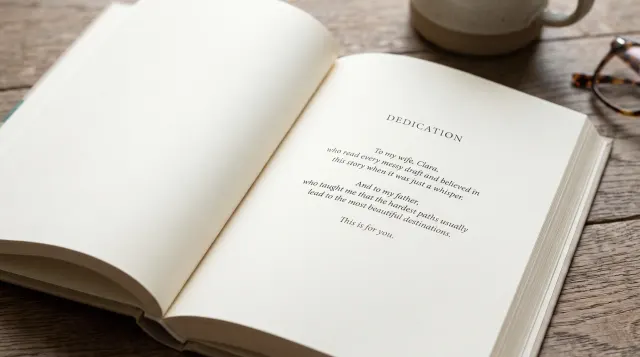
Acknowledgements differ from a dedication. A dedication is a short line that honors one person or group, often placed near the start. Acknowledgements are longer and thank many people for real help.
They also differ from a preface. A preface explains why the author wrote the book. Acknowledgements only say thank you.
Many authors write acknowledgements last. By then the list of helpers is complete.
Acknowledgements or acknowledgments: which spelling?
Key takeaway: Both spellings are correct. Pick one and use it throughout the book.
The word has two spellings. Both appear in books and style guides.
- Acknowledgments (no middle "e") is the form used by the Chicago Manual of Style.
- Acknowledgements (with the "e") is common in British English and in many search queries.
Writing for American readers? Use "acknowledgments". Writing for British or Commonwealth readers? Use "acknowledgements". Match the rest of your spelling.
What matters is that the heading, the table of contents and any text references use the same form. Mixed spellings look careless.
The Chicago Manual of Style is a widely used American guide to book style. It spells the word without the middle "e," which is why you will see both forms in print.
The spelling does not change how KDP or any store treats your book. It is a style choice only.
Where do acknowledgements go?
Key takeaway: Place them in the front matter after the preface, or in the back matter. Chicago style allows both.
Front matter is everything before the main text. Back matter is everything after it.
Chicago style says acknowledgments belong in the front matter if they are not part of the preface. It also allows them in the back matter.
Amazon KDP is Amazon's self-publishing service for ebooks and paperbacks. Its front matter guide suggests this order:
- Half title page
- Title page
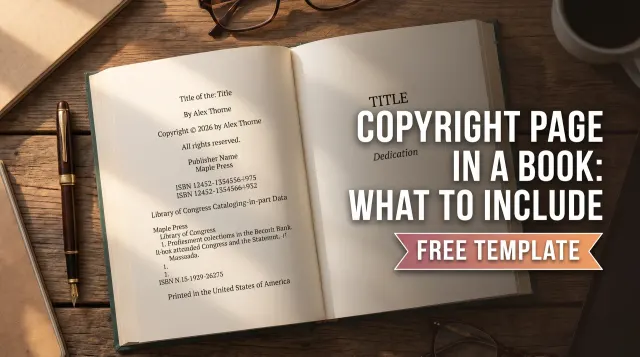
- Copyright page
- Reviews or praise
- Dedication
- Table of contents
- Preface
- Acknowledgments
- Prologue
- Introduction
Many elements are optional. Use only the pages your book needs.
Most fiction authors put the thank-you page at the back. This keeps the first pages clean, so readers reach chapter one faster. Nonfiction authors often keep it in the front.
Either way, the page should start on a new page. Use a clear heading, such as "Acknowledgments."
How to write book acknowledgements: steps
Key takeaway: List the helpers first. Then write one short line for each key person.
If you wonder how to write acknowledgements, use a fixed method. It keeps the page short and complete.
- List everyone who helped.
- Group them by role.
- Put the key people first.
- Write one line per person.
- Add a thanks to readers.
- Check every spelling.
- Keep it to one page.
Step one is the hard part. Check your emails and files. Include your editor, beta readers, cover designer and proofreader. Add mentors, family and any experts you consulted.
Step six matters most. A misspelled name hurts. Confirm each name with the person if you can.
Now apply a word budget. Here is a worked example.
- 12 people × 15 words each = 180 words.
- Opening line = 40 words.
- Closing thanks to readers = 30 words.
- Total = 180 + 40 + 30 = 250 words.
At about 250 words, the page fits on one printed page. If your count is higher, trim the lines for secondary helpers.
Acknowledgements examples you can adapt
Key takeaway: Sample text works as a template. Replace the names and details with your own.
Below are three short samples. They are templates, not real quotes.
Short version (about 40 words):
Thank you to my editor, Sam Rivers, for sharp feedback. Thanks to my beta readers for their honest notes. Thanks to my family for their patience. Most of all, thank you to the readers who picked up this book.
Standard version (about 90 words):
This book exists because of many people. I thank my editor, Sam Rivers, who made the story clearer. I thank Priya Patel for the cover design and Jordan Lee for proofreading. My beta readers gave me honest notes when I needed them. My family gave me time and space to write. Finally, thank you to every reader. You make the work worthwhile.
Nonfiction version (about 70 words):
I am grateful to the experts who shared their time. Thank you to Dr. Alex Morgan for reviewing Chapter 4. Thank you to the members of my writing group for their feedback on early drafts. I thank my editor for sharpening every chapter. Any errors that remain are mine alone.
Notice the pattern. Each line names a person and a reason. Short, specific thanks feel sincere.
Avoid generic lines such as "thanks to everyone." Name the role instead.
For more samples and layout ideas, look at books in your genre. Notice how long their pages run.
How to order and word the thanks
Key takeaway: Lead with the people who shaped the book most. Close with your readers.
Order tells the reader what mattered. There is no strict rule, but a clear pattern helps.
Start with the people who shaped the text. That means your editor, your writing partner and your early readers. Their feedback changed the book.
Next, thank the people who made the book look and work right. Name the cover designer, the formatter and the proofreader. These roles are easy to forget because their work is invisible when done well.
Then thank people who supported you. Family, friends and colleagues belong here. Keep each line short.
Finish with your readers. A closing line gives the page a clear end.
Tone matters as much as order. Be warm, but be specific. "Thank you for reading three drafts" says more than "thanks for your help."
Use full names on first mention. Add a role if the reader would not know who the person is. For example: "my editor, Sam Rivers."
Check permission for private people. Some helpers prefer not to be named. A quick message avoids awkward moments after publication.
Last, read the page aloud. Awkward lines stand out when you hear them. Trim any sentence that runs long.
What to leave out
Key takeaway: Keep the page about thanks, not sales.
Some things do not belong here.
- Promotion. Do not add links, discounts or sales copy.
- Long stories. Save anecdotes for the main text.
- Private details. Do not name people without permission.
- Complaints. A thank-you page is not the place for grudges.
Also avoid reviews and praise. KDP places reviews or praise on a separate page near the start.
If you want to reach readers after the book ends, use the about the author section. That page can hold your website and a short bio. It sits in the back matter on a right-facing page.
For a pre-publish review, use a checklist. A good one catches missing pages, misspelled names and order mistakes.
People Also Ask
Are acknowledgements required in a book?
No. Acknowledgements are optional. KDP's front matter guide says many elements are optional, so use the pages your book needs. Most authors include them anyway because the page costs nothing and honors the people who helped. It also builds goodwill with your team.
Who should I thank in my acknowledgements?
Thank your editor, proofreader, cover designer, beta readers and mentors. Add family and friends who gave you time and support. Include experts who reviewed facts. Finish with a thanks to your readers. Confirm each person's name and spelling first. Ask permission if someone is private.
How long should acknowledgements be?
Most run from 50 to 300 words. A short book may need only a few lines. A longer book may fill one page. If you pass about 300 words, trim the secondary names. Short and specific works better than long and general.
Common mistakes
Key takeaway: The common errors are all easy to prevent with a list and a proofread.
- Forgetting a key helper.
- Misspelling a name.
- Mixing "acknowledgements" and "acknowledgments."
- Writing three pages when one will do.
- Burying promotion inside the thanks.
Your next step: draft your thank-you list
Open a blank file and list every person who helped. Group them by role. Then write one line for each person using the samples above.
When the draft is ready, give it to your formatter or place it in your interior file.