How many pages is 1000 words?
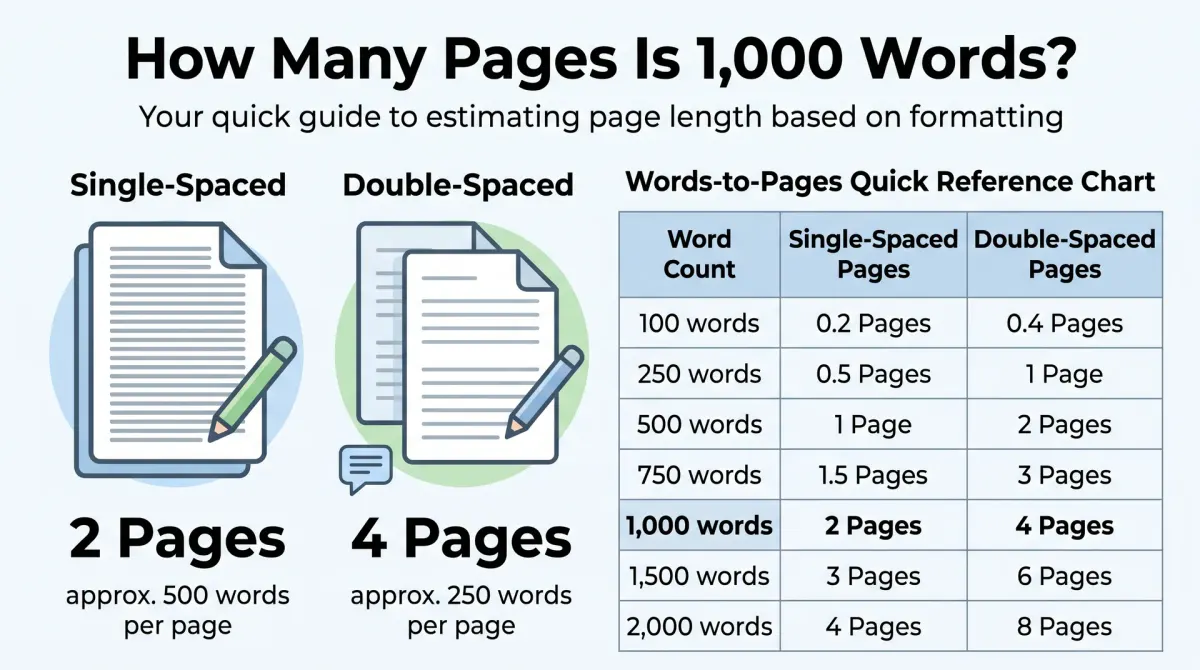
Key takeaway: 1000 words is about 2 pages single spaced or about 4 pages double spaced under standard settings.
How many pages is 1000 words is a conversion question that depends on spacing, font and margins. Under standard settings, 1000 words fills about 2 pages single spaced. It fills about 4 pages double spaced. Other settings change the result.
The core math is one division. Take your word count and divide it by the words per page.
- Single spaced: 1000 ÷ 500 = 2 pages.
- Double spaced: 1000 ÷ 250 = 4 pages.
Those two inputs are the standard assumptions. Word processors use slightly different defaults, so your result may shift by a few lines. A larger font such as Arial 12 gives fewer words per page. A smaller font gives more.
Margins matter too. A 1.5-inch margin cuts the words per page. A 0.75-inch margin raises it. Headings, images and white space also reduce the count.
So treat the chart as a starting point. Check the final number in your own file.
Words-to-pages chart: 1500, 2000, 2500 and 5000 words
Key takeaway: Use 500 words per page for single spacing and 250 for double spacing to scale any word count.
The chart below uses the same two assumptions. It covers the counts people search for most.
| Word count | Single spaced | Double spaced |
|---|---|---|
| 500 words | 1 page | 2 pages |
| 1000 words | 2 pages | 4 pages |
| 1500 words | 3 pages | 6 pages |
| 2000 words | 4 pages | 8 pages |
| 2500 words | 5 pages | 10 pages |
| 5000 words | 10 pages | 20 pages |
Here is the math behind each of the larger rows.
How many pages is 1500 words? Single spaced: 1500 ÷ 500 = 3 pages. Double spaced: 1500 ÷ 250 = 6 pages.
How many pages is 2000 words? Single spaced: 2000 ÷ 500 = 4 pages. Double spaced: 2000 ÷ 250 = 8 pages.
How many pages is 2500 words? Single spaced: 2500 ÷ 500 = 5 pages. Double spaced: 2500 ÷ 250 = 10 pages.
How many pages is 5000 words? Single spaced: 5000 ÷ 500 = 10 pages. Double spaced: 5000 ÷ 250 = 20 pages.
If your count is not in the chart, the formula still works. Divide by 500 for single spacing and by 250 for double spacing. Round up to the next whole page.
Words to pages in reverse: how many words is 4 pages?
Key takeaway: Multiply pages by words per page to go from pages back to words.
Sometimes you have the page limit and need the word target. Reverse the formula.
Pages × words per page = word count.
- 3 pages double spaced: 3 × 250 = 750 words.
- 4 pages double spaced: 4 × 250 = 1000 words.
- 5 pages double spaced: 5 × 250 = 1250 words.
- 10 pages single spaced: 10 × 500 = 5000 words.
If you ask how many words is 4 pages double spaced, the answer is about 1000. That matches the chart above.
Use the range, not the exact number. A page with a heading and a short paragraph holds fewer words. A page of dense text holds more. Aim for the target and then check the real page count.
Teachers and editors usually care about the page count, not the word count. If a task gives both, follow the word count first. It is the more precise measure.
How many words per page in a printed book?
Key takeaway: Printed book pages hold 250 to 350 words, so a book needs more pages than a typed document.
A typed document and a printed book are different. A book has smaller pages, a different font size, tighter margins and chapter breaks. Those choices change how many words fit on each page.
Many novels land between 250 and 350 words per page. This is a general rule of thumb. Your own trim size, font and line spacing decide the real number. Trim size is the final width and height of the printed page after cutting.
Here is a worked example for a 50,000-word book. Divide the word count by the words per page.
- At 250 words per page: 50,000 ÷ 250 = 200 pages.
- At 300 words per page: 50,000 ÷ 300 = 167 pages (rounded up).
- At 350 words per page: 50,000 ÷ 350 = 143 pages (rounded up).
So the same manuscript can print as 143 to 200 pages. A bigger trim size and smaller font pull the count down. A smaller trim size and larger font push it up.
Front matter and chapter openings add pages too. Plan for a few extra pages on top of the math.
Why page count matters for a paperback
Key takeaway: Page count sets your spine width, and spine text needs at least 79 pages on KDP.
If you plan to print a paperback, your page count affects the cover. The spine grows with the page count.
Amazon KDP is Amazon's self-publishing service for ebooks and paperbacks. Its cover help page says spine text needs a book of at least 79 pages. The spine width formula for a black-and-white book on white paper is page count × 0.002252 inches.
Here is a worked example for a 300-page book on white paper.
- Spine width: 300 × 0.002252 = 0.6756 inches.
That gives you a spine of about 0.68 inches. A shorter book has a thinner spine. A very thin book may have no room for spine text at all.
You only need this when you reach the cover stage. For now, use the word count to plan a realistic page range. Then confirm the final page count in your formatted interior file.
What 1000 words looks like in real writing
Key takeaway: Word counts map to real writing tasks, and reading time follows a simple formula.
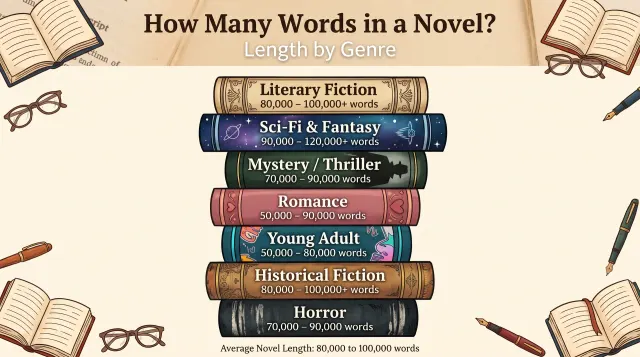
It helps to picture the length. A short blog post often runs 600 to 1,000 words. A chapter in a novel often runs 2,000 to 5,000 words. A full novel runs much longer.
Reading time is easy to estimate too. Divide the word count by a reading speed. Many adults read around 250 words per minute. This is an assumption, not a fixed rule.
Here is a worked example for a 60,000-word manuscript.
- Reading time: 60,000 ÷ 250 = 240 minutes.
- Convert to hours: 240 ÷ 60 = 4 hours.
The same method works for any text. A 1000-word piece takes about 4 minutes to read (1000 ÷ 250 = 4).
| Task | Typical word range | Double-spaced pages |
|---|---|---|
| Short blog post | 600 to 1,000 | 2.4 to 4 |
| Long article | 1,500 to 2,500 | 6 to 10 |
| Short story | 3,000 to 5,000 | 12 to 20 |
The page figures use 250 words per page. These ranges are common guides, not rules. Your publisher or teacher may set different targets, so follow their brief first.
For a book, chapter length drives the plan. Short chapters keep readers moving. Long chapters give room for depth. Pick a length and stay consistent.
How to convert words to pages: steps
Key takeaway: Follow five steps and you get a page estimate you can trust.
- Count the words in your document.
- Choose single or double spacing.
- Pick words per page: 500 or 250.
- Divide words by words per page.
- Round up to the next page.
For a printed book, replace step three with 250 to 350 words per page. Use your real trim size and font to choose within that range.
Check your answer in your word processor. Most programs show a live page count. If the estimate and the real count differ, trust the real count.
If you are still drafting, use a plan. A simple outline lets you set a word target per section. That makes the page count easy to predict.
People Also Ask
How many pages is 1500 words single spaced?
About 3 pages. Divide 1500 by 500 words per page. This assumes 12-point Times New Roman and 1-inch margins. Double spaced, the same text runs to about 6 pages. Headings, images and larger fonts can push the count higher. Check your own file.
How many pages is 2000 words double spaced?
About 8 pages. Divide 2000 by 250 words per page. This is a standard double-spaced estimate with 12-point Times New Roman and 1-inch margins. Single spaced, 2000 words fills about 4 pages. Check the real count in your word processor.
How many pages is 5000 words?
About 10 pages single spaced or about 20 pages double spaced. Divide 5000 by 500 for single spacing and by 250 for double spacing. In a printed book, 5000 words fills roughly 14 to 20 pages, depending on trim size.
Common mistakes
Key takeaway: Most errors come from mixing document pages with book pages.
- Using the typed-page rule for a printed book.
- Forgetting that headings and images take space.
- Rounding down instead of up.
- Ignoring front matter and chapter breaks in a book.
- Treating the chart as an exact rule for every file.
Your next step: count your words today
Open your document and check the word count. Pick your spacing, then use the chart or the formula. Write the page range in your plan.
If you are drafting a book, set a daily word target. Then use a time formula to see how long the draft will take.