The three formats
Key takeaway: The formats differ in cover, size, cost and who usually uses them.
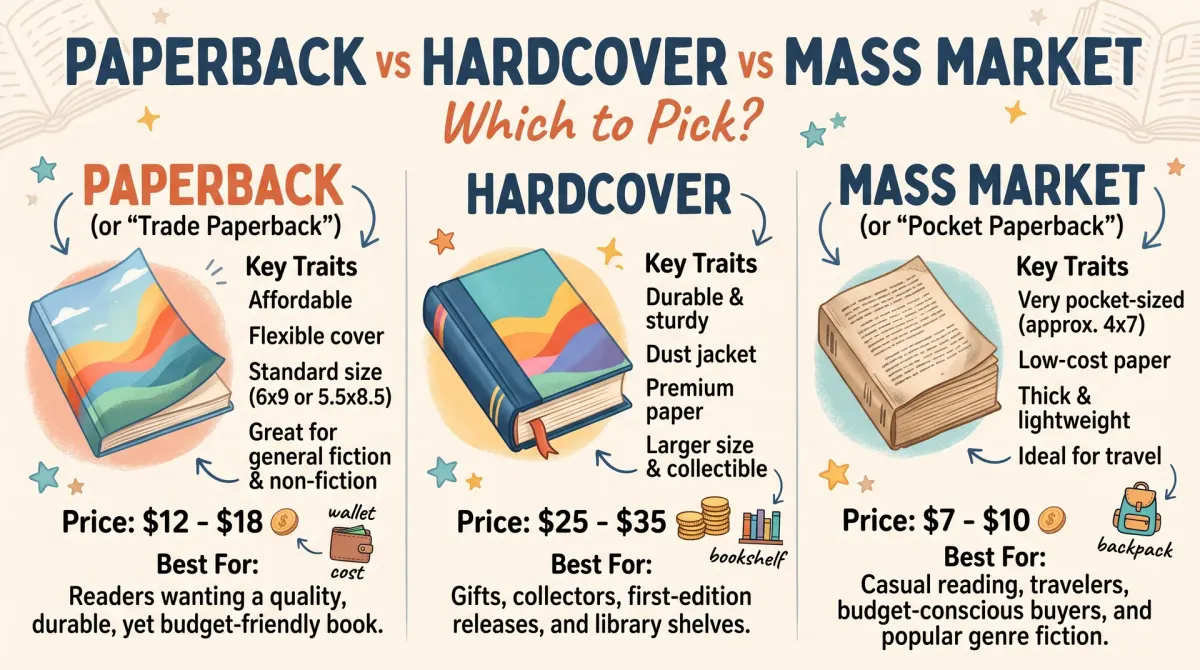
Paperback vs hardcover is a choice between a soft-cover book and a case-bound book. Paperbacks cost less to print and sell at lower prices. Hardcovers last longer and cost more. Mass market paperbacks are small, cheap books mainly produced by large publishers.
A paperback, also called trade paperback, has a flexible cover and a standard trim size such as 5.5 x 8.5 or 6 x 9 inches. It is the format most readers expect for a new book.
A hardcover has a rigid cover. It may have a dust jacket or a printed case cover. It is more durable and looks more premium.
A mass market paperback is a smaller, cheaper paperback made for wide sale in places such as supermarkets and airports. It is usually printed by offset in large runs by traditional publishers, with thin paper and tight margins.
Compare them
Key takeaway: Cost and reader habits decide the right format for you.
| Point | Paperback | Hardcover | Mass market |
|---|---|---|---|
| Cover | Flexible | Rigid | Flexible |
| Typical use | Most new books | Gifts, collectors, libraries | Large-run fiction by publishers |
| Printing cost | Lower | Higher | Lowest at volume |
| Durability | Medium | High | Low |
| Price to reader | Mid | Higher | Low |
| Easy for self-publishers | Yes | Yes | Rarely |
Check whether your platform offers a trim size close to mass market before you plan one. Many self-publishing platforms focus on trade sizes.
Printing cost example
Key takeaway: Hardcover costs more, so the price must rise to keep your royalty.
KDP paperbacks have a printing cost of a fixed amount plus a cost per page. A 6 x 9 black-and-white paperback with 300 pages costs $4.60 to print on Amazon.com ($1.00 + 300 x $0.012). KDP lists hardcover costs separately on its printing cost page, and they are higher than paperback costs for the same page count. Check the table for your trim size.
Use this method. Look up the hardcover printing cost for your trim and page count. Choose a list price, take 60%, and subtract the printing cost. If the result is too small, raise the price or skip the hardcover.
Always run the numbers with your own page count, because the cost per page differs by format.
When to choose a paperback
Key takeaway: The paperback is the safe first choice. Add other formats once readers ask for them.
Choose a paperback for most non-fiction, novels and self-help books. It keeps the price low, which matches what many readers expect. It is simple to produce and ship. You can add a hardcover later if demand grows.
When to add a hardcover
Key takeaway: A hardcover suits gifts, collector editions and library sales.
Think about a hardcover if your book is a gift book, a children's picture book, a cookbook, a photo book or a special edition for fans. Librarians and schools often prefer hardcovers for durability. A hardcover also makes a good limited edition.
Price it higher than the paperback, and make the difference clear on the product page. Readers expect a hardcover to feel premium.
Do not forget the ISBN and the cover
Key takeaway: Each format needs its own ISBN and its own cover file.
A paperback and a hardcover are different editions, so each needs a separate ISBN. Their covers are also different. A hardcover cover has extra wrap and a different spine calculation. Use the template for each format, and do not reuse the paperback cover.
How readers choose a format
Key takeaway: Readers pick a format by price, use and feel. Know what your readers value.
Many readers buy paperbacks because they cost less and are easy to carry. Readers who give books as gifts often prefer hardcovers because they look special and last longer. Readers who read a lot of cheap fiction may look for small, light paperbacks. Readers who prefer screens will choose the ebook.
Look at books like yours on the store. Note which formats exist and at what prices. If top books in your category are all paperbacks, a hardcover may sit unsold. If they offer both, you may be missing a chance.
Make your choice step by step
Key takeaway: Use a short decision list. It prevents costly formats you do not need.
Start with the ebook and the paperback. They cover most readers at a low cost. Run the royalty maths for each price. Publish them and watch your reports for a few months.
Add a hardcover if readers ask for it, if you plan a gift or special edition, or if libraries and schools are a target. Re-run the numbers with the hardcover printing cost. Check that the price you need is acceptable in your category.
Think about mass market only if you plan large print runs with an offset printer and a distributor. For most self-published authors, this is not the right first step.
Plan for updates
Key takeaway: Each format has its own files. Keep them in sync when you update the book.
If you fix a typo or add a chapter, update every edition. Keep a list of formats and file versions, so you know which files are live. When the page count changes, recalculate the spine and the cover for each print format.
Know the three formats
A paperback has a flexible cover and is the most common print format for self-published books. A hardcover has a rigid cover, often with a dust jacket or printed case. A mass market paperback is small and low-priced, made in large print runs.
For most self-publishers, the realistic choice is paperback or hardcover.
Each format needs its own cover file, and often its own ISBN.
Look at cost and price
Printing cost rises from paperback to hardcover. A higher cost means a higher price, or a lower royalty.
Use a calculator to see the royalty at several prices for each format. Check how your price compares with similar books.
If the hardcover price looks too high to readers, the format may not suit your book.
Think about use and readers
Think about where the book will be used. A workbook, a cookbook or a travel guide may benefit from lay-flat or sturdy binding. A novel suits paperback. A gift book, a reference or a coffee table book may suit hardcover.
Ask readers what they prefer. A short poll in your group can help.
Libraries often prefer hardcovers for durability.
Check platform limits
Platforms list which formats, trim sizes and page counts they support. Some limit hardcover options or colour printing.
Check the details before you design the interior. A page count that works for paperback may not work for hardcover.
Read the current help pages for each platform.
Plan covers and files
Each format needs its own cover size. Use the calculator for each. A hardcover has a different wrap and spine.
Keep the interior file the same where possible, but check that the margins suit both formats.
Start simple, add later
Begin with the format that costs least and sells easily. Add the other when you know there is demand. Update your product page so both formats appear together.
A printing cost example you can adapt
Use a small table in your own notes. Take the same book and price it as a paperback and as a hardcover. Look up the printing cost for each in the platform calculator. Then subtract it from the royalty share of the list price.
You will often find that the hardcover needs a much higher price to leave the same royalty. If the price that works looks too high for your genre, the hardcover may sell poorly. If your readers expect to pay more, such as for a reference book, it can work well.
Repeat the test with your real page count. Do not borrow numbers from another book, because trim size, paper and colour change the result.
Mistakes authors make when picking a format
The first mistake is to choose a format because it looks impressive. A hardcover that readers do not buy only adds work. The second is to forget the cover. Each format needs its own file, and a late change to the page count means a new spine.
A third mistake is to ignore the product page. Show all formats together, with matching titles and covers, so readers can compare. A fourth is to skip the proof. Paper, binding and colour look different in your hands than on screen.
A fifth is to change the format after you have reviews. Keep the edition stable where you can, so that reviews stay attached to the book.
A short decision method
Answer five questions. Who is the reader? Where will they use the book? What price do similar books have? What does the platform allow? What will it cost to print?
If the answers point to a low price and casual reading, choose a paperback. If they point to gifts, reference use or libraries, add a hardcover. If a bookshop or a large publisher is involved, ask them about mass market.
Write the answers in one place. Review them when you plan the next book.
People also ask about book formats
Is a paperback or hardcover better for self-publishing?
Most self-published authors start with a paperback because it costs less and sells at a lower price. A hardcover suits gift books, non-fiction and special editions. Check printing costs and platform rules for each format before you decide.
Can I publish a mass market paperback on KDP?
Mass market formats are mainly a traditional publishing format. KDP offers a range of trim sizes, and some small sizes are close to mass market. Check the current list of trim sizes on the KDP help pages before you plan.
Do hardcovers sell better than paperbacks?
Not always. Paperbacks often sell more because of price. Hardcovers can sell to gift buyers, libraries and collectors. Sales depend on your genre, your readers and your price. Test with a paperback first and add a hardcover if readers ask.
Choose with your numbers
Write down the costs, the prices and the reader needs for each format. Pick the one that fits. You can change your mind later.