The formula
Key takeaway: Your finish date is your word count divided by your daily words, plus time for revision.
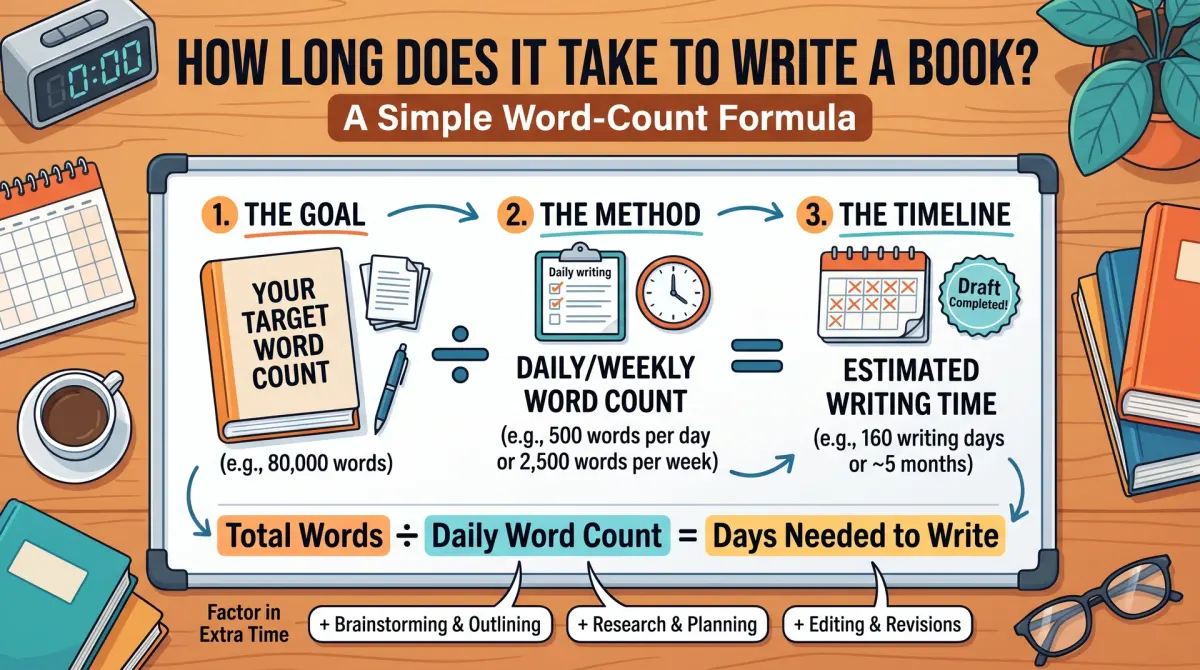
How long it takes to write a book depends on the word count, how many words you write per day and how much time you give to planning and revision. A simple formula divides the target words by your daily words, then adds time for editing and publishing.
Use three numbers.
- Target length. The total words you plan to write.
- Words per writing day. What you can write in one sitting.
- Writing days per week. How many days you actually write.
Drafting days = target length / words per day.
Calendar weeks = drafting days / writing days per week.
Be honest about your numbers. It is better to use a small number you can keep than a big number you will miss.
Worked examples
Key takeaway: The same book takes a very different time depending on daily output.
Take a 60,000-word book written on five days a week.
| Words per day | Drafting days | Calendar weeks |
|---|---|---|
| 300 | 200 | 40 |
| 500 | 120 | 24 |
| 1,000 | 60 | 12 |
| 2,000 | 30 | 6 |
These numbers cover drafting only. They do not include research, rest, revision or editing. Add them separately.
For a shorter book, such as 30,000 words at 500 words a day, drafting takes 60 days. On five days a week, that is 12 weeks.
Add time for the rest of the process
Key takeaway: Drafting is only one stage. Plan for planning, revision, editing and production too.
| Stage | What it includes | How to estimate |
|---|---|---|
| Planning | Idea, research, outline | Set a fixed number of weeks |
| Drafting | Writing the first draft | Use the formula above |
| Rest | Time away from the draft | One to two weeks |
| Revision | Two passes on your own | Often half to equal the drafting time |
| Feedback | Beta readers or an editor | Depends on their schedule |
| Production | Formatting and cover | A few weeks |
| Publishing | Upload and review | KDP says up to three business days |
Add the stages up for your own timeline. If the total is too long, shorten the book or increase your writing days.
What makes a book take longer
Key takeaway: Research, life changes and unclear plans are the main causes of delay.
- Heavy research. Books that need interviews, data or sources take longer to draft.
- A weak outline. Without a plan, you rewrite more.
- Inconsistent habits. Skipping days adds up fast.
- Perfectionism. Editing every page as you write slows the draft.
- Life events. Plan some slack in the schedule for busy weeks.
How to speed up without lowering quality
Key takeaway: A clear outline and a fixed writing time save more weeks than fast typing does.
- Write the outline first and keep it short.
- Choose a fixed daily time and protect it.
- Use a timer for short sprints of 25 or 30 minutes.
- Keep a list of research questions and answer them in batches.
- Dictate if typing is slow for you, then clean up the text later.
- Use writing software to track your word count.
Where AI can and cannot help
Key takeaway: AI can save time on brainstorming and editing. It cannot do your thinking, and you remain responsible for the result.
AI tools can suggest outlines, rephrase unclear lines or point out repetition. They may also make mistakes and invent facts. Check every claim yourself. KDP asks you to disclose AI-generated content when you publish.
Build your own schedule
Key takeaway: A schedule turns a vague wish into a date. Build one in ten minutes.
Open a calendar and follow these steps in order. First, write the target length of your book. Second, decide how many days a week you will write. Third, choose a daily word goal that you know you can reach on a bad day, not a good day. Fourth, use the formula to find the drafting weeks. Fifth, count forward from your start date and mark the finish date.
Then add the other stages. Mark one or two weeks of rest after the draft. Mark revision weeks. Mark the dates you plan to send the book to readers and to an editor. Mark the weeks for formatting and the cover. Finally, mark your planned publish date.
Share the plan with a friend who will check in on you. Review it once a month. If you fall behind, do not give up. Move the dates, or raise the number of writing days. The plan is a tool, not a test.
Quality beats speed
Key takeaway: A fast book that readers do not enjoy sells poorly. Aim for a steady pace and a finished, edited book.
Some authors publish a book in a few weeks, and others take years. Neither is wrong. What matters is that the book serves its reader and is free of errors. Readers leave reviews, and reviews follow a book for its whole life.
If you are tempted to rush, ask what you would cut. Cutting editing is the most costly cut. Cutting the proof copy is the second. It is better to move the publish date than to publish a book with obvious problems.
On the other side, do not wait for perfect. A book that is useful and clean is ready. You can update the files later, because KDP lets you upload a new version at any time.
Track your progress
Key takeaway: What you measure, you finish. A simple sheet is enough.
Make a table with the date, the words written and the running total. Add a column for notes, such as "stuck on chapter 4". Look at the table each Sunday. You will see patterns, such as your best days of the week or the effect of a busy month.
Some writers also draw a simple chart of the running total. A line that climbs, even slowly, is a strong reminder that you are moving forward.
Use your own numbers
Averages hide real differences. A person with a full-time job and a family writes at a different pace from a retired person with free mornings. Use your own numbers.
Track your writing for two weeks. Note the minutes you write and the words you produce. Find your typical words per hour. Then check how many hours you can truly give each week.
Multiply to find your words per week. Divide your target by that figure. You now have a realistic first-draft date.
Plan before you write
Planning saves time. A short outline of chapters, with one line on each, can cut the total time. You waste fewer words and rewrite less.
Spend a week on the outline. Write the main promise of the book, the reader's problem and the main points. List the chapters in order. Estimate the length of each.
If you prefer to write without a plan, expect more revision. That is a fair trade for some writers. Know which style you are.
Allow time for rest and revision
After a first draft, rest. Leave the manuscript alone for a week or two. You will see problems you missed when you return.
Then revise in passes. Fix the structure first: order, gaps and repeats. Then fix paragraphs and sentences. Last, check spelling and facts.
A useful rule is that revision takes as long as the first draft, and often more. Put it in your plan.
Add time for editing, formatting and the cover
Writing is only part of the work. Editing by others takes time. Formatting takes time. The cover takes time. Ordering a proof takes days.
Add these stages to your calendar. Book an editor early, since good ones fill up. Ask your cover designer for a date. Leave a buffer.
What slows writers down
Common delays include unclear ideas, perfectionism, lack of a routine, research that never ends and fear of sharing. Name your delay and plan for it.
If research slows you, set a limit and mark gaps to fill later. If perfectionism stops you, write a rough draft on purpose. If you lack time, protect short, regular sessions.
Ask a friend to check in weekly. Light accountability works for many writers.
What speeds you up safely
Write at the same time each day. Turn off notifications. Keep a notes file for ideas. Stop each session in the middle of a scene, so you know where to begin next.
Use tools that help, such as dictation or an outliner. If you use AI, use it for questions and feedback rather than for your core text, and check every fact.
Two worked examples
Example one: a 50,000-word book at 500 words a day needs 100 writing days. With five writing days a week, that is about 20 weeks.
Example two: a 30,000-word guide at 750 words a day needs 40 writing days, or about 8 weeks at five days a week.
Add time for planning, rest, revision and publishing. These examples are illustrations. Use your own pace.
Set milestones and review them
Break the project into milestones: outline done, a third drafted, two thirds drafted, first draft complete, first revision done, edit complete. Put a date next to each.
Review the dates every two weeks. If you are late, find out why. Was the goal too high? Did life get busy? Adjust the plan rather than quit.
Milestones turn a huge project into a series of small ones, and each one you finish builds momentum.
People also ask about how long a book takes
How long does it take to write a first draft?
It depends on your target length and daily pace. Divide your target word count by the words you can write in a day, then allow rest days. A steady writer with a clear outline often finishes a draft faster than one who plans as they go. Revision comes after.
How many words a day should I write?
Choose a number you can repeat. Some authors aim for a few hundred words, others for more. Consistency matters more than size. Start low, build the habit and raise the goal only if it feels easy. A missed day is not a failure, so restart the next day.
Can I write a book in 30 days?
You can write a short draft in a month if you plan well and write daily. A full, edited, published book usually takes longer. Rushed drafts need heavier revision. Treat a 30-day sprint as a first draft, then plan time for rest, editing and proofreading.
Your schedule starts today
Pick a word count, a daily goal and a start date. Write them down. Check your pace after two weeks and adjust. The plan is a guide, not a promise.