What a book outline is
Key takeaway: An outline is a map of your book. It shows the order of ideas or events before you write them.
If you search for a book outline, you will see many styles. The core idea is simple.
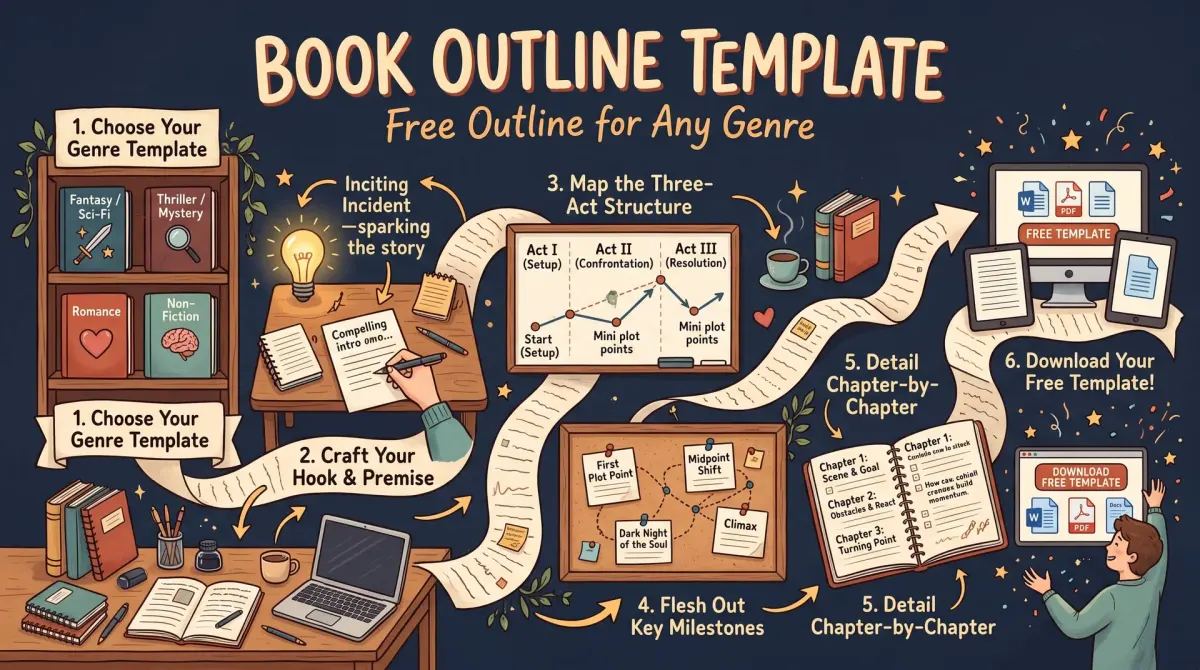
A book outline template is a ready-made structure for planning a book before you write it. It lists your chapters or scenes in order, with space for key points, goals and word counts. You fill it in, then use it as a map for drafting.
An outline is a plan that lists the main parts of your book in order. Think of it as a road map. You can take detours, but you know where you are going.
Outlines come in three levels:
- Short: a list of chapter titles
- Medium: chapter titles plus three to five key points each
- Detailed: scene-by-scene or section-by-section notes
Pick the level that suits you. Plotters like detailed outlines. Writers who prefer to discover the story may use a short list and a clear ending.
An outline also helps you spot gaps. If chapter seven has no clear point, you see it before you write 5,000 words.
It is useful later too. A non-fiction outline forms the base of a book proposal. Our proposal guide shows how to use it.
Schools teach outlining as well. The Purdue Online Writing Lab has free guides.
Non-fiction book outline template
Key takeaway: A non-fiction outline moves from the reader's problem to the solution in clear steps.
Use this template for how-to books, guides and business books.
| Section | What goes here | Sample length |
|---|---|---|
| Introduction | Reader problem, promise, how to use the book | 2,000 words |
| Chapters 1 to 10 | One main idea each, three to five key points | 5,000 words each |
| Conclusion | Summary and next step | 2,000 words |
For each chapter, fill in this mini template:
- Chapter title: a clear promise
- Main idea: one sentence
- Key points: three to five bullets
- Story or example: one real or sample case
- Action step: what the reader does next
- Target length: words
Do the math. Suppose your book has an introduction (2,000), ten chapters (5,000 each) and a conclusion (2,000). Then 2,000 + (10 × 5,000) + 2,000 = 54,000 words.
Now turn it into a schedule. At 600 words a day, 54,000 ÷ 600 = 90 days. At 900 words a day, it is 60 days.
Order chapters so each one builds on the last. Place easier ideas first. Put the most useful steps in the middle, not at the end where readers may stop.
Fiction book outline template
Key takeaway: A fiction outline tracks turning points and scenes. Start with five big moments, then fill the gaps.
For novels, use a simple three-act structure. Three-act structure divides a story into setup, confrontation and resolution.
| Act | Key moment | Share of story |
|---|---|---|
| Act 1: Setup | Opening, inciting event | About 25% |
| Act 2: Confrontation | Midpoint, lowest point | About 50% |
| Act 3: Resolution | Climax, ending | About 25% |
These shares are a common guide, not a rule. Adjust them to suit your story.
Fill in the five turning points first:
- Opening: who the hero is and what they want
- Inciting event: the problem that starts the plot
- Midpoint: a twist that changes the goal
- Lowest point: the moment all seems lost
- Climax and ending: the final test and its result
Then add scenes. For each scene, note the goal, the conflict and the change. A sample line: "Scene 4: Maya searches the attic (goal), her brother blocks her (conflict), she finds the letter (change)."
Do the word math. For an 80,000-word novel, Act 1 at 25% is 80,000 × 0.25 = 20,000 words. Act 2 at 50% is 40,000. Act 3 at 25% is 20,000.
If you want a deeper guide, read our novel-writing walkthrough.
Comic book outline template
Key takeaway: A comic outline plans pages and panels, not only chapters.
A comic or graphic novel needs a different plan. You must think in pages. A panel is one framed picture on a page.
Use this table for one issue:
| Page range | Story beat | Notes |
|---|---|---|
| Pages 1 to 3 | Opening hook | Show hero and problem |
| Pages 4 to 12 | Rising conflict | New obstacles |
| Pages 13 to 20 | Climax | Biggest challenge |
| Pages 21 to 22 | Resolution | Hook for next issue |
This sample covers 22 pages. Your count may differ. Check the length your artist or printer needs.
For each page, write a short line: who is on the page, what happens and the key image. Then break pages into panels. Keep four to six panels on most pages so they stay easy to read.
Keep dialogue short. Space is limited, and the art carries much of the story.
Share the outline with your artist early. They can suggest visual changes before you write the full script.
How to outline a book: 7 steps
Key takeaway: Start with the big picture and add detail in passes.
Follow this order:
- Write a one-sentence book idea.
- Name your reader or main character.
- List the main parts or acts.
- Add chapter or scene titles.
- Write key points for each.
- Set a word budget.
- Review for gaps and order.
Learning how to outline a book is mostly about order. First decide the large pieces. Then break them down.
Step six links the outline to your schedule. Add the word budget for each chapter. Then add them up. If the total is far from your goal, change the plan now.
Step seven is a quick check. Read only the chapter titles. Do they tell a clear story? If a title seems out of place, move it or cut it.
Keep a "parking lot" list for ideas that do not fit. You may use them in a later book.
Software can help you keep outlines in one place. Read our comparison of writing tools.
Book outline examples: how the levels look
Key takeaway: Compare the same chapter at three levels to pick the one that suits you.
Here are book outline examples for a sample chapter in a gardening guide. The title is made up.
Short: "Chapter 3: Start Your Balcony Herbs"
Medium:
- Chapter 3: Start Your Balcony Herbs
- Choose five easy herbs
- Pick pots and soil
- Set a watering routine
Detailed:
- Chapter 3: Start Your Balcony Herbs (target: 4,000 words)
- Opening story: a reader's first failed pot
- Section A: five easy herbs and why (800 words)
- Section B: pots, soil and drainage (1,000 words)
- Section C: a simple weekly routine (1,000 words)
- Example: a one-month plan (700 words)
- Action step and summary (500 words)
Check the math: 800 + 1,000 + 1,000 + 700 + 500 = 4,000.
Choose the level you will actually use. A detailed outline takes more time but saves rewrites. A short one is faster to start but leaves more decisions for later.
Check your outline before you write
Key takeaway: A quick test now saves weeks of rewriting later.
Run your outline through five checks before chapter one.
- Order: Does each chapter lead to the next? Move any chapter that feels out of place.
- Focus: Does every chapter serve the main idea or plot? Cut or merge the rest.
- Balance: Are chapters close in length? A chapter three times longer than the rest may need a split.
- Gaps: Is any step or turning point missing? Add a line now.
- Reader: Would your reader keep going after chapter two? If not, strengthen the early chapters.
Then test the outline on a friend. Read the chapter titles aloud and ask what the book is about. If they guess wrong, your titles or order may be unclear.
Store the outline where you will see it. A single document works well. A wall chart or index cards also work. Pick what you will open every day.
Date each version. When you change the plan, save the old copy. You may want an earlier idea back.
Finally, link the outline to your calendar. Give each chapter a due date. If chapter one is due on day five and has 5,000 words, you need 1,000 words a day. Deadlines make outlines real.
People Also Ask
How do I write an outline for a book?
Write a one-sentence idea, then list the main parts in order. Add chapter or scene titles and three to five key points for each. Set a word budget and check the order for gaps. Adjust the outline as you write.
How detailed should a book outline be?
It depends on your style. Plotters write scene-by-scene notes, while others use a short chapter list. A medium outline with three to five key points per chapter suits most writers. Use the level that keeps you writing without feeling trapped.
Can I change my outline while writing?
Yes. An outline is a guide, not a contract. Most writers change it as ideas improve. Note each change and check that the new order still works. Update your word budget so your schedule stays accurate. Small shifts are normal.
Common mistakes
- Making the outline too detailed too soon. Start with the big picture.
- Skipping word budgets. Without them, you cannot plan a schedule.
- Treating the outline as fixed. Change it when the story needs it.
- Cramming too many ideas in one chapter. Each chapter needs one clear point.
- Not testing the order. Read only the titles to check the flow.
Use your outline to start writing
Key takeaway: The best outline is one you use. Fill the template and start your first chapter.
Pick the template that fits your genre. Fill in the key parts, set word budgets and calculate your finish date. Then write chapter one.
When the draft is done, plan your route to readers. Our complete guide covers the steps to publish.