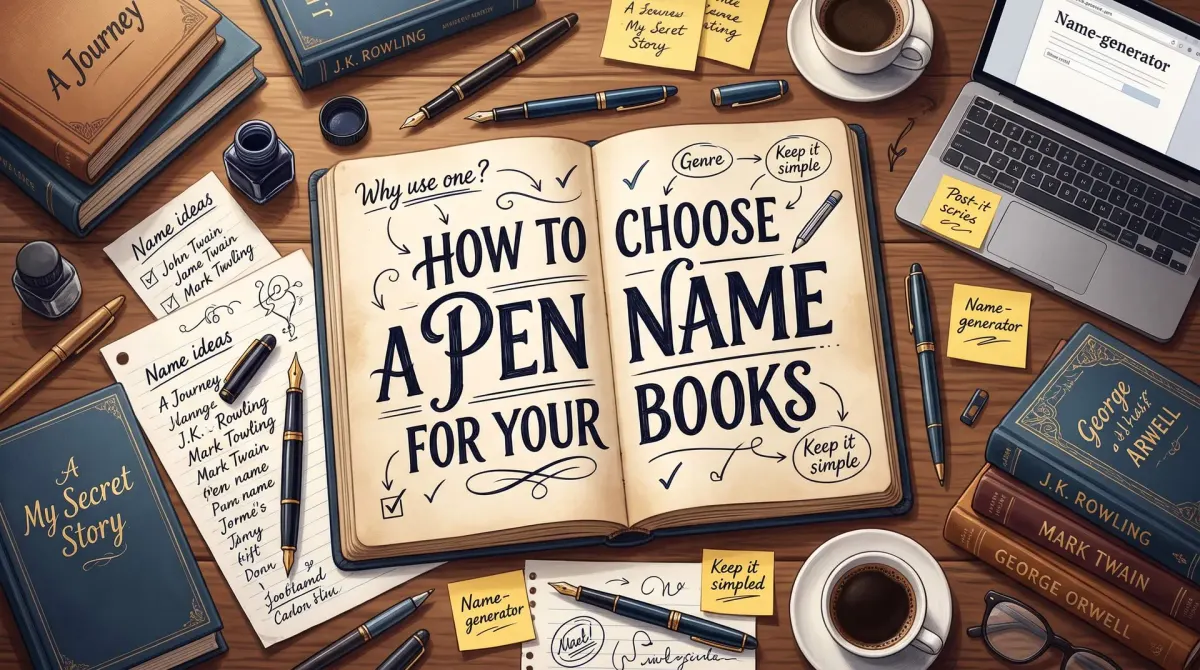
What is a pen name and why do authors use one?
Key takeaway: A pen name is a name you publish under instead of your legal name. Authors use one for privacy, genre, branding or to avoid a clash.
How to choose a pen name is the process of picking a public author name and testing it. You check it for clashes and spelling. Then you set it up on your book platform. The goal is a name that readers remember and can find in search.
If you ask what is a pen name, the short answer is simple. It is a made-up name that appears on your book as the author. Another word for it is a pseudonym. The pen name meaning is the same in every dictionary sense: a name used in place of your real one.
Authors choose a pen name for several reasons.
- Privacy. Your real name stays off the cover and the sales page.
- Genre. You write romance and thrillers and want two separate brands.
- Fit. Your real name is long, hard to spell or already taken by another author.
- Work reasons. Your day job or employer may not suit your books.
Famous writers did the same. Samuel Clemens wrote as Mark Twain. Mary Ann Evans wrote as George Eliot. Stephen King published some books as Richard Bachman, and J.K. Rowling published a crime novel as Robert Galbraith.
A pen name does not hide you from the law or from your platform. KDP still needs your real identity for payments. That point comes up again below.
Pen name ideas and examples that work
Key takeaway: Good pen names are short, easy to say and easy to spell. Build a list of ten before you test any of them.
Start with a list. Do not stop at your first idea. Ten options give you room to cut the ones that fail the checks.
Here are six patterns that work, with plain pen name examples for each.
| Pattern | Example | Best for |
|---|---|---|
| Middle name as surname | Anna Rose Hale | Keeping a link to your real name |
| Initials plus surname | A. R. Hale | Genres that read as neutral |
| Family name | Anna Mercer | A name with personal meaning |
| Place name | Anna Hollis | A name with a story behind it |
| Short blend | Rae Hale | Easy typing and search |
| Reversed name | Hale Anna | Quick, but test the spelling |
These pen name ideas are patterns, not real authors. Use them to start your own list. For more pen name examples, study the top books in your genre. Notice how their author names sound.
Say each name out loud. Write it by hand. Ask a friend to spell it after hearing it once. If they struggle, readers will struggle too.
The name should also fit the genre. A soft, warm name may suit a cozy mystery. A short, hard name may suit a thriller. This is a guide, not a rule.
How to choose a pen name: steps
Key takeaway: Test every name in the same order. A name that passes all eight steps is safe to publish.
Follow these steps for each name on your list.
- Decide why you need a pen name.
- List ten possible names.
- Say and spell each name aloud.
- Search each name in Google and Amazon.
- Check for famous authors with similar names.
- Check the domain name and social handles.
- Enter the final name in the KDP author field.
- Record which legal name sits behind it.
Step four matters most. Search the exact name in quotes. If another author already uses it, drop it. Search the name with the word "author" and with your genre.
Step five protects you from confusion. KDP's help page covers names similar to a popular author's. It suggests a pen name, a middle name or an initial. That advice shows the platform cares about clashes.
Step six saves money later. Buy the domain before you publish. Keep the same handle on the main social sites if you plan to use them.
Pen name generator tools: use them with care
Key takeaway: A pen name generator gives you ideas, not a finished choice. Every result still needs the eight-step test.
A pen name generator is a tool that mixes names, sounds and genre styles to produce author name ideas. Some ask for your real name. Others ask for a genre. You can also find a pen name generator for authors that sorts results by genre.
These tools are useful when you feel stuck. They break the blank page. They show patterns you had not tried.
They also have limits. They do not check whether a name is taken. They do not know your readers. They may suggest names that look like real authors, which creates a clash.
Use a generator like this:
- Run it three or four times for ten names each.
- Copy only the names that sound natural to you.
- Cut any name that feels like a famous author.
- Run the full eight-step test on the names that remain.
To build a name yourself, mix a first name you like with a family surname or a place you love. A name with a meaning you can explain in one sentence is easier to choose.
How KDP handles a pen name
Key takeaway: Use your legal name for your KDP account and your pen name for the book. The author name field is locked after publishing.
Amazon KDP is Amazon's self-publishing service for ebooks and paperbacks. Its help page says you can use a pen name or pseudonym to publish your titles.
The same page says KDP may ask for a copy of the rights to your book after you publish. It also says your real name is not published on its website. However, you must enter your real name in your KDP account information so KDP can issue payments and tax forms.
Two more rules matter.
- The author name field cannot be changed once the book is published. If you need a new name, you create a new edition.
- Your name should stay consistent across all your books. Amazon features such as author pages, series pages and format linking rely on a consistent name.
Amazon Author Central is the free tool where you build an author page with a bio and photo. KDP says an author page does not come with KDP. You register for Author Central, and your book must be published first.
Copyright and a pen name
Key takeaway: You can register a pseudonymous work. The copyright term differs unless your real name appears in the Copyright Office records.
The US Copyright Office is the government office that records copyright claims. Its Circular 32 explains pseudonyms.
For works created on or after January 1, 1978, the term is set by two dates. It is 95 years from the year of publication or 120 years from the year of creation. The shorter one applies. If your legal name is identified in the Office's records, the term becomes your life plus 70 years.
Here is a worked example you can check by hand.
- You create the book in 2025 and publish it in 2026.
- 95 years from publication: 2026 + 95 = 2121.
- 120 years from creation: 2025 + 120 = 2145.
- The shorter date is 2121, so the term would end in 2121.
The Office encourages you to give your real name on the application, even if the book carries a pen name. You enter your full name as the author and complete the pseudonym field. A pseudonym must be a name. The Office does not accept a number or a symbol.
Nicknames and short forms of your legal name do not count as pseudonyms under Circular 32. That matters if your pen name is only a shortened version of your own name.
People Also Ask
Can I use a pen name on Amazon KDP?
Yes. KDP says you can publish under a pen name or pseudonym. Enter the pen name in the author field when you set up the title. Enter your real name in your KDP account so payments and tax forms are correct. KDP may ask for proof of rights after you publish.
Do I have to tell readers my real name?
No. KDP says your real name stays anonymous and is not published on its website when you use a pen name. However, you must give KDP your real name in your account. If you register copyright and enter your real name, the Copyright Office record may reveal it.
Can I change my pen name after I publish?
Not in the same listing. KDP says the author name field cannot be changed once a book is published. You can create a new edition with the updated author name. Because the change affects author pages and linked formats, choose carefully before you publish.
Common mistakes
Key takeaway: Most pen name problems come from skipping the checks.
- Picking a name that is too close to a famous author.
- Skipping the search test on Google and Amazon.
- Entering the pen name in the KDP account section instead of the book details.
- Using a name you cannot spell or say easily.
- Forgetting to record which legal name stands behind the pen name.
Your next step: test one name today
Take your best three names and run the eight steps this week. Search each one, check the domain and say it aloud. Pick the winner and write down why you chose it.
Then set up your publishing steps in order. The Amazon guide shows where the author field sits in the KDP setup.