What is an author bio?
Key takeaway: An author bio is a short, factual profile. It tells readers who you are and why you wrote the book.
How to write an author bio is a skill with a simple answer. An author bio is a short profile of the writer, usually in third person. It states who you are, what you write and one detail that builds trust. Most bios run from 50 to 150 words.
You will also see it called the "about the author" section. The two terms mean the same thing. The page that holds it is often titled "About the Author."
A bio appears in several places.
- Inside the book. Typically on the last page in the back matter.
- On your retail page. On Amazon, through your author page.
- On your website. On the "About" page.
- In pitches and interviews. Often as a short paragraph.
Each place needs a slightly different length. That is why you should write three versions at once.
The next sections show how.
What to include in an author bio
Key takeaway: Include five items: your name, your genre, a credential, a fun fact and a way to connect.
If you wonder what to include in an author bio, use this list. Each item answers a question the reader has.
- Your name and what you write. "Jordan Lee writes cozy mysteries."
- A credential or reason you can write this book. A job, a degree, a hobby or a long interest.
- A short list of books or a series name. Only if you have them.
- A personal detail. A pet, a city or a hobby adds warmth.
- A way to connect. A website or a newsletter.
Not every bio needs all five. A first-time author can skip the book list. A nonfiction author should lead with the credential.
Keep the facts true and checkable. Do not claim awards you did not win. Do not list bestseller titles unless you can show proof.
Most bios use the third person. That means "Jordan Lee writes..." rather than "I write...". Third person reads as more professional and works well on retail pages.
First-person bios work on personal blogs and newsletters. Use them if your brand is casual.
How to write an author bio: steps
Key takeaway: Draft the 50-word version first. Then add detail for the longer versions.
Follow this method for every bio.
- Pick your reader and your genre.
- Write one line stating what you write.
- Add one credential or reason.
- Add one personal detail.
- Add your website or newsletter.
- Trim to 50 words.
- Expand to 100 and 150 words.
Start short because short is hardest. If the 50-word version works, the longer ones are easy to build.
Here is a word budget for a 50-word bio.
- Sentence 1 (name and genre): about 12 words.
- Sentence 2 (credential): about 18 words.
- Sentence 3 (personal detail and link): about 20 words.
- Total: 12 + 18 + 20 = 50 words.
Use that shape every time. Three sentences are enough.
After you draft, read it aloud. Cut any filler. Replace vague words such as "passionate" with a specific fact.
Author bio examples by length
Key takeaway: Write three lengths. Use the short one on retail pages and the long one on your website.
Use these short author bio examples as models. The names and facts are invented.
| Length | Word range | Best use |
|---|---|---|
| Short | 40 to 60 | Retail page, social profile |
| Medium | 90 to 120 | Back matter, press kit |
| Long | 150 to 200 | Website, speaker page |
Short author bio examples: the 50-word version
Jordan Lee writes cozy mysteries set in small coastal towns. A former librarian, Jordan spent twelve years helping readers find their next favorite book. Jordan lives in Maine with two cats and a very large tea collection. Visit jordanlee.example for news and free short stories.
Medium version (about 100 words):
Jordan Lee writes cozy mysteries set in small coastal towns. A former librarian, Jordan spent twelve years helping readers find their next favorite book. That experience shaped the warm, puzzle-driven stories in the Harbor Lane series. Jordan's first novel, Tea and Trouble, follows a baker who finds a clue in a cake box. When not writing, Jordan walks the shoreline and tests new tea blends. Jordan lives in Maine with two cats. Visit jordanlee.example to join the newsletter and read free short stories.
For the long version, add a short origin story and a line about what is next.
Notice the pattern. Each bio opens with the genre, adds a credential and ends with a link.
First time author bio examples (no credits yet)
Key takeaway: A new author can lead with a reason, not a résumé.
Many authors worry they have nothing to list. They do. Use the reason you wrote the book, a related job or a long-held interest.
Here are first time author bio examples with no publishing history. They are models.
Fiction:
Sam Rivers writes science fiction about ordinary people in strange places. Sam has worked as a nurse for ten years and draws on night-shift stories for many of the characters. This is Sam's first novel. Sam lives in Ohio with a dog named Pixel.
Nonfiction:
Priya Patel helps small business owners plan their first year of sales. She ran a bakery for eight years before she began coaching. The First-Year Plan is her first book. Priya lives in Austin.
Both examples share three traits. They use short sentences. They state a real fact. They end with a human detail.
Writing a bio with no experience comes down to honesty. Say what you do, why you wrote the book and where readers can find you.
Author bio template:
[Name] writes [genre] about [theme]. [Name] has worked as [job or role] for [number] years and draws on that experience in [book title]. [Name] lives in [place] with [pet, hobby or detail]. Visit [website] for [free gift or news].
If you are unsure what counts, ask a friend to describe you in one line. Their answer is often better than your own.
Where the author bio goes
Key takeaway: The bio goes in the back matter. A separate version goes on your Amazon author page.
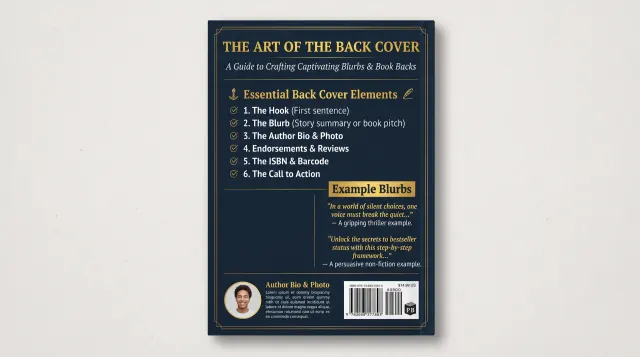
Amazon KDP is Amazon's self-publishing service for ebooks and paperbacks. Its front matter and back matter guide places the author bio in the back matter. In print, it should sit on a right-facing page.
An Amazon author page is different. Amazon Author Central is the tool authors use to build a public author page. KDP's help page says you can add bios, including bios in different languages. You can also see rank and reviews there.
KDP also says the book must be published before you can set up the author page. So plan to write your bios before launch and add them as soon as the listing is live.
Do not mix the bio with the book description. The description sells the book. The bio introduces the writer. KDP's description rules block contact information and URLs inside the description. Keep links for your bio and author page.
Keep your bio fresh
Key takeaway: Update your bio after each new book or big change, and keep every version in one file.
A bio is not a one-time task. Your books, your job and your links will change. Review the file every time you publish.
Keep all versions in one document. Label them 50, 100 and 150 words. When a fact changes, update every version at once. That prevents old details from staying on one site while the rest move on.
Match the tone to the genre. A thriller bio can sound sharp. A children's book bio can sound playful. A business book bio should sound clear and direct.
Add proof only when you can show it. A review quote or a real award adds weight. A vague claim does not.
Set up your author page in Amazon Author Central once your book is live.
People Also Ask
How long should an author bio be?
Most author bios run from 50 to 150 words. Use about 50 for retail pages and social profiles. Use 100 for the back of a book. Use 150 or more for a website. Keep a short and a long version ready.
Should an author bio be in first or third person?
Third person is the standard. It reads as professional and works on retail pages and in press kits. First person suits personal blogs and newsletters. Pick one voice and use it across every platform, so your brand stays consistent. Mixed voices confuse readers.
Can I write an author bio with no credentials?
Yes. Lead with why you wrote the book, a related job or a long interest. Add a personal detail and a link. Keep every fact true. A short, honest bio builds more trust than a list of weak claims. Readers value clear facts.
Common mistakes
Key takeaway: Weak bios are usually too long, too vague or too modest.
- Writing a full life story instead of three sentences.
- Using vague words such as "passionate" or "lifelong".
- Mixing first and third person.
- Listing awards or titles you cannot prove.
- Forgetting a link or way to connect.
Your next step: draft the 50-word version today
Fill in the author bio template above with three sentences. Then expand to 100 words. Save both in one file with your link.
Once your book is live, paste the short bio into your author page. Then add the medium version to your back matter.