What is a book genre?
Key takeaway: A genre is a group of books that share a story type and a set of reader expectations.
A book genre is a category of books that share a style, theme, setting or story pattern. Readers expect set features from each genre, like a puzzle in a mystery. Genre helps readers, stores and authors sort and compare books.
Genre is not the same as format. A format is how the book is made, such as ebook, paperback or audiobook. A genre is what the book is about and how the story works.
Genre is also not the same as topic. A topic is a subject, such as space or farming. A genre is a type of story or guide. A mystery can be set in space or on a farm.
The Book Industry Study Group (BISG) is a trade group that maintains the BISAC subject headings. Many retailers use these codes to place books on shelves. KDP uses its own category list, which is close to that system.
Most book genres lists start with one split. Fiction is made-up story. Non-fiction is fact, advice or true story. From there, each side divides into more genres.
Fiction genres list
Key takeaway: Fiction genres group invented stories by plot pattern, setting and mood.
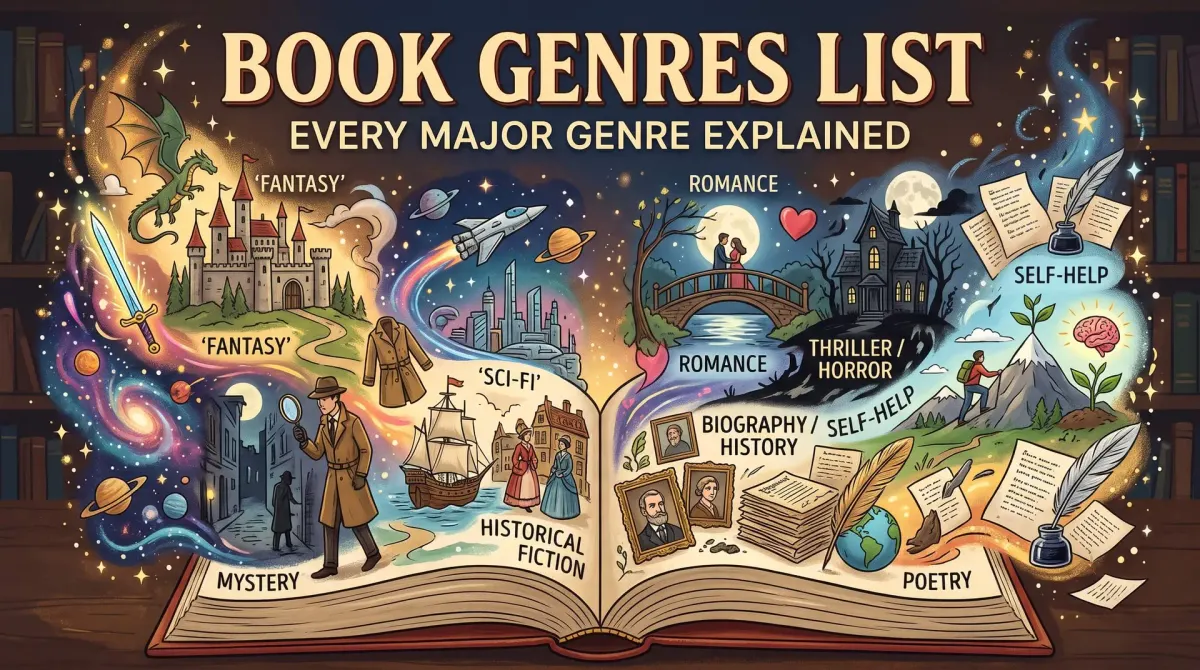
Here are the main fiction genres, with a short plain meaning for each.
- Literary fiction. Character-driven stories that focus on style and ideas.
- Mystery. A crime or puzzle that the lead must solve.
- Thriller. Fast, tense stories with high stakes and a ticking clock.
- Romance. Stories about a central love relationship, usually with a happy ending.
- Fantasy. Stories set in invented worlds, often with magic.
- Science fiction. Stories shaped by science, technology or the future.
- Horror. Stories built to frighten or unsettle.
- Historical fiction. Invented stories set in a real past period.
- Young adult. Stories aimed at teen readers, with teen leads.
- Children's. Stories for young readers, from picture books to middle grade.
Each of these splits again. Mystery includes cozy, police procedural and hard-boiled. Fantasy includes epic, urban and dark. Romance includes contemporary, historical and paranormal.
Length varies by genre too. A cozy mystery and an epic fantasy are very different sizes.
Most readers know the first few names on this list. The difference between a mystery and a thriller trips up many authors. A mystery asks "who did it?" and slowly reveals the answer. A thriller asks "will the lead survive?" and keeps the danger close.
Non-fiction genres list
Key takeaway: Non-fiction genres group factual books by purpose, such as teaching, telling a life or persuading.
Non-fiction is wide. Here are the main groups.
- Biography and autobiography. The story of a real life, told by someone else or by the subject.
- Memoir. A focused slice of the author's own life, such as one year or one theme.
- Self-help. Advice to improve skills, habits or well-being.
- Business. Guides on work, money, leadership and marketing.
- History. Accounts of real past events.
- Science and nature. Explanations of the natural world.
- Health and wellness. Guides on body, mind and lifestyle.
- Cooking. Recipes and food writing.
- Travel. Guides and stories about places.
- True crime. Factual accounts of real crimes.
- Religion and spirituality. Books on faith and belief.
- How-to and reference. Practical guides and look-up books.
Non-fiction sells on a clear promise. The reader wants to know what they will gain. So the title, subtitle and description must state the benefit.
If you write about your own life, read the memoir guide. It shows how to pick a theme and stay focused.
A non-fiction proposal also relies on genre. Agents ask which shelf your book belongs on and which books are its comparisons.
Genre vs subgenre
Key takeaway: A subgenre narrows a genre to a more specific style, setting or theme.
A subgenre is a smaller group inside a genre. It adds detail about tone, setting or plot. Readers often search by subgenre because it is a closer match to their taste.
Here is how it works for four broad genres:
| Genre | Example subgenres | What changes |
|---|---|---|
| Mystery | Cozy, police procedural | Tone and method |
| Romance | Contemporary, historical | Setting and era |
| Fantasy | Epic, urban | Scale and world |
| Self-help | Habits, mindset | Focus and method |
A subgenre is a better hook than a broad genre. "Cozy mystery" tells a reader more than "mystery." It signals a small town, an amateur detective and little violence.
Cross-genre books mix two or more. A "romantic thriller" has a love story and a tense plot. These books can win fans from both groups. However, you still need one lead genre. A book that tries to be everything is hard to pitch.
Some authors write under a pen name for each genre, so readers know what to expect. The pen name guide explains how to choose and register one.
How to pick the genre for your book
Key takeaway: Match your book to the genre whose readers expect what your story delivers.
Most lists stop at names. The harder task is choosing one for your own book. Use this two-step test.
First, write down five features of your book. Second, check each feature against a genre's common expectations.
Here is a worked example. Your book is a story about a baker who solves a village crime. The five features are:
- The lead is an amateur, not a police officer.
- The setting is a small village.
- A crime drives the plot.
- The tone is warm and light.
- The ending reveals who did it.
Now score two genres. A feature that fits earns one point.
- Cozy mystery: amateur lead (1), small village (1), crime plot (1), warm tone (1), reveal ending (1). Score: 5 out of 5.
- Thriller: amateur lead (0), small village (0), crime plot (1), warm tone (0), reveal ending (0). Score: 1 out of 5.
Fit score for cozy mystery: 5 ÷ 5 = 100 percent. Fit score for thriller: 1 ÷ 5 = 20 percent.
The book belongs in cozy mystery. The score is a guide, not a law. Still, a gap of 80 points leaves little doubt.
Next, compare with real books. Pick three books you think are close to yours. Check which shelf each sits on. If all three sit in the same genre, you likely have your answer.
Genre, categories and keywords
Key takeaway: Genre guides your KDP categories, your keywords and the first line of your description.
Your genre shapes the choices you make when you publish. KDP lets you choose up to three categories. Each category places the book in a browse list on the store.
Pick categories where books like yours already sit. Do not pick a popular category that does not match. Readers who land there will not buy, and the sales rank will not help.
Keywords work the same way. A good keyword is a phrase a reader would type. "Cozy village mystery" is better than "mystery book." The category and keyword guide shows the steps.
Your description should name the genre in the first lines. A reader should know in five seconds what kind of book it is. The description guide covers the rules KDP applies.
How to explore genres as a reader
Key takeaway: Read a sample of three genres, then keep the one that holds your attention.
Readers can use a genre list as a map. Pick a genre you have never tried. Read the first chapter of three well-reviewed books. Notice what you enjoy.
A short checklist helps:
- Do you like fast plots or slow ones?
- Do you want a happy ending or an open one?
- Do you prefer real settings or invented worlds?
- Do you like one lead or many?
Answer these and the right genre often shows itself. If you like puzzles, try mystery. If you like invented worlds, try fantasy.
Writers should read in their own genre. This shows what readers expect. It also shows what the market already has.
People Also Ask
What are the main genres of books?
The main groups are fiction and non-fiction. Fiction genres include mystery, romance, fantasy, science fiction, thriller, horror, historical fiction and literary fiction. Non-fiction genres include biography, memoir, self-help, business, history, science and cooking. Each group also splits into smaller subgenres.
How many book genres are there?
There is no single count. Retailers and trade groups use long lists with hundreds of categories and subcategories. For readers and authors, about 20 to 30 broad genres cover most books. The number grows when you add subgenres, so use the list that fits your platform.
What is the most popular book genre?
It depends on the market and the year. Romance, mystery and thriller are often named as strong sellers in fiction. Self-help and memoir are common in non-fiction.
Common mistakes
- Choosing a genre because it is popular, not because it fits.
- Mixing too many genres in one pitch.
- Confusing genre with topic or format.
- Picking KDP categories that do not match the book.
- Skipping the genre name in the first lines of the description.
Your next step: score your own book
Write five features of your book. Score them against two or three genres, as in the baker example. Pick the highest score. Then choose KDP categories and write the opening line of your description to match.
Then build the description with a free tool. It helps you write a hook-first blurb.