Memoir or autobiography
Key takeaway: Most readers want a memoir: a story with a clear theme, not a list of everything that happened.
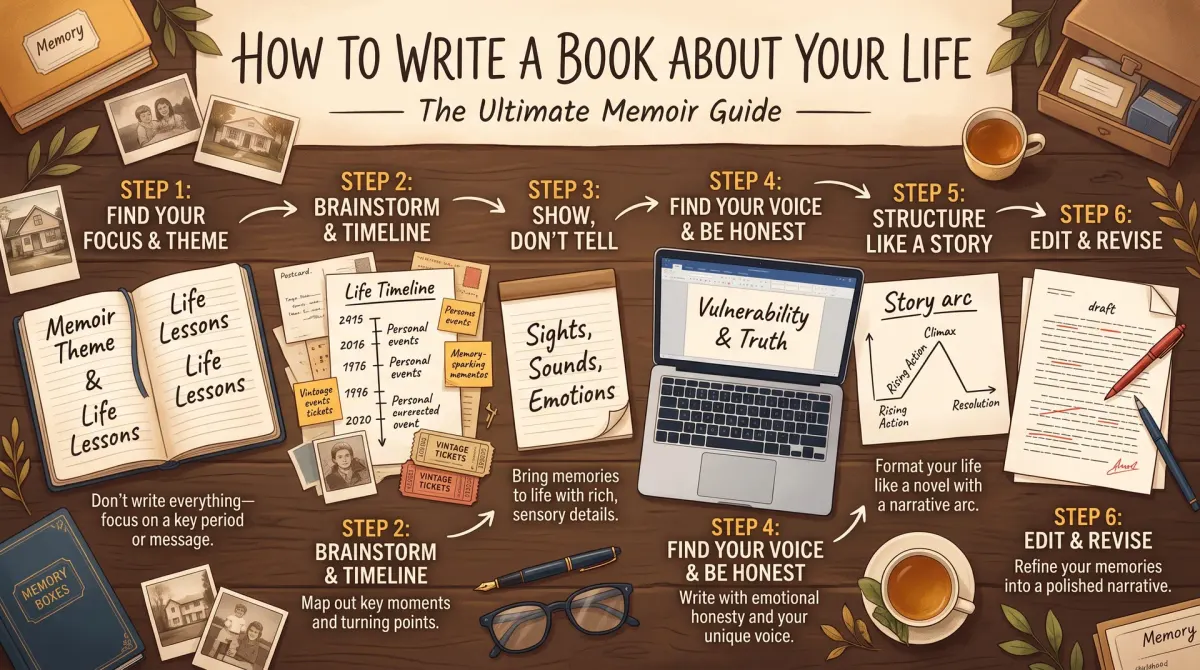
To write a book about your life, you decide whether it is a memoir or an autobiography, choose a theme that holds the story together, list the key scenes in order, write them as scenes rather than summaries and handle real people and facts with care.
An autobiography tells the story of a whole life, usually in order. It suits well-known people, where readers already care about every part.
A memoir picks one theme, such as recovering from an illness, building a business, moving to a new country or raising a child with special needs. It uses only the events that serve that theme.
If you are not famous, a memoir is usually the better choice. A narrow focus gives the book a clear promise.
Find your theme
Key takeaway: Ask what the reader will take away. Your theme is the answer.
Write one sentence that says what the book is about, beyond the events. For example, "This book is about learning to ask for help." The events are the evidence for the theme.
Test the theme. Would a reader who has never met you care? What will they learn or feel? If the answer is vague, narrow the story.
List and order the scenes
Key takeaway: A memoir is built from scenes. List the moments that matter most.
Brainstorm the moments linked to your theme. Include turning points, mistakes, conflicts and quiet moments that show change. Write each on a card or line.
Then put them in an order. Many memoirs run in time order, but you can start in the middle of the action and go back. Choose the order that keeps readers curious. Make sure the story shows change from the start to the end.
Write scenes, not summaries
Key takeaway: Put the reader in the moment. Show what you saw, heard and said.
A summary says, "We argued a lot." A scene shows one argument: the room, the words, the pause, the door. Use specific details. Use dialogue as you remember it, and keep it believable.
Memory is imperfect. You can say so in a note at the start of the book. Do not invent events and call them true. If you fill gaps for flow, say that dialogue is reconstructed.
Handle real people with care
Key takeaway: Think about privacy and fairness. Get advice if the content is sensitive.
People in your story did not agree to be in a book. Before you publish, think about each one.
- Would this person be hurt or identified?
- Is what you say true and fair?
- Does the story need this detail?
- Could you change names or details to protect them?
- Should you ask for permission?
Changing a name does not protect you if the person is still identifiable. Statements that harm a person's reputation can lead to legal claims in some countries. This guide is not legal advice. If your book includes serious allegations or private information, talk to a lawyer who knows publishing law.
Add a short note, if it fits, that some names and details were changed.
Draft, rest, revise
Key takeaway: Write the first draft quickly. Fix it later.
Set a small daily goal and write the scenes in any order. Do not stop to polish. After the draft, rest for a week or two. Then revise in two passes: structure first, then language. Ask honest readers where they lost interest.
Pay attention to the opening and the ending. The opening must hook. The ending must show how you have changed.
Publish your memoir
Key takeaway: Memoirs suit self-publishing well, especially for family, community and niche audiences.
Edit and proofread the book. Choose a cover that shows the theme, not just a photo of yourself. Choose a trim size, format the interior and publish on a platform such as KDP. Order a proof, because family and friends will want printed copies.
Write a description that opens with the reader's feeling or question, not with your biography.
Make it readable for strangers
Key takeaway: A reader who does not know you needs context, emotion and a reason to care.
Explain who people are the first time they appear. Give dates and places so readers can follow the timeline. Share what you felt and thought at the time, not only what happened. Include small, specific details, such as a smell, a phrase or an object, because details make a scene real.
Be honest about mistakes and doubts. Readers connect with a narrator who is human. Avoid long lists of events and avoid lecturing the reader. Let the story carry the lesson.
Protect yourself and your family
Key takeaway: Think about the effect the book will have after it is public.
Once the book is published, it can be read by relatives, colleagues and future employers. Decide what you are comfortable sharing. Some authors let a trusted relative read sensitive chapters first. Others change places or details to reduce the risk.
Keep drafts and notes safe. If your book touches on legal or medical matters, add a short disclaimer and avoid giving advice you are not qualified to give.
Choose a theme the reader can use
A life is too big for one book. A theme gives it a spine. Ask what the story shows. It might be recovery, a move, a career change, a family bond or a loss and what came after.
Write the theme in one sentence. Then ask who would care and why. A story that helps the reader see something in their own life is more likely to connect.
Use the theme to decide what to cut. A scene that does not support it can be left out, even if you love it.
Make a scene list
List the key scenes in the order they happened. For each, note when, where, who was there, what changed and why it matters.
Then look at the order. Does the story start in the right place? A strong start can be an event in the middle, with the background added later.
Mark gaps. You may need to interview family members or look through letters, photos and diaries to fill them.
Write scenes, not summaries
A summary tells the reader what happened. A scene lets them see it. Use details: what you saw, heard and felt. Use dialogue as you remember it, kept short.
Show your thoughts at the time and your view now. This contrast gives memoir its depth.
Keep paragraphs short. Use simple words. Read aloud to check the voice.
Be honest about memory
Memory is not perfect. You do not need to claim exact words. You can say, "As I remember it" and tell it truthfully.
Check facts where you can, such as dates and places. Use documents to support your account.
If you recreate a conversation, keep it faithful to the sense of what was said and note this in an author's note.
Handle real people with care
People in your story have their own view. Think about how they will feel. Consider asking for their view on parts that involve them.
Stick to facts and your own experience. Avoid claims you cannot support, especially about crimes or health.
For sensitive stories, consider changing names and identifying details and seek legal advice before you publish.
Revise in layers
Rest the draft. Then read it as a stranger. Fix structure first, then scenes, then sentences.
Ask a few trusted readers for feedback. Ask them where they were moved and where they were lost.
Check length. A focused memoir often runs shorter than a full autobiography.
Plan to publish and protect your story
Choose a title that reflects the theme. Prepare a copyright page and consider registering your copyright. Decide on format and platform.
Keep your notes, photos and permissions in one folder.
Tools to gather your memories
Memories come back with prompts. Look through photos, letters, diaries, calendars, old emails and social posts. Visit places if you can. Talk to family and friends.
Record interviews with older relatives, with their permission. Ask open questions such as "What do you remember about that day?"
Keep a notes file with dates, names and places. It will save time when you write.
Find your voice
Write the way you speak, with care. Avoid trying to sound like a famous writer. Read a few pages aloud and mark places where you sound stiff.
A clear, honest voice is more important than fancy words. Let your humour and your doubts show if they are part of the story.
If you write about hard times, take breaks and look after yourself.
Make a plan for the rest of the project
A memoir is a long project, so give it a schedule. Set a small goal for each week, such as one scene drafted or one interview recorded. Review the schedule once a month and move dates when life gets in the way.
Share a short scene with a trusted reader early, not only at the end. Their reactions show whether your theme is clear and whether the voice feels honest.
When the draft is done, plan editing, proofreading and a cover. Decide whether the book is for family, for local readers or for a wide audience, because that choice shapes the format and the price.
People also ask about writing about your life
What is the difference between memoir and autobiography?
An autobiography covers a whole life in order. A memoir focuses on a theme, a period or a set of events, and it tells them with reflection. Most readers prefer a memoir with a clear focus, because it has a shape and a reason to be read.
How do I start writing a memoir?
Start with a short theme sentence and a list of key scenes. Write the first scene you can picture clearly, rather than the first scene in time. Write a rough draft before you edit. Aim for regular short sessions and save your notes and photos.
Can I write about real people in my memoir?
You can, but take care. Describe events as you remember them and stick to facts. Think about privacy and the impact on others. Changing names or details can help, and a legal review is wise for sensitive stories. Ask a lawyer if you are unsure.
Begin with one scene
Do not wait for the perfect plan. Write one scene today. Momentum will help you find the rest.