What is an epigraph?
Key takeaway: An epigraph is a short quotation at the start of a book or section. It points to the theme.
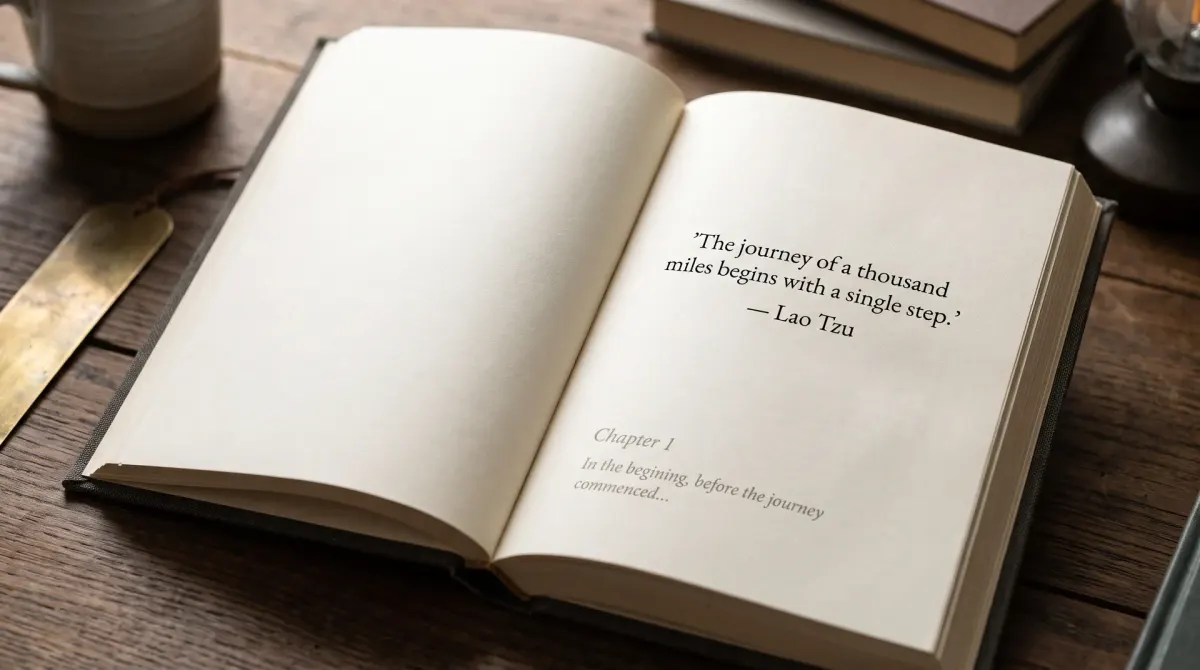
Epigraph in a book is a short quotation or phrase placed at the start of a book, part or chapter. It sets the tone or hints at the theme. Oxford Learner's Dictionaries describes it as a line used as an introduction to part of a book.
If you ask what is an epigraph, think of it as a signpost. It points the reader toward a mood before the story starts.
Oxford Learner's Dictionaries gives two senses. One is a line of writing on a building or statue. The other is a line used as an introduction to part of a book. Authors use the second sense today.
Epigraphs appear in three places.
- At the start of the book. One quote sets the tone for the whole work.
- At the start of a part. A quote opens each major section.
- At the start of a chapter. A short quote opens each chapter.
An epigraph is not a dedication. A dedication honors a person. An epigraph quotes a text. The two can sit side by side in a book, on separate pages.
Epigraph examples that work
Key takeaway: Short, relevant quotes with a clear credit work best.
Here are three public-domain epigraph examples. Each is old enough that no copyright applies in the United States, as the next section explains.
| Quote | Source | Fits a book about |
|---|---|---|
| "It was the best of times, it was the worst of times." | Charles Dickens, A Tale of Two Cities (1859) | Contrast and change |
| "All the world's a stage." | William Shakespeare, As You Like It | Performance and identity |
| "The mass of men lead lives of quiet desperation." | Henry David Thoreau, Walden (1854) | Work and meaning |
Notice what makes them work. Each one is short. Each one echoes a theme rather than telling the plot. Each one has a clear author and source.
Here are three ways to match a quote to your book.
- By theme. Pick a line that names the big idea.
- By mood. Pick a line that matches the tone of the opening.
- By contrast. Pick a line that the story will challenge.
Avoid a quote that tells the reader what to think. The best epigraph raises a question the book will answer.
You can also write your own. A line from an invented text or from your own world works in fantasy and science fiction. Credit it to the fictional source.
Is it legal to use a quote as an epigraph?
Key takeaway: There is no safe word count. Use public domain text, get permission or rely on fair use with care.
The US Copyright Office is the government office that records copyright claims. Its fair use page says no legal rule permits a specific number of words. The same goes for a certain number of musical notes or a percentage of a work. It also says fair use depends on all the circumstances.
The same page says that in cases of doubt, the Copyright Office recommends that permission be obtained.
That is clear guidance. It means a rule like "one line is always safe" is a myth. A short line from a song can still need permission.
Use this three-step check for every quote.
- Is it public domain? If yes, you may use it.
- Is it your own text? If yes, you may use it.
- Otherwise, get written permission from the rights holder.
The Copyright Office also says words and short phrases, such as names, titles and slogans, are not copyrightable. But a quotation from a longer work is different. A sentence from a novel or poem may be part of a protected work.
This article is general information, not legal advice. For a quote you cannot clear, ask a lawyer or choose another line.
The public domain date test
Key takeaway: Works published before January 1, 1931 are in the US public domain today.
Public domain works are free to quote. The test depends on the year of publication.
Copyright Office Circular 15A states that US works published before January 1, 1931 are in the public domain. An American Bar Association article confirms that works from 1930 became free on January 1, 2026.
A work's term for those years is 95 years from publication. It runs through the end of the calendar year. Here is a worked example with shown math.
- A work published in 1930: 1930 + 95 = 2025. The term ends on December 31, 2025.
- The work is in the public domain from January 1, 2026.
- A work published in 1931: 1931 + 95 = 2026. The term ends on December 31, 2026.
- That work enters the public domain on January 1, 2027.
So for a book you publish now, any US work from 1930 or earlier is safe on this test. A work from 1931 is not yet free.
Two cautions apply. First, a new translation or edition of an old text may carry its own copyright. Use the original text. Second, the rules for works from other countries can differ. Check the source before you quote.
How to format an epigraph page
Key takeaway: Keep it short, center it, credit the source and give it its own page.
An epigraph page is simple. Follow these formatting steps.
- Place the quote on its own page.
- Center the text or align it left.
- Use italics or the regular font.
- Put the author and source below.
- Leave white space around it.
KDP's front matter page does not mention an epigraph, so no platform rule fixes its place. A common choice is to put it after the dedication and before the table of contents. That is a suggestion, not a rule.
KDP does list a suggested front matter order. It runs from half title through copyright, dedication, contents, preface, acknowledgments, prologue and introduction. Use that order as your base. Slot the epigraph where it reads best.
For chapter epigraphs, place the quote under the chapter heading. Use a smaller font than the body text. Keep the credit on its own line.
Keep the style the same across the book. If one chapter has an epigraph, readers will expect the rest to have one too.
How to choose an epigraph: steps
Key takeaway: Start from your theme, then search for a line you are free to use.
Follow these steps.
- Write your book's theme in one sentence.
- List moods you want at the start.
- Search public domain texts for matches.
- Pick three short candidates.
- Check the publication year of each.
- Confirm the exact words and source.
- Choose the one that raises a question.
Step six prevents embarrassing errors. Check the quote against the original text. Many quotes online are wrong or misattributed.
If you want a modern quote, plan for permission. Write to the rights holder or publisher. State the quote, the book and the use. Keep the reply in your records.
People Also Ask
What is the purpose of an epigraph?
An epigraph sets the tone or hints at a theme before the text begins. It also shows the writer's influences. A good one raises a question that the book answers. It should be short, relevant and credited. It does not replace the need for a strong first page.
How long should an epigraph be?
Keep it to one or two lines. A short quote is easier to read and easier to clear. The US Copyright Office says no rule sets a safe word count, so shorter is not automatically legal. Choose brevity for impact and check rights for safety.
Do I need permission for an epigraph?
Only if the text is protected and your use is not fair use. Public domain text and your own text need no permission. The Copyright Office recommends getting permission in cases of doubt. For a modern song lyric or poem, plan to ask the rights holder.
Common mistakes
Key takeaway: Most epigraph problems come from rights errors and wrong credits.
- Assuming a short line never needs permission.
- Quoting from memory without checking the source.
- Using a translation that is still protected.
- Skipping the credit line.
- Adding an epigraph that does not match the theme.
Your next step: shortlist three quotes
Write your theme in one sentence. Then find three public domain quotes that match it. Check each year with the date test above.
Once you choose one, place it in your front matter and review the full order.
Sources
- US Copyright Office: Can I use someone else's work?
- US Copyright Office: Circular 15A, Duration of Copyright
- US Copyright Office: Circular 33, Works Not Protected by Copyright
- Oxford Learner's Dictionaries: Epigraph
- American Bar Association Landslide: Celebrating the Public Domain
- KDP: Format your book front matter