What is a prologue in a book?
Key takeaway: A prologue is an opening section that sits before chapter one and belongs to the story.
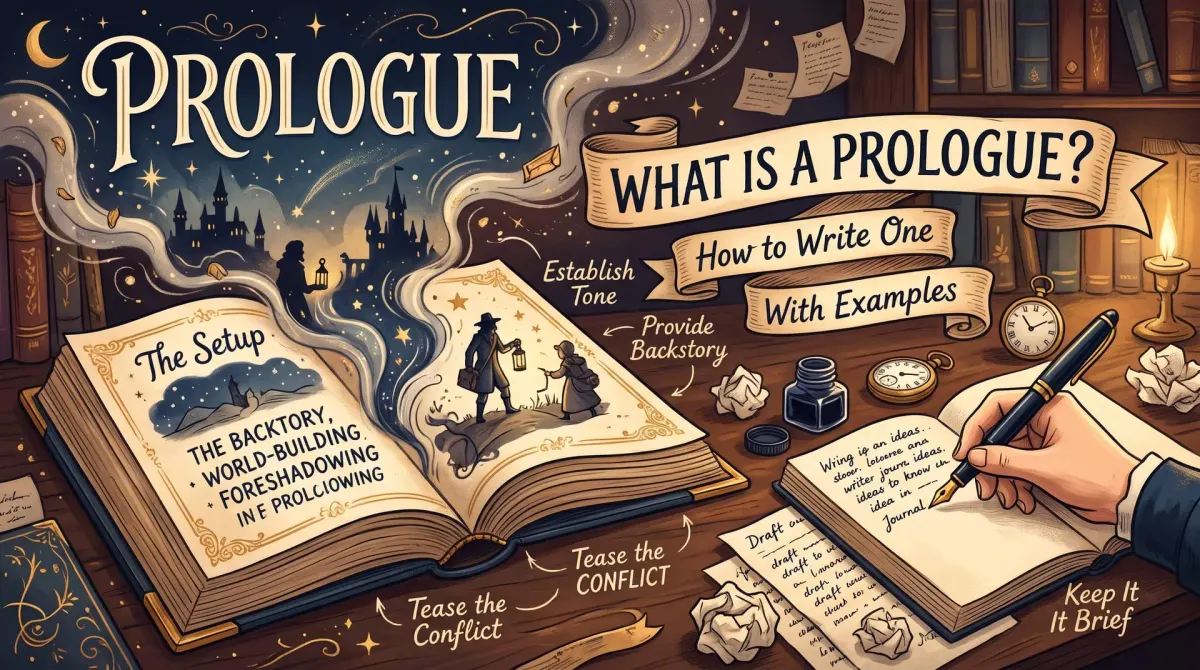
What is a prologue is a common question with a short answer. A prologue is an opening section of a book that comes before the first chapter. It opens the story with a hook, a past event or background. The reader needs it before the main plot begins.
The Britannica Dictionary gives the shortest prologue definition: an introduction to a book, play and similar works. That covers the prologue meaning in a book in one line.
In practice, a prologue does one of four jobs.
- A hook. It shows a dramatic moment to pull the reader in.
- A past event. It shows something that happened years before the main story.
- A different point of view. It shows a scene through a character who may not return.
- A world note. It sets up a setting that readers need to understand.
A prologue is not a place for author notes. A short note from the author belongs in a preface or foreword. The prologue is fiction or narrative, not commentary.
The word also appears in plays and films. A play can open with a prologue spoken to the audience. A film can open with a short scene before the title. The idea is the same in each form.
Prologue vs preface vs introduction
Key takeaway: A prologue is story. A preface and an introduction are about the book.
Authors often mix these three. They look alike, but they do different jobs.
| Section | Who speaks | Purpose |
|---|---|---|
| Prologue | The story | Sets up the plot |
| Preface | The author | Explains why the book exists |
| Introduction | The author | Prepares the reader for the content |
A preface is a note from the author about how the book came to be. An introduction prepares the reader for the main content, especially in nonfiction. A foreword is written by someone other than the author.
Amazon KDP is Amazon's self-publishing service for ebooks and paperbacks. Its front matter guide gives this suggested order:
- Half title page
- Title page
- Copyright page
- Reviews or praise
- Dedication
- Table of contents
- Preface
- Acknowledgments
- Prologue
- Introduction
So the prologue sits near the end of the front matter, right before the introduction. KDP also says many front matter elements are optional. Use only what your book needs.
Does your book need a prologue?
Key takeaway: Add a prologue only if chapter one cannot do its job. Test with three questions.
Use this quick test before you write one.
- Does it give the reader something new? If chapter one can hold the same material, cut the prologue.
- Would the book lose power without it? If the answer is no, skip it.
- Is it tied to the main plot? A prologue that never comes up again feels random.
If you answer yes to all three, keep it. If you answer no to any, fold the material into chapter one or later chapters.
Some readers skip a prologue. That is a real risk. Make it as short and gripping as chapter one. Then readers lose nothing by reading it.
A prologue works best in genres that lean on a hook or a past event. Thrillers, mysteries and fantasy often use one. Many contemporary and literary novels do not.
It also fits a series. A short prologue can remind readers of earlier events. Keep it brief and avoid a long recap.
Finally, ask a beta reader. Let them read chapter one with and without the prologue. Their reaction tells you more than any rule.
How long should a prologue be?
Key takeaway: Keep it short. A prologue should be a small share of the whole book.
No official source sets a prologue length. The story decides it. Still, a simple ratio helps you check balance.
Here is a worked example. Say your novel is 80,000 words and your prologue is 1,500 words.
- Share of the book: 1,500 ÷ 80,000 = 0.01875, or about 1.9 percent.
- Pages, double spaced at 250 words per page: 1,500 ÷ 250 = 6 pages.
- Compare with a chapter of 3,000 words: 1,500 ÷ 3,000 = half a chapter.
A prologue at half a chapter or less usually feels quick. A prologue as long as a full chapter starts to feel like chapter one with another name.
The 250 words per page figure is a common rule of thumb for double-spaced pages, not a standard. Printed book pages hold different amounts.
If your prologue grows past a chapter, test again. Ask whether you should rename it as chapter one. The label matters less than the pacing.
How to write a prologue: steps
Key takeaway: Start with the hook. Write the scene. Then check the link to chapter one.
Follow these steps for a prologue that earns its place.
- Decide what the reader must see first.
- Pick one scene, not a summary.
- Start in the middle of the action.
- Show one clear question or threat.
- End on a hook.
- Trim to under half a chapter.
- Test it with a beta reader.
Step two matters most. A scene shows people doing things. A summary only tells. Scenes pull readers in.
Step five connects the prologue to chapter one. End with a question the first chapter will begin to answer.
Here is a short prologue example. It is invented and only shows the shape.
The lighthouse lamp went dark at midnight. Mara counted the seconds, as her father had taught her. At forty, the door below opened. Nobody had a key but him. And he had been gone ten years.
Notice the pattern. It is short, it starts in the moment, and it ends with a question. Chapter one can now open on the next day.
Prologue example styles
Key takeaway: Pick the style that fits your story. Short and focused beats long and broad.
A prologue example can take several forms.
- The cold open. A tense scene before the hero appears.
- The historical frame. A short scene from years earlier.
- The document. A letter, report or news clip that sets the stage.
- The villain's view. A scene from the antagonist's side.
Each form has risks. A cold open can feel like a trick if it never connects. A historical frame can bury readers in backstory. A document can feel flat. A villain's view can give away too much.
For each form, test the link to the main plot. If you can cut the prologue and lose nothing, cut it.
Another good test is the page-one test. Read chapter one first. Then read the prologue. If chapter one now feels slower, the prologue may be doing its job less well than you thought.
Look at three books in your genre. Check whether they open with a prologue. Count its length. Compare it with your own.
People Also Ask
What is the purpose of a prologue?
A prologue gives the reader something they need before chapter one. It can offer a hook, a past event or background about the world. It should connect to the main plot. If it does not add anything new, the material may fit better inside the first chapter.
Should a prologue be numbered like a chapter?
No. A prologue usually has no chapter number. It carries the heading "Prologue" and sits before chapter one. In the table of contents, list it as its own entry. Keep the style of the heading the same as your chapter headings.
Is a prologue part of the book's front matter?
Yes. KDP's suggested front matter order lists the prologue ninth, after acknowledgments and before the introduction. Many authors treat it as the first part of the story. Place it where it reads naturally, and keep the heading style consistent with the rest of the book.
Common mistakes
Key takeaway: Most weak prologues are too long, too vague or disconnected from the plot.
- Writing a long backstory instead of a scene.
- Giving away the main twist.
- Using the prologue for author notes.
- Skipping the link to chapter one.
- Adding one because other books have one.
Your next step: run the three-question test
Take your draft and answer the three questions in the needs-it test. If you still want a prologue, write one scene using the steps above.
Then check the full front matter order. A short list will show where the prologue sits.