What is an epilogue in a book?
Key takeaway: An epilogue is a closing section that follows the main story and belongs to it.
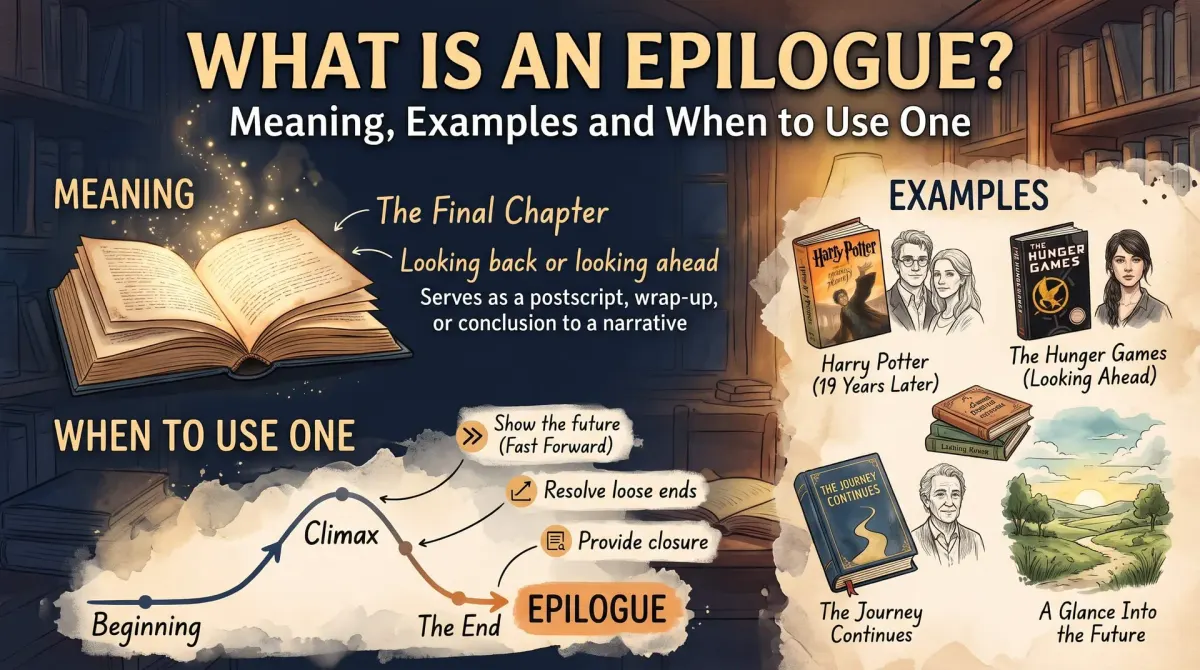
What is an epilogue is a question with a clear answer. An epilogue is a final section that follows the main part of a book. It gives closure by showing what happened later, tying loose ends or leaving a last image. It is part of the story.
The Britannica Dictionary defines an epilogue as a final section or speech after the main part of a work. That covers books, plays and musical pieces. It is the epilogue definition in short.
An epilogue does one of four jobs.
- Closure. It shows how the characters end up.
- A time jump. It moves forward months or years.
- A tie-in. It resolves a thread the last chapter left open.
- A series link. It hints at the next book.
An epilogue is not the same as the last chapter. The last chapter ends the main plot. The epilogue happens after the plot is done.
The word also applies to plays and films. A play can end with a speech to the audience. A film can end with text that tells what happened to the characters. The role is the same: a final look after the main action.
Epilogue vs prologue vs afterword
Key takeaway: A prologue opens the story, an epilogue closes it and an afterword is a note from the author.
Three words cause most of the confusion. Here is how they compare.
| Section | Position | Voice |
|---|---|---|
| Prologue | Before chapter one | Story |
| Epilogue | After the final chapter | Story |
| Afterword | After the story | The author |
Many people search for prologue vs epilogue. The simple rule is this. A prologue comes first and sets up. An epilogue comes last and wraps up. Both are part of the story.
An afterword is different. It is a note by the author, often about how the book was written or what came after. It is not fiction.
If you write a note about your research or your thanks, call it an afterword or an author's note. If you write a scene, call it an epilogue.
Where does an epilogue go in a KDP file?
Key takeaway: KDP does not set a place for an epilogue. Put it after the last chapter and before the author bio.
Amazon KDP is Amazon's self-publishing service for ebooks and paperbacks. Its front matter and back matter page lists the pieces it covers. In the back matter, it names a bibliography, an author bio and an index.
The page does not mention an epilogue. So no KDP rule fixes its place. That gives you freedom.
A sensible order is simple.
- The final chapter
- The epilogue
- Any author note or afterword
- Acknowledgments, if you place them in the back
- The author bio
- The index, if you have one
This order is a suggestion, not a platform rule. It keeps the story together and puts notes after it.
KDP also says that the first back matter section starts on a right-facing page. The author bio also sits on a right-facing page. Plan your page breaks so each starts clean.
Finally, add the epilogue to the table of contents. Use the same heading in the body and in the contents list, as KDP asks for table of contents entries.
Does your book need an epilogue?
Key takeaway: Add an epilogue only if the ending still has a question the reader cares about.
Use this short test.
- Is the main plot fully resolved? If not, fix the last chapter first.
- Is there a question the reader will still ask? If yes, an epilogue may answer it.
- Does the epilogue add emotion, not only facts? If it only lists facts, cut it.
If you answer yes to the first and second, and the epilogue adds emotion, keep it.
An epilogue is a good fit for a story with a big time gap. It can show a family years later or a place after a war. It is also a good fit for a series, where a final image can point to the next book.
It is a poor fit for a story that already ends with a strong image. Adding more can feel like over-explaining.
Ask a beta reader to read the book with and without the epilogue. Their reaction will show whether the ending lands better with it.
How long should an epilogue be?
Key takeaway: Keep it short. A small share of the book is usually enough.
No official source sets an epilogue length. The story decides it. A simple ratio helps you check balance.
Here is a worked example. Say your novel is 90,000 words and your epilogue is 800 words.
- Share of the book: 800 ÷ 90,000 = 0.0089, or about 0.9 percent.
- Pages, double spaced at 250 words per page: 800 ÷ 250 = 3.2, or about 4 pages.
- Compare with a 3,000-word chapter: 800 ÷ 3,000 = 0.27, or about a quarter of a chapter.
At about a quarter of a chapter, the epilogue feels like a final breath. At a full chapter, it starts to feel like a second ending.
The 250 words per page figure is a rule of thumb for double-spaced pages. Printed book pages hold different amounts.
How to write an epilogue: steps
Key takeaway: Pick one image, show time passing and end on feeling.
Follow these steps for a clean ending.
- Decide what the reader still wants to know.
- Pick one scene to show it.
- Set the time jump in the first line.
- Show one change in the main character.
- Echo an image from chapter one.
- End on a feeling, not a fact.
- Trim to the shortest version.
Step five gives a sense of a full circle. If the book opened with a lighthouse, the epilogue might return to it.
Here is a short epilogue example. It is invented and shows the shape.
Ten years later, the lighthouse had a new keeper. Mara climbed the stairs she once feared and lit the lamp at dusk. Below, the harbor glowed. Her father's chair still sat by the window. She let it stay.
The example is short and echoes the setting. It does not explain. It shows time passing and ends on a quiet gesture.
Common epilogue example types
Key takeaway: Choose the type that fits your story, and keep it focused.
An epilogue example can take several forms.
- The time jump. Years later, we see how things settled.
- The reunion. Characters meet again after the main plot.
- The letter. A short note that gives closure.
- The teaser. A short scene that points to a sequel.
Each form has risks. A time jump can feel like a list of outcomes. A reunion can be too sweet. A letter can feel like an info dump. A teaser can feel like an ad.
Write scenes, not summaries. A scene lets readers feel the ending. A summary only informs them.
Read the epilogues in three books you admire. Notice the length, the tone and the final line. Then compare them with your own draft.
People Also Ask
What is the purpose of an epilogue?
An epilogue gives closure after the main story ends. It can show what happened later, tie up a last thread or leave a final image. It belongs to the story and should add emotion or meaning. If it only repeats facts, the ending may be stronger without it.
Is an epilogue necessary?
No. An epilogue is optional. KDP's page on front and back matter does not list it, and many novels end without one. Add one only if the ending leaves a question that readers care about. Otherwise, a strong last chapter is enough.
Can I have an epilogue without a prologue?
Yes. The two are independent. A book can have a prologue, an epilogue, both or neither. Use each only if it helps the story. A prologue should open the story with something new, and an epilogue should close it with meaning.
Common mistakes
Key takeaway: Most weak epilogues explain too much or run too long.
- Explaining what the ending already showed.
- Writing a full chapter instead of a short scene.
- Listing outcomes for every character.
- Adding a sequel hook that feels like an ad.
- Mixing author notes into the story section.
Your next step: test your ending
Read your last chapter. Write down the one question a reader may still have. If one scene can answer it, draft an epilogue using the steps above.
Then run a final check on the whole book before you publish.