What is a synopsis?
Key takeaway: A synopsis is a short, complete retelling of the plot, ending included.
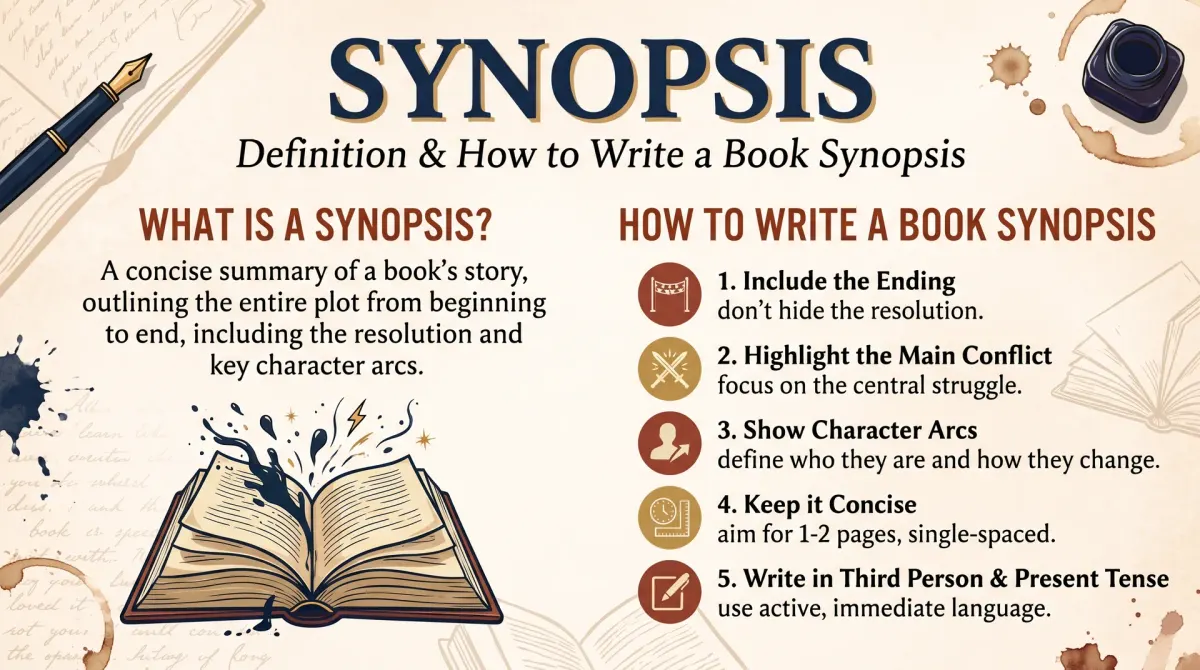
Synopsis definition is simple: a synopsis is a short summary of the main points of a work. For a book, it retells the plot in order, from opening to final scene. It reveals the ending. Authors send it to agents and publishers with their sample chapters.
The word comes from a Greek term that means a general view. That fits. A synopsis gives a general view of the whole story in a few pages.
Here is the synopsis meaning in a writing setting. It is a short document that:
- Names the main characters and what they want.
- Shows the main events in order.
- Explains why events happen.
- Gives the ending and the final change.
Notice what is missing. A synopsis has no teaser lines. It does not say "will she survive?" It says what happens.
If you ask whats a synopsis for, the answer is trust. An agent wants to know that the plot works before reading the full book. A clear synopsis answers that fast.
Nonfiction uses a different tool. A nonfiction author sends a book proposal. A proposal includes an overview, a chapter list and market notes.
Synopsis vs summary vs blurb vs outline
Key takeaway: Each tool has a different reader and a different rule about spoilers.
People often confuse these four. Here is how they differ.
| Tool | Reader | Ending |
|---|---|---|
| Synopsis | Agent or editor | Revealed |
| Blurb | Book buyer | Hidden |
| Summary | Anyone | Usually revealed |
| Outline | The author | Planned |
A blurb is the short sales text on the back cover or retail page. It teases the story. A summary is a general term for any short retelling. An outline is a planning tool that lists scenes or chapters.
When people search synopsis vs summary, the difference is small. Both are short retellings. In publishing, a synopsis has a clear job: it goes to an agent or editor and includes the ending.
Do not send a blurb when someone asks for a synopsis. They want to see how the story ends.
Use the blurb for readers and the synopsis for professionals. Keep them in separate files so you do not mix them up.
How long should a synopsis be?
Key takeaway: Length varies. Check each agent's guidelines and match them exactly.
There is no single standard. Agents and publishers post their own rules. Some ask for a short version. Some ask for a longer one. Always follow the posted guidelines.
You can still plan your length with math. Here is a worked example for a one-page synopsis.
Say your novel is 80,000 words and your synopsis is 500 words.
- Compression ratio: 80,000 ÷ 500 = 160. The synopsis is 1/160 of the book.
- Pages, single spaced at about 500 words per page: 500 ÷ 500 = 1 page.
- Pages, double spaced at about 250 words per page: 500 ÷ 250 = 2 pages.
Now a longer version. Say you need a two-page single-spaced synopsis of 1,000 words.
- Compression ratio: 80,000 ÷ 1,000 = 80.
- Pages, single spaced: 1,000 ÷ 500 = 2 pages.
- Pages, double spaced: 1,000 ÷ 250 = 4 pages.
The 500 and 250 words per page figures are common rules of thumb, not standards. Check them in your own file.
It helps to keep three versions: about 250 words, about 500 words and about 1,000 words. Then you can send the one that matches each agent's request.
How to write a book synopsis: steps
Key takeaway: Write the skeleton first, then add only what the plot needs.
Follow these steps.
- List your main characters and goals.
- Write the opening situation.
- List the key turning points.
- Write the climax and ending.
- Join the points in order.
- Cut minor subplots.
- Read it aloud and trim.
Step three is the core. A turning point is an event that changes the direction of the story. A novel often has five to eight of them. List them in order before you write full sentences.
Step six keeps the synopsis clean. A synopsis has room for the main plot and perhaps one subplot. It has no room for every scene.
Write in the present tense and the third person. For example: "Mara discovers the ledger and follows the clues." This is a widely used convention. Follow the agent's guidelines if they differ.
Use plain words. Avoid questions and avoid teasers. State what happens, and state why.
Synopsis example and template
Key takeaway: A good synopsis reads like a clear story in miniature.
Here is a short synopsis example. It is invented and shows the shape.
Mara Torres, a baker in a coastal town, learns that her late father hid a ledger in the family bakery. The ledger records a secret deal that could ruin a powerful local family. Mara follows a trail of coded notes across the town.
Her search draws the attention of Dale Kerr, the family's fixer, who wants the ledger destroyed. After a break-in at the bakery, Mara teams up with an old friend, Sam, to stay ahead of Dale.
At the midpoint, Mara learns her father was part of the deal. She must decide whether to protect his name or expose the truth. She chooses the truth.
In the climax, Mara hands the ledger to a reporter during a town festival. Dale is arrested. The bakery survives, and Mara takes over as its owner.
This example is about 150 words. Real synopses run longer, but the structure is the same.
Now a fill-in template. Replace the brackets.
[Main character], a [role] in [setting], wants [goal]. When [inciting event], [main character] must [choice]. [Opponent] stands in the way because [reason]. At the midpoint, [turning point]. In the climax, [main character] [action] and [result]. By the end, [change in main character].
You can reuse this template for any novel. Fill it in with your own plot.
Search for a synopsis example in your genre. Notice the length and the tone. Then match the form, not the words.
Common synopsis problems and fixes
Key takeaway: Most weak synopses list events without reasons.
A synopsis fails in three common ways.
- It lists events but not causes. Add "because" and "so" to link events.
- It names too many characters. Name only the ones who drive the plot.
- It hides the ending. Reveal it. Agents want to see the whole shape.
Another problem is tone. A synopsis should not sound like a blurb or a review. Avoid phrases such as "a thrilling ride" and "a heart-stopping finale." Describe what happens and let the plot speak.
Check the logic. Ask yourself whether each event causes the next. If a link is missing, the agent will notice.
Finally, run a spelling check. Names matter. A misspelled character name looks careless in a short document.
Tips for a stronger synopsis
Key takeaway: Clear cause and effect make a short synopsis feel complete.
A few habits lift a synopsis from a list to a story.
- Start with the lead's want, not the setting.
- Link events with "because" and "so".
- Show the lead's choices, not only what happens to them.
- Keep names to the people who matter.
- End with the change in the lead.
Test the draft on a friend who has not read the book. Ask them to retell it in two sentences. If they cannot, the plot may not be clear yet.
Read it once for logic and once for length. Cut any sentence that does not move the plot. A tight synopsis shows control of the story.
People Also Ask
What is the difference between a synopsis and a summary?
A synopsis is a short retelling of a story's plot, written in order and including the ending. A summary is a general term for any short retelling. In publishing, a synopsis has a clear job: it goes to an agent or editor with sample chapters.
Should a synopsis include the ending?
Yes. A synopsis reveals the ending. Agents and editors want to see that the plot works from start to finish. A blurb hides the ending to tease readers, but a synopsis does not. If you hide it, the reader will assume the plot has a weak ending.
How long is a book synopsis?
It depends on who asks. Agents and publishers post their own rules, so follow them exactly. For planning, a 500-word synopsis fills about one single-spaced page at 500 words per page. Keep a short, medium and long version ready. That saves time on each submission.
Common mistakes
Key takeaway: Most errors come from teasing, over-detail and ignoring guidelines.
- Ending on a question instead of the real ending.
- Naming every minor character.
- Writing in the past tense when the agent asks otherwise.
- Ignoring the posted length limit.
- Using a blurb in place of a synopsis.
Your next step: draft three turning points
Write the opening, the midpoint and the climax in one sentence each. Then fill in the template above. Expand to 500 words.
Once the draft works, check the guidelines of the first agent on your list and adjust the length.