What a book review is
Key takeaway: A review gives an opinion supported by evidence. It is not a plot summary.
How to write a book review is a method for giving a clear, honest opinion on a book. You name the book and summarise it without spoilers. You judge its strengths and weaknesses with examples. You end with a verdict that tells readers who should read it.
A book review is a short piece of writing that describes and judges a book. It helps readers decide whether to read it. It may appear on a store page, a blog, a school assignment or a newspaper.
A review differs from a book report. A report mostly retells what happened. A review adds your view and evidence.
It also differs from a book summary. A summary stays neutral. A review takes a stand.
Keep your audience in mind. A reader review on a store page can be short. A school review needs structure and sources. A professional review may need a formal tone.
Use plain words. Be fair. Even a negative review should point to specific reasons.
Be honest about your taste. If you rarely read thrillers, say so. That helps readers judge your opinion.
Book review template you can reuse
Key takeaway: A template gives you a start. Fill each part with your own words and examples.
A template is a fixed structure you reuse. This one has five parts and works for most books.
| Part | What to include | Words (500-word review) |
|---|---|---|
| Opening | Title, author, genre, your first view | 75 |
| Summary | Setup without spoilers | 150 |
| Analysis | Strengths and weaknesses with examples | 200 |
| Verdict | Who should read it and rating | 75 |
Add the numbers: 75 + 150 + 200 + 75 = 500. Change the plan for longer or shorter reviews.
Here is the template in words:
- Opening: "[Title] by [Author] is a [genre] about [one-line idea]. My first view: [short opinion]."
- Summary: Describe the setup and main conflict. Stop before the ending.
- Analysis: Pick two strengths and one weakness. Support each with a short example.
- Verdict: Say who will enjoy the book and who may not. Add a rating if the site uses one.
Save the template in a note app. Fill it in as you read, and the review will take less time.
For fiction, comment on plot, characters, pacing and style. For non-fiction, comment on clarity, evidence, usefulness and structure.
Book review example (a sample review)
Key takeaway: A strong review is specific. It names scenes, ideas and reasons.
Here is a short sample for an imaginary novel. The title and author are made up for this guide.
Sample review of "The Lantern at Harrow Bay" by A. Reed (fictional):
The Lantern at Harrow Bay is a slow, atmospheric mystery set in a seaside village. A retired detective returns home and finds a letter that points to an old disappearance.
The book's best feature is its setting. The author describes the fog, the harbour and the creaking pier in a few clean lines. I could picture each scene.
The pacing is uneven. The middle chapters repeat the same interviews, and the reveal arrives late. A tighter plot would have helped.
The main character feels real. Her stubbornness drives the plot, and her mistakes cost her.
I would recommend it to readers who like quiet, character-led mysteries. Fans of fast thrillers may find it slow. Rating: 3.5 out of 5.
Notice what works here. The review names the genre, avoids spoilers and gives reasons. It also tells readers who will enjoy it.
You can adapt this model for school too. Add a short thesis, such as "The novel succeeds because of its setting but loses force in the middle."
How to write a book review: 7 steps
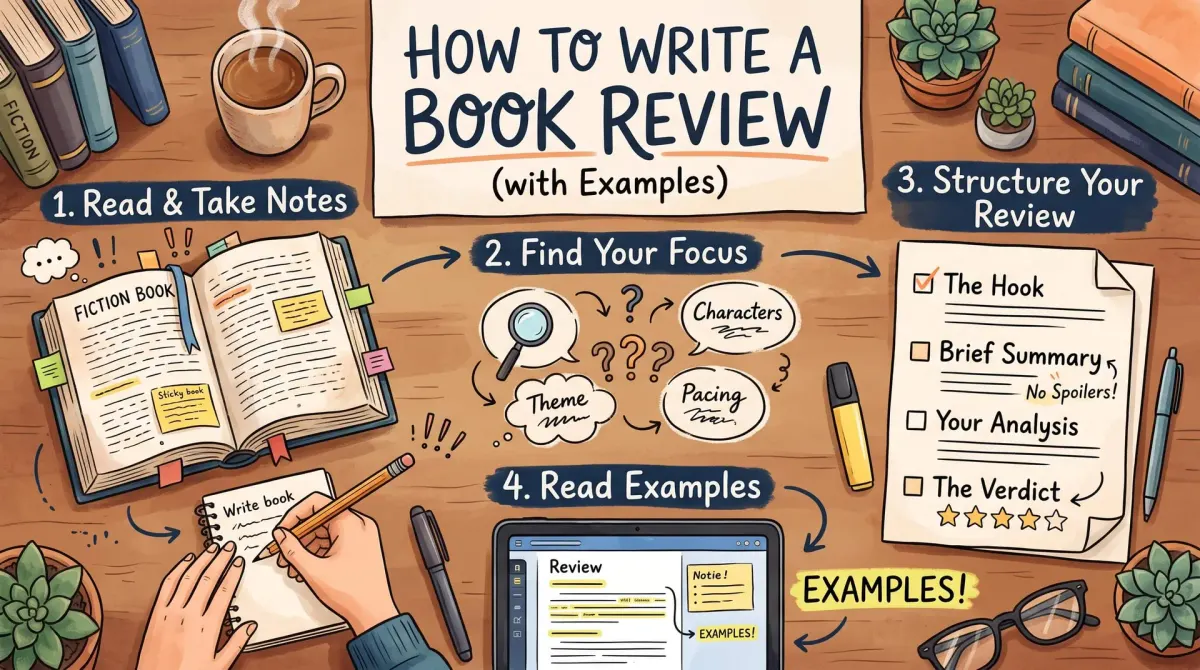
Key takeaway: Take notes while you read. A review written from notes is faster and more accurate.
Follow this order:
- Read the book and take notes.
- Note your first reaction.
- Pick two strengths and one weakness.
- Write the summary without spoilers.
- Add examples for each point.
- Write a short verdict.
- Edit for length and clarity.
While reading, note page numbers for key moments. These help you find examples later.
Pay attention to the author's aim. What does the book try to do? Judge it on that aim, not on a book you wish it had been.
When writing, avoid vague words such as "good" or "boring." Say why. "The dialogue felt stiff because every character spoke in full sentences" is clearer than "bad dialogue."
Keep spoilers out unless you add a clear warning. Never reveal the ending in the opening.
Edit last. Cut repeated points and check names and titles. Read the review aloud once.
Notes for students
Key takeaway: School reviews need a thesis, evidence and correct citations.
If you write a review for class, follow your teacher's rules first. Many assignments ask for a thesis, quotes and a reference list.
Add these elements:
- A thesis: one sentence that states your main judgment
- Evidence: short quotes or page references
- Context: the author's background or the book's place in its genre
- A conclusion: a short summary of your view
Cite quotes in the style your school uses, such as MLA, APA or Chicago. The Purdue Online Writing Lab explains these styles.
Plan your time. Read the book once for pleasure and once with a pen. The second pass gives you quotes, page numbers and patterns. Write the thesis after the second pass, not before.
Use a formal tone. Avoid slang and use the third person unless your teacher allows "I."
Write your own words. Copying from other reviews or tools is plagiarism. Use sources only to support your own analysis.
Notes for authors who want reviews
Key takeaway: Ask for honest reviews. Never pay for positive reviews or write fake ones.
If you are an author, reviews matter. They help readers trust your book. Still, you must follow the rules.
Do:
- Ask early readers to leave an honest review after reading.
- Offer free copies without requiring a positive review.
- Disclose a free copy when you review a book yourself or tell reviewers to do so.
- Read each store's review rules.
Do not:
- Buy reviews or trade positive reviews.
- Write reviews under fake names.
- Pressure readers for five stars.
In the United States, the Federal Trade Commission publishes guidance on endorsements and reviews. Read it and follow your local rules.
A launch plan can include a review step. Our week-by-week guide shows when to ask.
Keep a simple list of reviewers who asked for copies. Thank each one, whether the review is kind or not. Give a clear deadline, but allow enough time to read.
Handle bad reviews calmly. Do not argue in public. Use the feedback to improve your next book.
Review length and tone by place
Key takeaway: Match your review to the place where you post it.
Different places expect different styles. Use this table as a guide.
| Place | Length | Tone |
|---|---|---|
| Store page | 50 to 300 words | Friendly, direct |
| Blog | 400 to 800 words | Personal, detailed |
| School | Set by teacher | Formal, with citations |
These ranges are common guides, not rules. Follow each site's rules.
For store reviews, lead with your verdict in the first line. Many readers see only a few lines. For blogs, add context, such as why you picked the book and what you expected.
Pick a rating scale and explain it. A star rating alone means little. Say what each score means to you. For example, three stars may mean "good, but flawed."
Be kind to the author but honest about the book. Avoid personal attacks. Explain how you felt without insulting the writer.
If you must discuss the ending, add a clear spoiler warning and put that part last. A short quote can strengthen a point. Keep it brief and credit the book. Check names, titles and quotes before you post, since errors weaken trust.
People Also Ask
How long should a book review be?
Most reviews run 300 to 600 words. A store review can be shorter, and a school review may need more. Match the length to your purpose. Cover the summary, your view with examples and a verdict. A short, clear review beats a long, vague one.
Should a book review include spoilers?
No, not unless you add a clear warning. Avoid the ending and major twists. Describe the setup and main conflict instead. Readers use reviews to decide whether to read the book, so spoilers defeat the purpose. Mark any spoiler section clearly.
What is the difference between a book review and a book report?
A book report mainly summarises the plot and characters. A book review adds your judgment and supports it with examples. It tells readers whether the book is worth their time. Teachers often ask for a report to check understanding and a review to check analysis.
Common mistakes
- Retelling the plot. Summaries should be short. The review needs your view.
- Using vague praise. "Great book" tells readers nothing.
- Including spoilers. Warn readers or skip the twist.
- Skipping evidence. Back each claim with a scene or idea.
- Ignoring the author's aim. Judge the book on what it tries to do.
Write your review today
Key takeaway: Use the template, write 300 words and edit once.
Choose a book you finished recently. Fill in the five-part template with notes. Write 300 to 500 words, then edit once and post.
If you are an author, build review requests into your launch and marketing plan.