What a short story is and how long it should be
Key takeaway: A short story is a tight piece of fiction with one main conflict. Length depends on where you plan to send it.
If you ask what is a short story, the answer is simple. It is a brief work of fiction with one event, one conflict and a small cast.
How to write a short story means shaping one character, one conflict and one change into brief fiction. You plan a few scenes and write a rough draft. Then you trim and revise until every line serves the story.
Many writers ask how long is a short story. There is no single rule, but common guides use ranges. The Science Fiction and Fantasy Writers Association uses under 7,500 words for a short story in its awards. Many magazines set their own limits, so read each call for submissions.
Use this table as a rough guide:
| Type | Typical length | Best for |
|---|---|---|
| Flash fiction | Under about 1,000 words | Contests and quick reads |
| Short story | About 1,000 to 7,500 words | Magazines and anthologies |
| Longer short story | 5,000 words and up | Collections |
Short story length depends on the market. A contest may cap you at 2,000 words. A collection has no cap. Choose the length before you start.
Shorter is not easier. Every line must pull weight, and you have little room to waste.
Short story ideas: where to find them
Key takeaway: Ideas come from questions, not from waiting. Ask "what if?" and write down the answers.
New writers often wait for a big idea. Strong short story ideas usually start small: an odd moment, a strong feeling or a "what if."
Try these simple sources:
- A what-if question. What if a lighthouse keeper receives a letter meant for someone else?
- An overheard line. A single sentence in a café can start a plot.
- A strong emotion. Start with fear, shame or hope, and invent a person who feels it.
- A news item. Take a small event and imagine the people behind it.
- A memory. Change names and details, and ask "what if it went differently?"
Keep an ideas file. Add ten ideas each week. Most will be weak, but a few will grow.
Then test an idea with three questions:
- Who wants something?
- What stands in the way?
- What changes by the end?
If you can answer all three in one sentence each, you have a story seed.
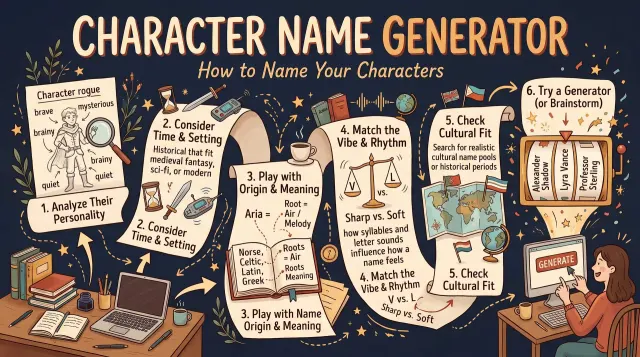
A short story works best with a small cast. Aim for two to four named characters. Our naming guide shows how to pick names that readers can tell apart.
Short story prompts to get you writing
Key takeaway: A prompt gives you a starting point. Add a character, a want and an obstacle to turn it into a plot.
Short story prompts are short ideas or sentences meant to spark a draft. They help when you face a blank page. Use them for practice, then shape the best ones into full stories.
Try these:
- A woman finds a key that fits no door she owns.
- Two strangers share a delayed train and one lies about why they travel.
- A boy keeps a secret that would save his town but break his family.
- The last shop in a village is about to close.
- A character opens a message that was sent ten years ago.
Turn each prompt into a story with this formula: Character + want + obstacle + cost. Take the first prompt. The woman is the character. She wants to know what the key opens. Her sister hid it, which is the obstacle. The answer may end their family bond, which is the cost.
Set a timer for 20 minutes. Write the opening without stopping. If it excites you, keep going. If not, try another prompt.
Do not wait for a perfect prompt. Practice builds skill. Write one short draft a week and your craft will grow.
How to start a short story
Key takeaway: Start late and start close to the problem. Skip the long setup.
Learning how to start a short story is mostly about picking the right moment. Open as close to the conflict as you can.
Use one of these openings:
- A person in action: "Mara hid the letter under the bread."
- A line of dialogue: a sentence that raises a question
- A strong image: a detail that sets mood
- A problem: something already going wrong
Avoid openings that describe the weather, a dream or the character waking up. They rarely hold attention.
Introduce your main character and want within the first paragraph. Show what they want and what they fear. Readers will care once they know.
Keep the first scene short. A tight scene of 300 to 500 words can set up the whole story.
Do not explain the backstory in the first page. Drop in small hints and share more later.
You can also write the opening last. Many writers draft the middle first and craft the first lines after they know the ending.
How to write a short story: 7 steps
Key takeaway: Plan a little, then write the draft quickly. A short outline is enough.
Here is a simple process:
- Write a one-sentence story seed.
- Name your main character and want.
- List three to five scenes.
- Set a word budget for each scene.
- Draft the story in one go.
- Rest, then cut and revise.
- Read it aloud and proofread.
Step four helps you control length. Suppose your target is 3,000 words and you plan three scenes. Then 3,000 ÷ 3 = 1,000 words per scene. If you plan five scenes, 3,000 ÷ 5 = 600 words each.
Use the same rules for every scene: a goal, a conflict and a change. If a scene has none, cut it.
End with a small change. The character should leave the story different from how they entered. The ending can be happy, sad or open, but it should feel earned.
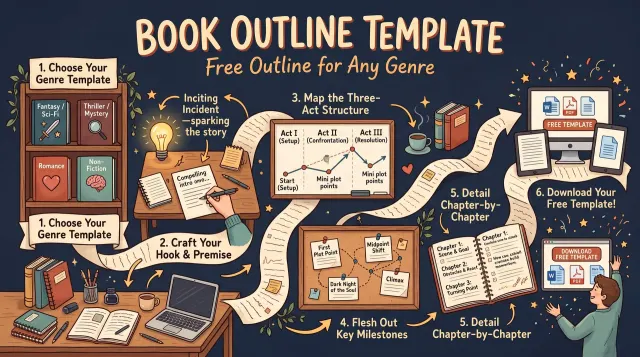
Our outline guide gives a ready format that works for short stories too.
Short story examples to study
Key takeaway: Reading short stories teaches structure faster than any guide. Study how they open, build and end.
Reading is the best teacher. Study stories in your genre and note how each one begins, builds and ends.
Several classic short stories are in the public domain and free to read. Examples include Edgar Allan Poe's "The Tell-Tale Heart" and O. Henry's "The Gift of the Magi." Project Gutenberg hosts many public-domain stories.
When you read, ask these questions:
- What does the character want in the first page?
- Where is the turning point?
- How many scenes are there?
- What changes at the end?
- Which details are most vivid?
Make a quick note for each story. Write the word count, the number of scenes and the one-line ending.
Also read recent stories in magazines in your genre. Each publication has a taste, and reading helps you match it.
Revise, publish and share
Key takeaway: Cut ruthlessly, then pick a path: submit, enter a contest or self-publish.
After your draft, rest for a few days. Then cut anything that does not serve the conflict. Trim openings, repeated phrases and extra explanation. A tight story is better than a long one.
Next, choose a path:
- Submit to magazines. Read each publication's guidelines and send only what they ask for.
- Enter contests. Check word limits and fees.
- Build a collection. Gather several stories and self-publish.
- Share online. Post on your own site to build an audience.
Self-publishing a collection on Amazon KDP has no setup fee. A collection works best when the stories share a theme or tone. Our guide walks through the full process.
Check the platform's official help pages for rules on content and files.
Short story structure at a glance
Key takeaway: A simple split of your word count keeps the story balanced.
Use this sample split for a 3,000-word story:
| Part | Share | Words |
|---|---|---|
| Opening | 10% | 300 |
| Middle | 60% | 1,800 |
| Ending | 30% | 900 |
Check the math: 300 + 1,800 + 900 = 3,000. These shares are a guide, not a rule. Change them to suit your plot.
The middle holds most of the conflict, so it needs the most room. Keep the ending short enough to land with force.
People Also Ask
How long should a short story be?
Many short stories run between 1,000 and 7,500 words. The right length depends on where you submit. Contests and magazines often set a cap, so check their rules. For practice, aim for about 2,000 to 3,000 words, which is enough for three or four scenes.
How do you end a short story?
End on a small change in your main character. Return to an image or line from the opening, or show a choice with a cost. Avoid sudden twists that do not fit the story. The ending should feel earned and leave readers with a clear feeling.
Can I publish a short story I wrote?
Yes. You can submit it to magazines, enter contests, post it on your website or include it in a collection. Read each publisher's rules about rights and prior publication. If you self-publish, Amazon KDP has no setup fee. Plan before you send.
Common mistakes
- Starting too early. Open near the conflict, not with background.
- Adding too many characters. A short story has little room for a large cast.
- Skipping a clear want. Without a goal, the plot drifts.
- Ending with no change. Readers need to feel something shifted.
- Not cutting. Trim every line that does not serve the story.
Write your first story this week
Key takeaway: Pick a prompt, set a word budget and finish a rough draft in one sitting.
Choose one prompt from this guide. Write a one-sentence seed, plan three scenes and set a word budget. Then write the draft in a single session.
When you have several finished stories, you can explore a collection. A strong title helps it stand out.