What is a logline?
Key takeaway: A logline is a one- or two-sentence pitch that names the lead, the goal and the obstacle.
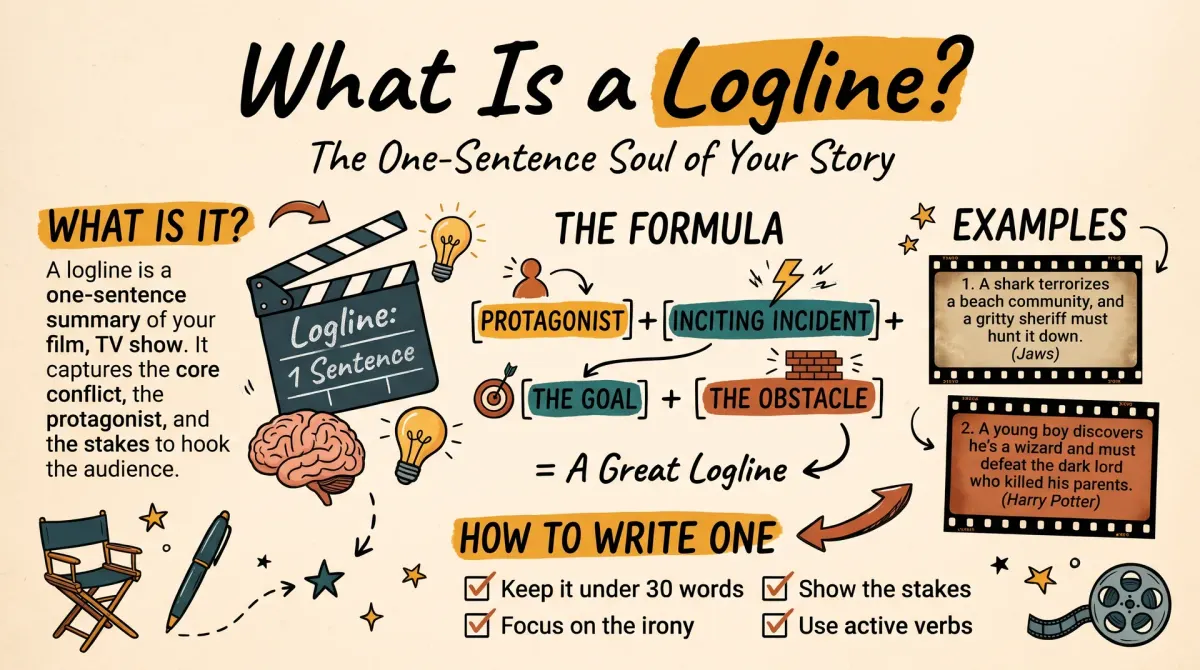
A logline is a story summary in one or two sentences. It names the lead character, the central problem or goal, and the force that stands in the way. It sums up the plot in about 25 to 35 words and is used to pitch a story quickly.
The word comes from film and TV, where short summaries listed a script in a log. Today novelists use loglines too.
Merriam-Webster lists the term.
A logline has four parts:
- The lead. Who is the story about? Add one trait.
- The inciting event. What starts the story?
- The goal. What does the lead want?
- The obstacle or stakes. What stands in the way, and what is lost if they fail?
Many loglines also hint at irony. A hitman who wants to retire, or a cook who has lost her sense of taste. The gap between the lead and the problem makes the line interesting.
A logline is not a summary of the whole plot. It does not give the ending. It sells the premise.
A logline is also a test. If you cannot write one, your story may lack a clear goal or conflict. Many writers use it to fix a draft before they edit.
If you need a fuller summary of the plot, a synopsis guide covers it.
Logline vs tagline vs synopsis
Key takeaway: The three vary in length and purpose. Use each in the right place.
| Term | Length | Use |
|---|---|---|
| Tagline | A short line | Hooks browsing readers |
| Logline | One or two sentences | Pitches the plot to the industry |
| Synopsis | One to two pages | Summarizes the full plot with ending |
A tagline is a teaser. It may not name a character.
A logline is a pitch. It names the lead, the goal and the obstacle. It does not give the ending.
A synopsis tells the whole story, including the ending. Agents and editors read it to see whether the plot holds.
Think of them as a ladder. The logline is the top rung. The synopsis is the middle. The full book is the base. Each step adds detail.
Write the logline first, because it forces you to know your core. Then the other forms are easier.
Anatomy of a logline: a word-count breakdown
Key takeaway: Break a logline into parts and count the words. Each part has a job.
Most pages say "include the lead, goal and stakes". Here is a real breakdown.
Here is an original logline for a novel:
A retired lighthouse keeper finds a message from his missing daughter. To reach her, he must cross a storm-wracked sea before the tide closes the only path.
Now split it into parts and count the words.
| Part | Text | Words |
|---|---|---|
| Lead | A retired lighthouse keeper | 4 |
| Inciting event | finds a message from his missing daughter | 7 |
| Goal | To reach her | 3 |
| Action | he must cross a storm-wracked sea | 6 |
| Stakes | before the tide closes the only path | 7 |
Add the words: 4 + 7 + 3 + 6 + 7 = 27 words.
That is inside the common range of 25 to 35 words. Notice how each part pulls weight.
- The lead has one trait. "Retired" suggests age and a past.
- The event is concrete. A message is something you can see.
- The goal is personal. He wants his daughter.
- The stakes have a clock. The tide gives a deadline.
Share of the line by part:
- Lead: 4 ÷ 27 = about 15 percent
- Event: 7 ÷ 27 = about 26 percent
- Goal and action: 9 ÷ 27 = about 33 percent
- Stakes: 7 ÷ 27 = about 26 percent
The shares are close to balanced. A logline that spends 20 words on the lead and 3 on the stakes feels lopsided. Check your own balance the same way.
Avoid names. Say "a retired lighthouse keeper", not "Tom Brandt". Names mean nothing to a stranger. A trait and a role paint a picture.
From weak to strong: a rewrite
Key takeaway: Replace vague words with a lead, an event and a deadline.
Take a weak logline.
A man goes on a journey to find his daughter and learns about himself and the meaning of family.
Count the words: 19. What is wrong?
- No trait. "A man" could be anyone.
- No event. "Goes on a journey" has no trigger.
- No obstacle. Nothing stands in his way.
- Vague theme. "Learns about himself" is a result, not a plot.
- No stakes. Nothing is lost if he fails.
Now build the strong version in three passes.
Pass one: add a trait and an event. "A retired lighthouse keeper finds a message from his missing daughter."
Pass two: add an obstacle. "He must cross a storm-wracked sea."
Pass three: add stakes and a clock. "Before the tide closes the only path."
The result is the 27-word logline above. It has more words than the weak one, which had 19. Yet it says far more. Length is not the goal. Clarity is.
Keep the theme out of the logline. Do not write "learns the meaning of family". The theme lives in the book. The logline sells the plot.
Test your own logline with these questions:
- Can a stranger picture the lead?
- Is there a clear goal?
- Is there a force that blocks it?
- Do the stakes matter?
- Is it under about 35 words?
If any answer is no, revise.
How to write a logline step by step
Key takeaway: Start with the parts, then join and trim.
Use these steps.
- Name the lead and one trait.
- State the event that starts the story.
- State the goal in one clause.
- Name the opposing force or stakes.
- Combine the parts into one or two sentences.
- Cut to 35 words or fewer.
- Remove names and backstory.
Step one asks for a trait that creates tension. "A shy translator" is better than "a woman". Pick a trait that clashes with the story.
Step two names a trigger. Something must happen. A letter arrives, a body is found, a door opens.
Step four is where many loglines fail. Name a force, not just a hope. The obstacle can be a person, a place, a rule or time.
Step six is a trim. Cut adjectives. Cut extra clauses. Cut any detail the listener does not need to grasp the premise.
Then read the line aloud. If you stumble, simplify. A logline should be easy to say in one breath.
Now test it on a friend. Ask them to repeat what the story is about. If they get it right, the line works.
Logline examples by genre
Key takeaway: Each genre bends the same formula. The lead, goal and obstacle stay in place.
Here are original loglines, written to show the pattern.
- Romance: A shy translator must pose as her boss's fiancée for one weekend. But the groom's brother can read her lies.
- Thriller: A night-shift nurse realizes her patient is a witness the mob wants silenced. She has until dawn to move him.
- Fantasy: A thief inherits a cursed crown. To lift the curse, she must steal it back from the dragon that made it.
Check the word counts. The romance and thriller loglines have 20 words each. The fantasy logline has 21.
All three sit just under the common range of 25 to 35 words. That is fine for a first pass. Add one more detail of stakes if you want more weight.
Each one has the same parts. The lead has a trait, such as "shy" or "night-shift". An event starts the story. A goal drives the lead. An obstacle blocks the way.
Notice what is missing. There are no names, no backstory and no endings. The lines sell the premise, not the plot.
Where to use a logline
Key takeaway: Use the logline to pitch, plan and market.
A logline has many uses.
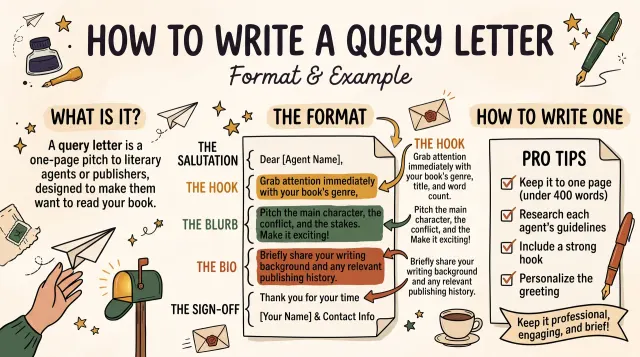
- Query letter. The logline often opens the hook paragraph.
- Pitch. Say it at a conference or in an email.
- Planning. Use it to stay on track while drafting.
- Marketing. A trimmed version can become a tagline or ad hook.
- Book description. The first sentence of your blurb can echo it.
If you plan to seek an agent, a book proposal or query letter is the next step. For nonfiction, a proposal is common.
Choosing between a traditional deal and self-publishing is a big decision. A guide compares the routes.
If you self-publish, you will not pitch an agent. Yet the logline still helps. It sharpens your description and your ads.
A quick plan helps you place it. Write your logline. Trim it to a tagline. Expand it to a blurb. Use each in the right place.
People Also Ask
How long should a logline be?
Most loglines run one or two sentences and about 25 to 35 words. A 27-word logline can name the lead, the event, the goal and the stakes. If your line passes 40 words, trim it. Clarity matters more than length.
What is the difference between a logline and a synopsis?
A logline is one or two sentences that pitch the premise and do not reveal the ending. A synopsis runs one to two pages and sums up the full plot, including the ending. Agents use loglines to judge an idea fast and synopses to check the plot.
Do novels need a logline?
A novel does not need one to be published, but a logline helps. It tests whether your story has a clear goal and conflict. It also supports query letters, pitches and marketing copy. Many writers draft a logline before they write the book.
Common mistakes
- Using names instead of traits.
- Leaving out the obstacle.
- Writing the theme instead of the plot.
- Giving away the ending.
- Packing in too many characters.
Your next step: write your logline in three passes
Write your lead with one trait and the inciting event. Add the goal and the obstacle. Add the stakes and a clock. Count the words by part, and trim to about 35 or fewer.
Then use it to write your query letter or description.