What is a query letter?
Key takeaway: A query letter is a one-page pitch that asks an agent to read your book.
Merriam-Webster lists the word "query" among its entries.
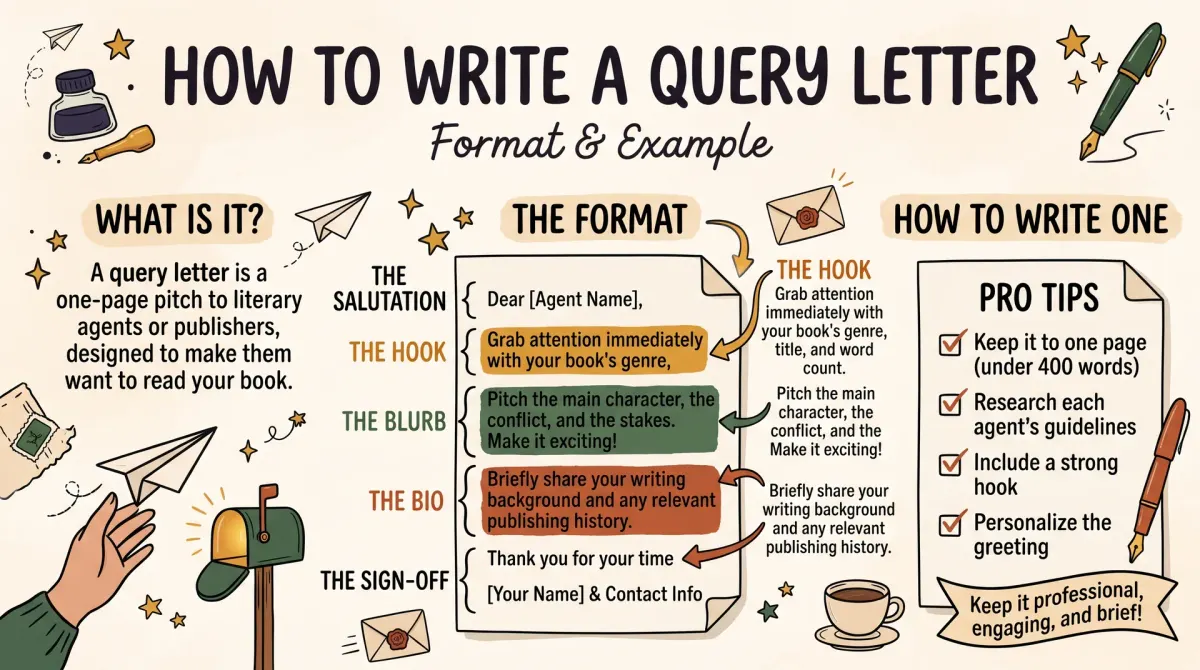
A query letter introduces you and your book. You send it before the full manuscript. If the agent likes it, they ask for pages, a synopsis or the whole book.
The letter has three jobs:
- Hook. Make the agent curious about the story.
- Prove fit. Show that the book matches the agent's list.
- Show professionalism. Give the facts agents expect, such as genre and word count.
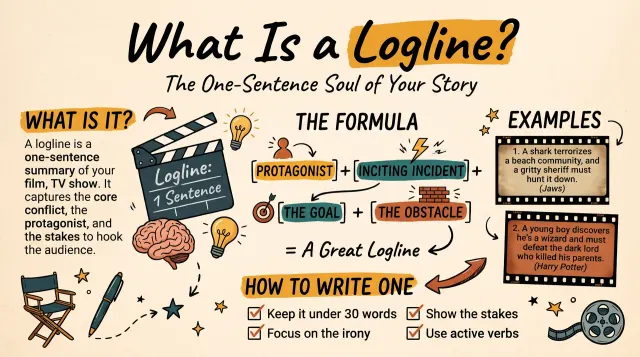
A query letter differs from other forms. A synopsis sums up the full plot with the ending. A proposal sells a nonfiction book with market data and sample chapters. A logline is one or two sentences, often used in the hook.
For the plot summary agents may request, see the synopsis guide.
Most fiction authors query with a finished manuscript. Nonfiction authors usually query with a proposal. Follow each agent's guidelines.
The structure of a query letter: a word budget
Key takeaway: Plan the letter in four parts and give each a word budget.
Most pages say "keep it short". A budget gives you numbers.
Say your target is 300 words.
| Part | Words | Job |
|---|---|---|
| Hook | 90 | Pitch the premise |
| Book details | 120 | Title, genre, length, plot detail |
| Bio | 50 | Credits and why you |
| Close | 40 | Thanks and next steps |
Check the total: 90 + 120 + 50 + 40 = 300 words.
Share by part:
- Hook: 90 ÷ 300 = 30 percent
- Book details: 120 ÷ 300 = 40 percent
- Bio: 50 ÷ 300 = about 17 percent
- Close: 40 ÷ 300 = about 13 percent
Most of the letter, 70 percent, sells the story. Only 17 percent covers you. That is a good balance for a first-time author.
Let us look at each part.
The hook (about 90 words). Open with the lead, the problem and the stakes. Make the agent want to know what happens. Skip long setup. Some writers open with a one-line personalization instead, such as why they chose this agent.
The book details (about 120 words). State the title, genre and word count. Round the word count to the nearest thousand. Add a short paragraph with more plot detail and the central conflict. Do not give the ending.
The bio (about 50 words). Share relevant credits, such as prior publications, awards or a related job. If you have none, keep it short: your name, where you live and one fact tied to the book. A guide helps with bios.
The close (about 40 words). Thank the agent. Say you can send the pages or proposal as requested. Add your contact details.
These numbers are guides. Some letters run 250 words and some 400.
A fill-in template
Key takeaway: A template gives you a clean frame. Fill it with your own details.
Here is a simple template. Replace the brackets with your details.
Dear [Agent's name],
[Hook: one to three sentences that name the lead, the problem and the stakes.]
[TITLE] is a [genre] novel of [word count] words. [One short paragraph with more detail about the conflict and what is at risk. Do not give the ending.]
[One sentence on why you chose this agent, such as a book on their list that your story resembles.]
[Bio: one or two sentences with credits or relevant background.]
Thank you for your time and consideration. [State what you can send, as requested.]
Sincerely, [Your name] [Email and phone]
Fit your own book into this frame. Keep the language plain.
A few notes on the template:
- Use the agent's name. Check the spelling.
- Use a comp title carefully. A comparison to a recent book in your genre can help. Avoid claims like "the next big bestseller".
- Keep the tone professional. Be warm, but do not be casual.
- Do not add a long plot summary. If the agent wants one, they will ask.
For length norms by genre, see the word count guide. Agents may reject a manuscript that is far too long or short for its category.
How to write a query letter step by step
Key takeaway: Research first, write second, proofread last.
Use these steps.
- Research agents who represent your genre.
- Read their submission rules.
- Write a one-paragraph hook.
- Add title, genre and word count.
- Write a short author bio.
- Close with thanks and next steps.
- Proofread and send as asked.
Step one saves time. Sending to the wrong agents wastes effort. Look at an agent's current list and recent sales. Pick agents who represent books like yours.
Step two prevents mistakes. Some agents want a query only. Others ask for the first pages in the body of the email. Follow the rules to the letter.
Step three is the hardest. Draft your hook as a logline first. Then expand it to a few sentences. A tight hook can open the door.
Step five deserves care. Do not list unrelated jobs. Include only what helps your case.
Step seven is the polish. Read the letter aloud. Check the agent's name. Check the title. Check the word count. A small error can hurt your chance.
Track your submissions in a log. Note the date, the agent and the reply. Many writers send queries in small batches of 5 to 10 and adjust the letter based on results. A simple rule helps you read the results. If 10 queries bring 0 requests, the hook needs work. If 10 queries bring 3 requests, the hook works, and the pages may need work. That is a hit rate of 3 ÷ 10 = 30 percent.
The pre-send checklist
Key takeaway: Score your letter before you send it. Fix every no.
Run this check. Give one point for each yes.
- Is the hook clear in three sentences?
- Does the letter name the lead, the problem and the stakes?
- Are the title, genre and word count present?
- Is the bio short and relevant?
- Is the letter between 250 and 400 words?
- Is the agent's name correct?
- Did you follow the submission rules?
- Is the letter free of typos?
The top score is 8.
Here is a worked example.
- Clear hook: yes. 1 point
- Lead, problem and stakes named: yes. 1 point
- Title, genre and word count present: yes. 1 point
- Short bio: yes. 1 point
- Length of 250 to 400 words: no, it runs 520. 0 points
- Right agent name: yes. 1 point
- Rules followed: yes. 1 point
- Free of typos: no, there is one typo. 0 points
Six yes answers give 6 points out of 8.
A score of 6 means you have work to do. Cut the letter from 520 words to about 300, since 520 − 300 = 220 words to remove. Fix the typo. Then recheck.
Send only at 8 out of 8.
A last note on scams. Real agents earn money by selling your book, not by charging you fees. Be careful with anyone who asks for payment up front. Writers' organizations such as SFWA publish warnings and advice.
What happens after you send it
Key takeaway: Expect a wait and many rejections. Keep writing while you wait.
After you send a query, you wait. Replies can take weeks or months. Some agents do not reply unless they are interested.
Here is a simple plan.
- Send in batches. Send 5 to 10 queries at a time.
- Track responses. Note each date and reply.
- Adjust. If you get no requests from 10 queries, revise the hook.
- Follow up once. If the agent's guidelines allow, send a polite note after the stated wait.
- Keep writing. Start your next book while you wait.
Rejection is normal. Many strong books are turned down many times. It does not always mean the book is bad. It may mean a poor fit.
If the agent asks for pages, send what they ask for and nothing more. If an offer comes, take time to review the contract.
Traditional publishing is one path. Self-publishing is another. A guide compares the routes so you can decide.
People Also Ask
How long should a query letter be?
Most query letters run about 250 to 400 words and fit on one page. A 300-word budget might use 90 words for the hook and 120 for book details. It might give 50 to the bio and 40 to the close. Always check each agent's guidelines.
What should a query letter include?
A query letter should include a short hook and the title, genre and word count. Add a brief plot paragraph and a short author bio. It should also include a polite close and your contact details. Add a line on why you chose the agent. Do not include the ending.
Do you send a synopsis with a query letter?
Only if the agent asks. Many agents request a query letter first. Others ask for a synopsis or sample pages with the query. Read each agent's submission rules and send exactly what they request. A synopsis sums up the full plot, including the ending.
Common mistakes
- Sending a mass email with no personalization.
- Writing a plot summary instead of a hook.
- Making the letter too long.
- Ignoring submission rules.
- Claiming the book is the next big bestseller.
Your next step: draft your 300-word letter
Write your hook as a logline. Then fill in the template with your title, genre and word count. Keep to the 300-word budget by part. Run the pre-send checklist and send only at 8 out of 8.
If you plan to self-publish instead, a checklist helps you prepare.