What is editing?
Key takeaway: Editing improves a manuscript in layers, from big ideas to tiny details.
Merriam-Webster gives the dictionary meaning.
Editing is more than fixing mistakes. It shapes a draft into a stronger book. A good editor sees problems the author cannot, because the author is too close to the text.
Think of editing as a set of passes. Each pass looks at a different level.
- The story level. Plot, characters, pacing and structure.
- The sentence level. Voice, flow and word choice.
- The rule level. Grammar, spelling, punctuation and consistency.
- The final level. Typos and layout errors.
Each type of editing matches a level. If you start at the wrong level, you waste effort.
The four main types of editing
Key takeaway: Each type has a clear focus. Know what you need before you hire.
| Type | Focus | Stage |
|---|---|---|
| Developmental editing | Story and structure | After the first draft |
| Line editing | Style and flow | After revision |
| Copyediting | Grammar and consistency | Before layout |
| Proofreading | Final typos | After layout |
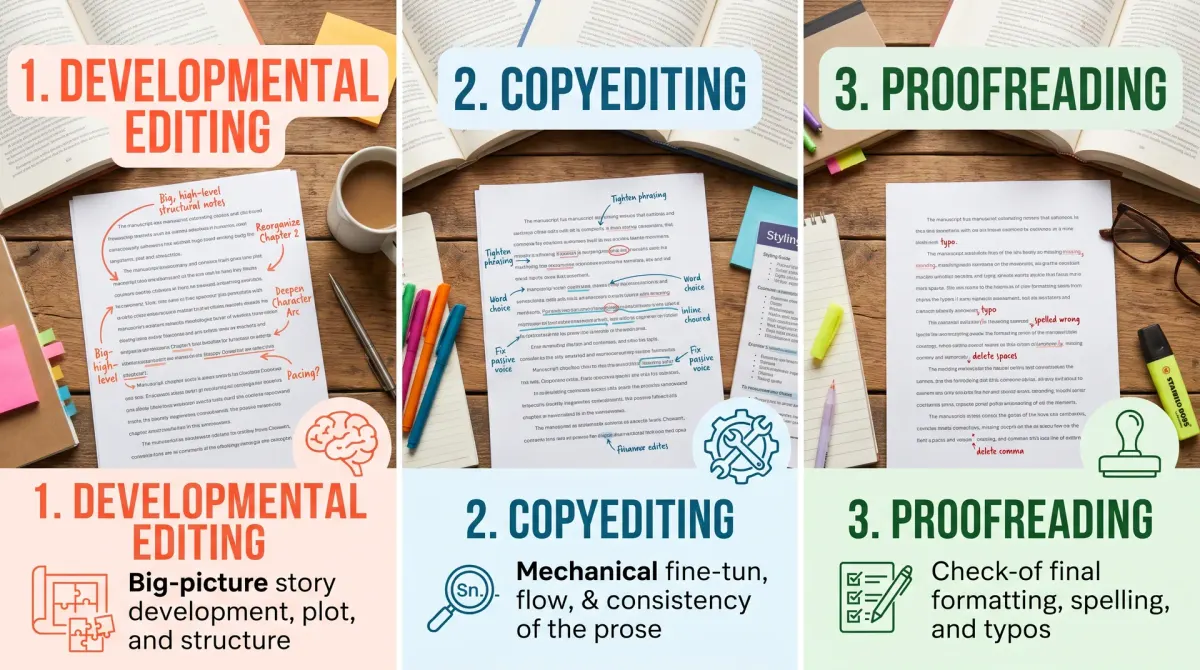
Developmental editing. This is the big-picture edit. The editor looks at plot, character arcs, pacing, structure and theme. In nonfiction, the editor checks the argument, the order and the gaps. The result is often a detailed report and notes on the manuscript.
Line editing. This is the style edit. The editor works sentence by sentence. They improve voice, rhythm and clarity. They cut wordiness and fix awkward phrases.
Copyediting. This is the rules edit. The editor fixes grammar, spelling, punctuation and usage. They also check consistency, such as character names, dates and spelling choices. Many follow a style guide, such as the Chicago Manual of Style.
Proofreading. This is the final check. The proofreader reads the formatted pages and catches typos, spacing errors and layout slips. It is not a time for big changes.
Some people also use the term manuscript assessment. It is a lighter, report-only version of a developmental edit. It tells you what to fix but does not mark the text.
Other related roles include:
- Beta readers. Test readers who give feedback on the story.
- Sensitivity readers. Readers who check for harmful or inaccurate portrayals.
- Fact-checkers. They check claims in nonfiction.
The right order of editing
Key takeaway: Edit from big to small. Never polish text you may cut.
Order matters. Here is the usual path.
- Self-edit the first draft.
- Get feedback from beta readers.
- Do a developmental edit.
- Revise the manuscript.
- Do a line edit.
- Do a copyedit.
- Format the book.
- Proofread the formatted pages.
Why this order? A developmental edit may cut a whole chapter. If you copyedited that chapter first, you paid to polish words that vanished.
The same logic applies to proofreading. Proofread after formatting, not before. Formatting can add errors, such as odd line breaks or missing text. A proofread of the final pages catches them.
If you plan to format the book yourself or hire help, see the formatting guide.
Some editors combine services. A "line and copyedit" is common. Ask what is included, since names vary.
An example budget for an 80,000-word novel
Key takeaway: Add up each type. The total may be larger than you expect.
Most pages say "costs vary". Here is a worked example.
Rates differ widely by editor, genre and skill. The numbers below are examples, not quotes.
Say you pay these per-word rates for an 80,000-word novel.
| Type | Rate per word | Cost |
|---|---|---|
| Developmental | $0.03 | $2,400 |
| Copyedit | $0.02 | $1,600 |
| Proofread | $0.01 | $800 |
Check the math:
- Developmental: 80,000 × $0.03 = $2,400
- Copyedit: 80,000 × $0.02 = $1,600
- Proofread: 80,000 × $0.01 = $800
Total: $2,400 + $1,600 + $800 = $4,800.
That is a big sum for a first-time author. Many writers cannot afford every type.
Now find the cost per 1,000 words.
- $4,800 ÷ 80 = $60 per 1,000 words
So each 1,000 words of your book costs $60 across all three steps.
Where can you save?
- Self-edit well. A cleaner draft costs less to edit.
- Use beta readers. They can replace a developmental edit for some writers.
- Skip line editing. Combine it with the copyedit.
- Never skip the proofread. It is the cheapest and catches embarrassing errors.
A rough rule: if you can afford only one paid edit, many authors choose a copyedit. Yet a book with a weak plot needs a story edit first. Know your weak points.
A wider budget guide covers other costs, such as cover design and formatting.
How to edit your book step by step
Key takeaway: Rest, self-edit, test, hire, revise and proof. Do it in order.
Use these steps.
- Let the draft rest for two weeks.
- Do a big-picture self-edit.
- Get beta reader feedback.
- Hire a developmental editor if needed.
- Revise, then hire a copyeditor.
- Format the book, then proofread.
- Fix final errors before publishing.
Step one gives you fresh eyes. Put the draft away. Work on something else. When you return, problems will stand out.
Step two is a list of checks. Read the whole book as a reader. Ask these questions:
- Does the story start in the right place?
- Does each scene move the plot?
- Do the characters want something?
- Does the ending feel earned?
- Is the pacing even?
Step three tests your book on real readers. Give them clear questions. Ask where they felt bored or lost.
Step four is optional but powerful. A developmental editor gives a trained view of structure. If your beta readers agree on a problem, hire help.
Step six matters because formatting can add errors. A final read of the finished pages is your last defense.
Do you need every type?
Key takeaway: Match the edit to the weakness in your draft.
Not every book needs all four types. Use this quick guide.
- Story problems. A weak plot, flat characters or slow pacing point to a developmental edit.
- Clunky prose. Wordy or uneven sentences point to a line edit.
- Messy mechanics. Frequent grammar slips and inconsistent names point to a copyedit.
- Clean text, ready to publish. A proofread may be enough.
Score your draft to decide. Give each area a mark from 1 (weak) to 5 (strong): story, style and mechanics.
Say your marks are story 2, style 4 and mechanics 3. Story is the weakest. Start with a developmental edit or strong beta feedback. Style at 4 may need only light polish. Mechanics at 3 needs a copyedit.
Add the marks: 2 + 4 + 3 = 9 out of 15. A total under 10 suggests you need more than one paid edit. A total of 13 or more suggests a copyedit and proofread may be enough.
These cutoffs are a rough guide, not a rule. Ask an editor for a sample edit to confirm.
How to choose an editor
Key takeaway: Ask for a sample edit, references and a clear contract.
Hiring an editor is a trust decision. Use these checks.
- Genre fit. Choose an editor who knows your genre.
- Sample edit. Many editors offer a short free or paid sample.
- References. Ask for clients or testimonials.
- Clear scope. Get the services, word count, rounds of revision and deadline in writing.
- Style guide. Ask which guide they use.
- Price and payment. Agree on the total and the schedule.
- Communication. Check how quickly they reply.
Be careful with offers that seem too cheap or too good. Check reviews and credentials. Professional editing groups can help you find qualified editors.
Ask what happens if you disagree with a change. A good editor suggests, and you decide. The book is yours.
Keep your own checklist for the final steps before you publish.
Self-editing tips
Key takeaway: Fix what you can before a paid edit. A clean draft saves money.
You can lower costs by doing a thorough self-edit.
- Read aloud. Your ear catches clumsy lines.
- Change the format. Print the draft or view it on a different device.
- Search for habit words. Words like "just", "very" and "really" can pile up.
- Check names and dates. A list of facts prevents errors.
- Cut 10 percent. Most drafts have extra words.
- Run a spell check. But do not rely on it alone.
Here is a quick example of a 10 percent cut. If your draft has 88,000 words, cut 8,800 words to reach 79,200. Check: 88,000 × 0.10 = 8,800, and 88,000 − 8,800 = 79,200.
Fewer words also lower your per-word cost. At $0.02 per word, a copyedit of 88,000 words costs $1,760. At 79,200 words it costs $1,584. The saving is $1,760 − $1,584 = $176.
Self-editing tools can flag issues, but they cannot judge story. Use them as helpers, not as editors.
People Also Ask
What are the four types of editing?
The four main types are developmental editing, line editing, copyediting and proofreading. Developmental editing fixes story and structure. Line editing polishes style and flow. Copyediting fixes grammar and consistency, and proofreading catches final typos. Do them in that order, from big changes to small ones.
What is the difference between copyediting and proofreading?
Copyediting fixes grammar, spelling, punctuation, usage and consistency in the manuscript, before layout. Proofreading is the final check of the formatted pages and catches typos, spacing and layout errors. Copyediting comes first. Proofreading is the last step before you publish.
Do I need a developmental editor?
Not always. If your beta readers love the story and find no big problems, you may skip it. If readers report plot holes, weak characters or pacing trouble, a developmental editor can help. It is the most expensive type, so use feedback to decide.
Common mistakes
- Hiring a proofreader to fix story problems.
- Editing in the wrong order.
- Skipping the final proofread of the formatted book.
- Hiring without a sample or a contract.
- Sending a rough draft to a paid editor.
Your next step: price your edit
Count your words. Pick the types you need. Multiply each by a per-word rate from quotes you receive. Add the totals and compare with your budget. Then decide what to self-edit.
When your plan is set, work through the steps before you publish.