What are character traits?
Key takeaway: A character trait is a lasting quality that shapes how someone acts.
Character traits list is a set of words naming lasting qualities in a person, such as honest, stubborn or curious. Writers use it to plan how a character thinks, feels and acts. It keeps behavior steady across the whole story.
If you ask what are character traits, think of habits of mind and action. A trait is not a mood. A mood changes in an hour. A trait shows up across many situations.
A trait is also not a physical feature. Tall and red-haired are looks. Patient and sarcastic are traits. Looks help the reader picture a character. Traits help the reader understand them.
Character traits examples include honest, generous, impatient, loyal, secretive and ambitious. Each word points to a pattern of behavior.
Traits matter for three reasons.
- They make characters feel consistent.
- They create choices, since traits push people toward some actions.
- They create conflict when two traits pull in different directions.
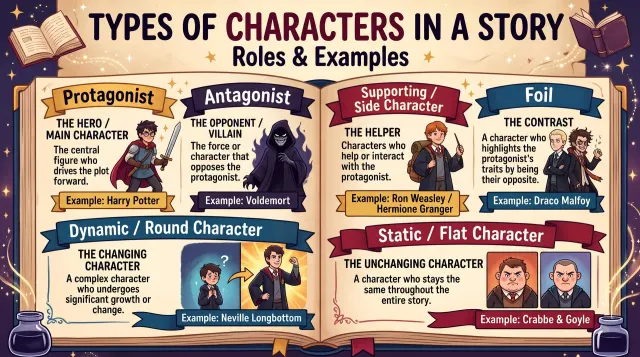
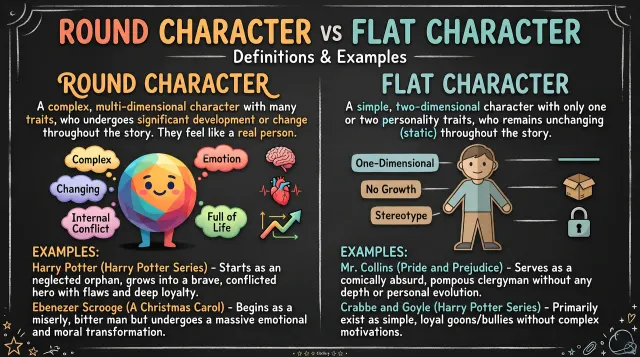
The more a character matters to the plot, the more traits they need. E.M. Forster, in a 1927 book, described flat characters as built around one idea and round characters as complex. A lead needs several traits to be round.
Positive character traits list
Key takeaway: Positive traits make characters admirable, but they need limits to feel real.
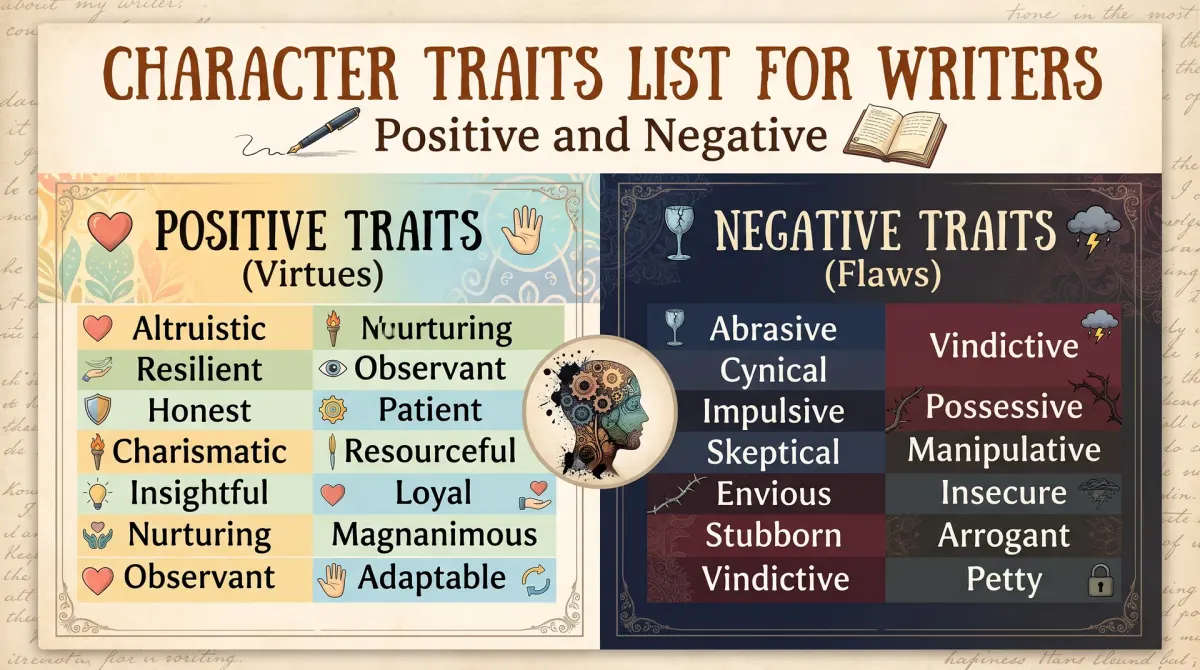
Here is a list of positive character traits. Use it to find the exact word you need.
| Group | Traits | Shows up as |
|---|---|---|
| Moral | honest, fair, loyal, humble | Telling the truth when it costs |
| Social | warm, generous, patient, friendly | Helping without being asked |
| Mental | curious, creative, wise, focused | Asking the next question |
| Drive | brave, determined, resilient, ambitious | Trying again after failure |
More positive traits to consider:
- Kind, thoughtful, dependable, calm
- Optimistic, adaptable, resourceful, disciplined
- Compassionate, courageous, honorable, persistent
- Witty, charming, open-minded, protective
Use these words with care. A character with only positive traits feels flat and unreal. Readers want to see limits.
The trick is to pair every strength with a cost. A brave character may take foolish risks. A loyal character may ignore warning signs. A determined character may refuse help. The cost makes the trait feel true.
Also vary the words. Do not call every hero "brave." Choose resilient, protective or stubborn instead. The right word adds precision.
Negative character traits list
Key takeaway: Negative traits create conflict and make characters feel human.
Here is a list of negative character traits. These are the traits that drive trouble.
| Group | Traits | Shows up as |
|---|---|---|
| Moral | dishonest, greedy, cruel, vain | Lying for gain |
| Social | rude, jealous, cold, manipulative | Using people |
| Mental | closed-minded, careless, lazy, reckless | Skipping the hard step |
| Drive | impatient, stubborn, fearful, bitter | Refusing to change |
More negative traits to consider:
- Arrogant, selfish, impulsive, bossy
- Secretive, petty, defensive, anxious
- Controlling, indecisive, forgetful, cynical
- Resentful, gullible, harsh, restless
You may also search bad character traits. The word "bad" is too broad for fiction. A trait is not bad in itself. Stubborn can be a flaw in one scene and a strength in another.
Negative traits are plot fuel. A reckless character jumps into danger. A jealous character makes a rival. An anxious character avoids the one thing they must face.
Give your lead at least one negative trait that hurts them. The hurt should cost something in the story. Without cost, the trait is only decoration.
Neutral traits and trait pairs that clash
Key takeaway: Pairs of clashing traits are the fastest way to build a round character.
Some traits are neither good nor bad. Their value depends on the situation.
- Quiet, private, independent, practical
- Competitive, traditional, intense, serious
- Talkative, emotional, ambitious, skeptical
Neutral traits work well for side characters because they add flavor without a clear moral pull.
Now the most useful tool: clashing pairs. A pair of traits that pull against each other creates a round character in one line.
| Trait pair | The tension | A character who has it |
|---|---|---|
| Generous and secretive | Gives, but hides why | A donor with a past |
| Brave and anxious | Acts despite fear | A soldier who shakes |
| Honest and ambitious | Truth versus winning | A reporter with a scoop |
| Loyal and resentful | Stays, but bitter | A sibling in a family firm |
Each pair gives a built-in scene. The reporter must decide whether to publish a true story that hurts a friend. The soldier must act while shaking.
Pick one clashing pair for each major character. The pair then drives your scenes well. That alone makes them feel more real than a list of single words.
How to pick character traits: steps
Key takeaway: Choose five traits per major character, then test them against the plot.
Follow these steps.
- Write the character's role in the plot.
- List ten possible traits.
- Cut to five that fit the role.
- Make sure two of them clash.
- Add one trait that hurts them.
- Write one action for each trait.
- Check that the plot tests each one.
Here is a worked example for a story with 4 major characters.
- Traits per major character: 5.
- Total traits to plan: 4 × 5 = 20 traits.
- Of those, clashing pairs: 4 characters × 1 pair each = 4 pairs, which is 8 traits.
- Remaining traits: 20 − 8 = 12 single traits.
So you plan 20 traits in total, with 8 of them in clashing pairs and 12 as single traits. The numbers are a planning aid, not a rule.
For side characters, use one or two traits. That keeps them flat and quick to read.
Step seven matters most. A trait that the plot never tests is wasted. If your lead is brave, the plot must put them in a place where bravery costs something.
Show the trait, do not name it
Key takeaway: Readers believe what they see a character do.
Naming a trait is weak. "Sam was generous" tells the reader what to think. A scene shows it.
Compare these pairs.
| Told | Shown |
|---|---|
| Sam was generous. | Sam handed over his coat and walked home in the rain. |
| Mara was stubborn. | Mara rebuilt the wall a third time, ignoring the crew. |
| Dale was secretive. | Dale closed the ledger when anyone entered. |
Each shown line gives the reader proof. It also gives room to infer. Readers enjoy working out who a person is.
Use this check on each trait you list. Write one sentence of action that proves it. If you cannot, the trait may be too vague. Pick a sharper word.
Also watch for repetition. If you show the same trait the same way five times, readers will tire. Vary the setting, the stakes and the cost.
Finally, let traits change under pressure. A calm character may snap once. That moment tells readers more than ten calm scenes.
Match traits to your genre
Key takeaway: Genre sets expectations, but surprising traits make a character memorable.
Different genres lean on different traits. This is a guide, not a rule.
- Mystery. Curious, observant and persistent leads fit well.
- Romance. Warm, guarded or stubborn leads create natural tension.
- Thriller. Determined, resourceful and reckless leads drive pace.
- Fantasy. Brave, loyal and ambitious leads suit big quests.
- Memoir and nonfiction. Honest and reflective voices build trust.
Then add one trait that breaks the pattern. A curious detective who is afraid of heights is more interesting than a curious detective alone. The surprise makes the character yours.
Check your list against the genre once. If every trait feels expected, swap one for a trait that adds friction.
People Also Ask
What are good character traits for a protagonist?
Good traits for a protagonist include determined, curious, resourceful, loyal and brave. But pair each with a cost, such as reckless or secretive. A lead with only strengths feels flat. Mix positive and negative traits, and include at least one clashing pair to create depth.
How many character traits should a character have?
About five for a major character is a practical target. Include a mix of positive and negative traits, and at least one clashing pair. Side characters need only one or two. Add more only if the plot tests them. A long list of untested traits adds little.
What is the difference between a trait and a flaw?
A trait is any lasting quality, positive, negative or neutral. A flaw is a negative trait that causes problems for the character or others. Every flaw is a trait, but not every trait is a flaw. Flaws drive conflict, so give your lead at least one.
Common mistakes
Key takeaway: Most trait problems come from naming instead of showing and from missing costs.
- Listing traits without showing them.
- Giving a lead only positive traits.
- Using the same word for every character.
- Picking traits the plot never tests.
- Treating a trait as a mood.
Your next step: pick five traits for your lead
Take one major character. List ten traits from the tables above. Cut to five and include one clashing pair. Write one action for each.
Then build a short profile sheet and repeat for your other major characters.