What is a round character?
Key takeaway: A round character is complex, has contradictions and can surprise the reader.
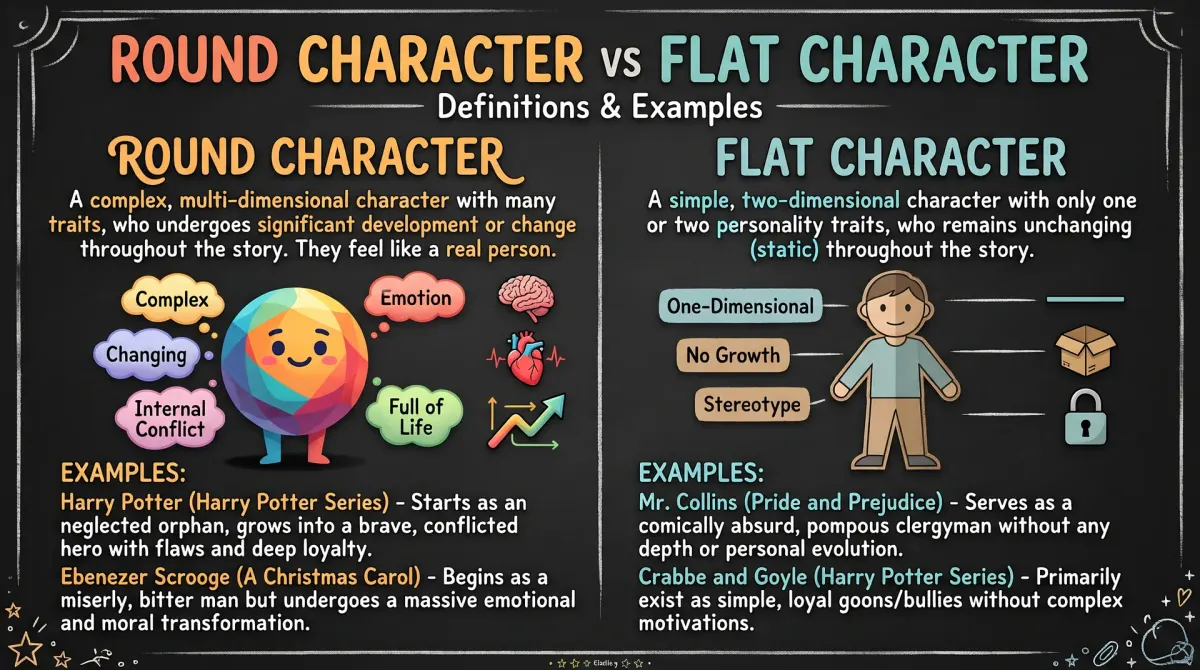
Round character is a term for a fictional person with depth and complexity. A round character has several traits, some in conflict, and can grow or surprise the reader. E.M. Forster used the term in 1927 to contrast these characters with simple, unchanging flat ones.
If you ask what is a round character, think of a real person. Real people are mixed. They are kind and selfish, brave and afraid. Round figures have that same mix.
Britannica describes round characters as complex and developing, sometimes enough to surprise the reader. Forster's example is Becky Sharp in William Thackeray's Vanity Fair, published in 1847 and 1848.
A deep character usually has:
- Several traits that do not all point the same way.
- A clear want and a hidden need.
- A choice that costs something.
- A change, or a strong refusal to change.
Round characters carry the emotional weight of a story. Readers care about their choices. That is why the lead is almost always round.
An example from your own reading will help. Think of a lead who surprised you. They did something you did not expect, but it still felt true.
What is a flat character?
Key takeaway: A flat character is simple, built on one main trait and does not change.
Britannica describes flat characters as relatively simple and two-dimensional. It says they do not change over the course of the work. Forster's example is Mrs. Micawber in Charles Dickens's David Copperfield, published in 1849 and 1850.
If you ask what is a flat character used for, the answer is support. A flat character can:
- Make a scene feel real and populated.
- Provide a fixed point the lead can push against.
- Add humor or tension quickly.
- Save the reader's attention for the main cast.
A flat character is not a bad character. A shopkeeper who appears in two scenes does not need a full backstory. The reader only needs to know what role they play.
The danger is a flat lead. If your main character is a one-trait type, the story will feel thin. Give leads depth.
Round vs flat character: side by side
Key takeaway: The two types differ in depth, change and role.
Use this table to compare them.
| Feature | Round character | Flat character |
|---|---|---|
| Depth | Many traits | One main trait |
| Change | May change | Stays the same |
| Role | Lead or key ally | Support or background |
Many writers search round vs flat character because they want a rule. The rule is simple. Match depth to importance. The more a character matters to the plot, the rounder they should be.
Here is how the two types feel on the page.
- A round one gets a scene of doubt, a mistake and a reason.
- A flat character gets a clear entrance, a clear job and an exit.
Forster gave a useful test. A character is round if they can surprise the reader in a convincing way. If a character never surprises, they are flat.
That does not mean flat characters are weak. Many classic novels rely on them. The skill is knowing where to use each type.
Notice also that the line is not fixed. A flat character can become round if the plot gives them a larger role. Many writers do this in revisions.
How to plan your cast with a worked example
Key takeaway: Count your characters by role, then set depth for each group.
You can plan your cast with simple math. Here is a worked example.
Say your novel has 12 named characters.
- 1 lead (round)
- 1 opponent (round)
- 2 allies (round)
- 8 side characters (flat)
Count the round characters: 1 + 1 + 2 = 4. Count the flat ones: 8. Total: 4 + 8 = 12.
Now check the ratio.
- Round share: 4 ÷ 12 = 0.33, or about 33 percent.
- Flat share: 8 ÷ 12 = 0.67, or about 67 percent.
That is a balanced cast. A third have depth, and two thirds support them. This ratio is only an example, not a rule. A short story may have one round figure and two flat ones.
Use the plan to spot problems. If all 12 characters are round, you may run out of space for each. If only the lead is round, the cast may feel empty.
Next, give each round one a short profile. Write their want, their need, one flaw and one secret. Four lines are enough to start.
How to turn a flat character into a round one: steps
Key takeaway: Add a want, a flaw and a choice, and the character gains depth.
Follow these steps when a flat character needs more depth.
- Give them a clear want.
- Give them a hidden need.
- Add one flaw that costs them.
- Add one contradiction.
- Write a scene where they choose.
- Show a small change or a refusal.
The contradiction in step four does the most work. A gruff guard who secretly feeds stray cats feels real. The two traits pull against each other.
Step five is the test. A round figure makes a choice that costs something. If a character's choices cost nothing, they stay flat.
You can also go the other way. If a side character steals too much attention, make them flatter. Give them one clear trait and a short scene.
Round and flat character examples
Key takeaway: Examples help, but your own cast is the best test.
Here are the two classic examples again, with a short note on each.
- Mrs. Micawber in David Copperfield is Forster's example of a flat character. She is defined by one idea and she stays the same.
- Becky Sharp in Vanity Fair is Forster's example of the round type. She is complex and can surprise the reader.
You can find your own round character example and flat character example in any novel on your shelf. Pick a book you know well. List the cast. Mark each character as round or flat.
Then ask why the author chose each. You will often find that the flat characters make the round ones stand out.
A good habit is to do this in your own manuscript. Mark each character on a page. If a key character is flat, add depth. If a minor one is too round, trim the scenes.
Why flat characters still matter
Key takeaway: Flat characters give a story speed, humor and a stable world.
Many writers try to avoid flat characters. That is a mistake. Flat characters do real work.
They let the reader recognize a role at once. A guard, a clerk or a neighbor can enter a scene and do a clear job. The reader does not need to learn their history.
They also save space. If every character had depth, the book would need far more pages. Flat characters let you spend words where they count.
They create contrast. A steady, simple character beside a complex one makes the complex one stand out. This is why many comic and adventure novels use bold, flat figures around a deeper lead.
Finally, they help pacing. A scene with a flat character can move fast. It sets a tone, gives a clue and ends.
The rule is not to avoid them. The rule is to place them with care.
People Also Ask
What is the difference between a flat and a round character?
A flat character is simple, built on one main trait and does not change. A round character is complex, has several traits and may surprise the reader. E.M. Forster named both types in 1927. Round characters usually lead the story, and flat characters support them.
Who created the terms flat and round characters?
E.M. Forster, the English novelist, described flat and round characters in his book Aspects of the Novel, published in 1927. Britannica credits him with both terms. His examples were Mrs. Micawber from David Copperfield for flat and Becky Sharp from Vanity Fair for round.
Can a flat character be a main character?
It can, but it is risky. A flat lead can feel thin because the reader has little to care about. Some comic or fable-style stories use flat leads on purpose. In most novels, the lead should be round so that the story can show change.
Common mistakes
Key takeaway: Most cast problems come from uniform depth or an unplanned lead.
- Making every character deeply complex.
- Leaving the lead flat.
- Treating flat as a bad word.
- Giving a side character a full backstory.
- Never testing a character with a hard choice.
Your next step: label your cast
List every named character in your draft. Mark each as round or flat. Then check that your lead, opponent and key allies are round.
Once the cast is clear, build a short profile for each of them.