What are the types of characters?
Key takeaway: Character types fall into three groups: role, depth and change.
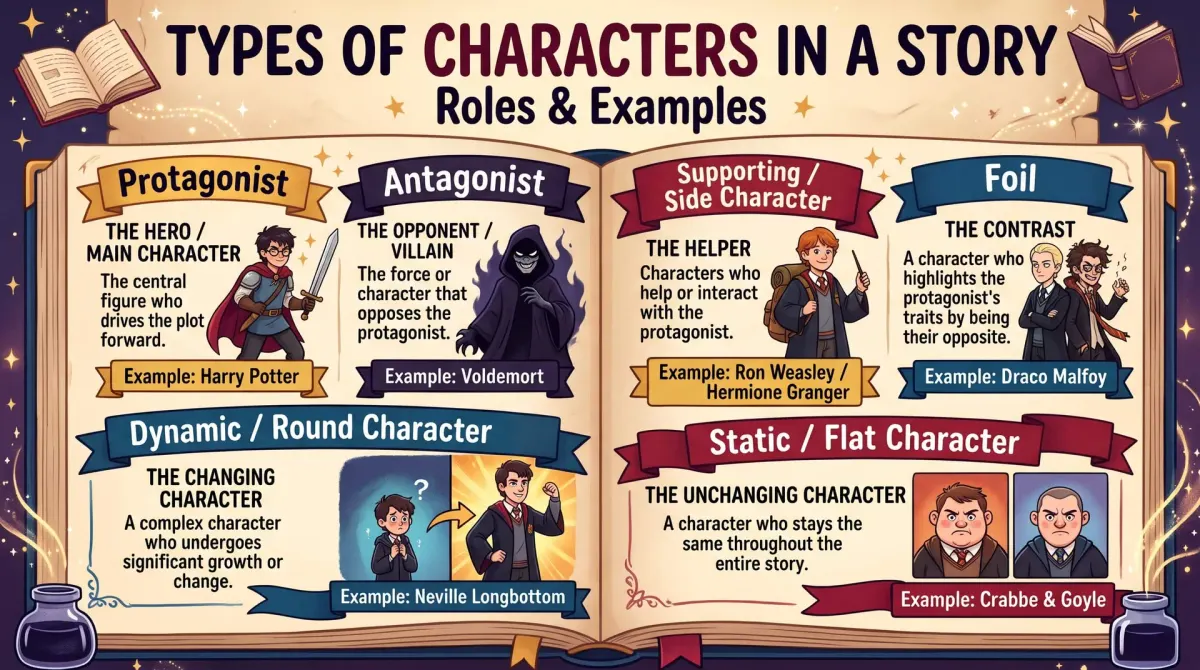
Types of characters are the labels writers use for a character's part in the plot. They also show how deep the character is and whether they change. The main types are protagonist, antagonist, round, flat, dynamic, static and foil. One character can hold several labels.
Think of three questions.
- Role: What job does this character do in the plot?
- Depth: How complex is this character?
- Change: Does this character change by the end?
Each question has its own labels.
| Question | Labels | Meaning |
|---|---|---|
| Role | Protagonist, antagonist, foil | Part in the plot |
| Depth | Round, flat | How complex |
| Change | Dynamic, static | Changes or not |
This table is the key to the whole topic. Once you see it, the labels stop clashing. A character is never "round or protagonist." They can be both, because the labels answer different questions.
Many writers search for types of characters in a story and find a long list. The list is easier to use when you sort it into these three groups.
Role: protagonist, antagonist and foil
Key takeaway: Role labels describe what a character does in the plot.
A protagonist is the main character. The story follows their goal, their choices and their change. Most novels have one. Some have several.
An antagonist is the force or person that opposes the protagonist. It can be a villain, a rival or even a system. The antagonist creates the conflict.
A foil character is a character who contrasts with another, usually the protagonist, to highlight differences. A foil makes qualities clearer by setting them side by side.
If you ask what is a foil character, picture two people standing together. One is bold and the other is careful. Each makes the other's trait easier to see. A foil is often a friend or a rival, and need not be a villain.
Here is how the three differ.
- The protagonist drives the story.
- The antagonist blocks the protagonist.
- The foil sharpens our view of the protagonist.
A character can be more than one. A rival can be an antagonist and a foil at once. A best friend can be a foil without opposing the lead.
Other role labels exist too. A mentor guides the lead. A sidekick supports the lead. A love interest adds a personal stake. These are useful but less formal.
Depth: round and flat
Key takeaway: Depth labels describe how complex a character is.
E.M. Forster described the depth labels in his 1927 book Aspects of the Novel. Britannica summarizes them this way.
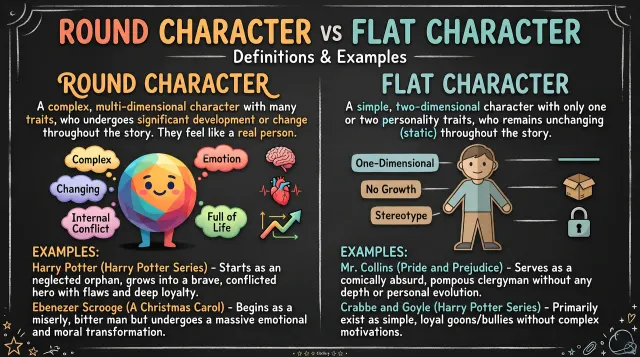
- Flat characters are relatively simple and two-dimensional. They do not change over the course of the work.
- Round characters are complex and do develop, sometimes enough to surprise the reader.
Forster's examples are Mrs. Micawber in Dickens's David Copperfield for flat and Becky Sharp in Thackeray's Vanity Fair for round.
So a flat character is simple and a round character is complex. Round characters usually lead the story. Flat characters usually fill the world.
Notice one detail in Britannica's summary. It says flat characters do not change. That overlaps with the change group below. In practice, the two labels often travel together, but they answer different questions. Depth asks "how complex?" and change asks "do they change?"
For a deeper look at this pair, read the full guide on round and flat characters.
Change: dynamic and static
Key takeaway: Change labels describe whether a character is different at the end.
A dynamic character changes in a meaningful way over the story. They learn, grow or fall. The change is often internal, such as a new belief or a new fear.
A static character stays the same. Their beliefs, goals and traits are steady at the end. A static character can still be important. They may stay firm while the world changes around them.
If you ask what is a dynamic character, the test is simple. Compare them at the start and at the end. If the person is meaningfully different, they are dynamic.
If you ask what is a static character, run the same test. If the person is the same, they are static.
Here are two common pairings.
- Round and dynamic. The lead who learns and changes. Most protagonists fit here.
- Flat and static. The side character who stays the same. Many support roles fit here.
But the pairings are not fixed. A round character can be static. A lead who refuses to change, despite pressure, can be deeply round and still static. Tragedies often use this pattern.
A flat character can also be dynamic in a small way. A minor character may change their mind once. The change is small but real.
Map your cast on one grid
Key takeaway: Plot each character on role, depth and change to see gaps.
A cast map shows who does what. Here is a worked example for a mystery with 8 named characters.
| Character | Role | Depth and change |
|---|---|---|
| Mara | Protagonist | Round, dynamic |
| Dale | Antagonist | Round, static |
| Sam | Foil to Mara | Round, dynamic |
| Reporter | Ally | Flat, static |
| Mayor | Obstacle | Flat, static |
| Baker | Setting | Flat, static |
| Clerk | Setting | Flat, static |
| Cat | Comic relief | Flat, static |
Count the labels. Round characters: Mara, Dale and Sam, so 3. Flat characters: 5. Total: 3 + 5 = 8.
Dynamic characters: Mara and Sam, so 2. Static characters: 6. Total: 2 + 6 = 8.
Now check for gaps. The lead is round and dynamic. The antagonist is round, which gives the conflict weight. There is a foil in Sam. The five flat characters fill the town. This is a healthy cast.
If your map shows a flat antagonist, the conflict may feel thin. If it shows no dynamic characters, the story may lack change. Use the grid to spot these problems early.
How to label a character: steps
Key takeaway: Ask three questions and give each answer a label.
Follow these steps for any character.
- Name the character's job in the plot.
- Decide how many traits they show.
- Compare them at start and end.
- Mark role, depth and change.
- Check for contrast with the lead.
- Fix any gaps in the cast.
Step five finds your foils. Ask whether another character highlights the lead by contrast. If not, consider adding or sharpening one.
Keep the labels as tools, not rules. They are useful for planning and for revision. They do not replace the need to write people who feel real.
Other roles you will meet
Key takeaway: Informal role labels help with planning, but they are tools, not rules.
Beyond the formal terms, writers use several informal role labels. They are handy for planning a cast.
- Mentor. A guide who teaches or warns the lead.
- Sidekick. A loyal helper who supports the lead.
- Love interest. A character who adds a personal stake.
- Confidant. A person the lead talks to, which lets the reader hear thoughts.
- Comic relief. A character who lightens the mood.
- Red herring. A person who seems guilty but is not, common in mysteries.
These labels describe function. A mentor can be round or flat, dynamic or static. A sidekick can also be a foil. As with the other types, labels can overlap.
Use roles to check balance. If every character is a helper, the lead has no friction. If every character is an opponent, the lead has no support. A mix gives the story warmth and tension.
Also remember that roles can change. A mentor can become an opponent. A rival can become an ally. Those shifts create strong scenes.
People Also Ask
What are the 5 main types of characters?
The five most used types are protagonist, antagonist, round, flat and dynamic. Many lists add static and foil. The labels cover role, depth and change, so one character can hold several at once. For example, a lead may be a round, dynamic protagonist.
What is the difference between a dynamic and a static character?
A dynamic character changes in a meaningful way over the story, such as a new belief or a new skill. A static character stays the same. Compare the character at the start and at the end. If they are different, they are dynamic. If they are the same, they are static.
What is a foil character?
A foil character contrasts with another character, often the protagonist, to highlight differences. If the lead is bold, the foil may be careful. A foil can be a friend, rival or even an antagonist. The purpose is to make traits clearer by setting them side by side.
Common mistakes
Key takeaway: Most errors come from mixing labels that answer different questions.
- Treating round and protagonist as opposites.
- Assuming flat characters are bad.
- Making every character dynamic.
- Forgetting to give the lead a foil.
- Labeling a character by one scene only.
Your next step: build a cast grid
List your characters in a table. Mark role, depth and change for each one. Look for gaps, such as a flat antagonist or a lead with no foil.
Then write a short profile for each round character and move on to the traits that define them.