Two kinds of company
Key takeaway: Platforms sell your book. Service companies sell you help. Do not confuse the two.
Self-publishing companies are platforms and services that help authors print, distribute or produce a book. The best self-publishing companies are open about fees, leave you in control of your rights and files, and let you leave without penalty.
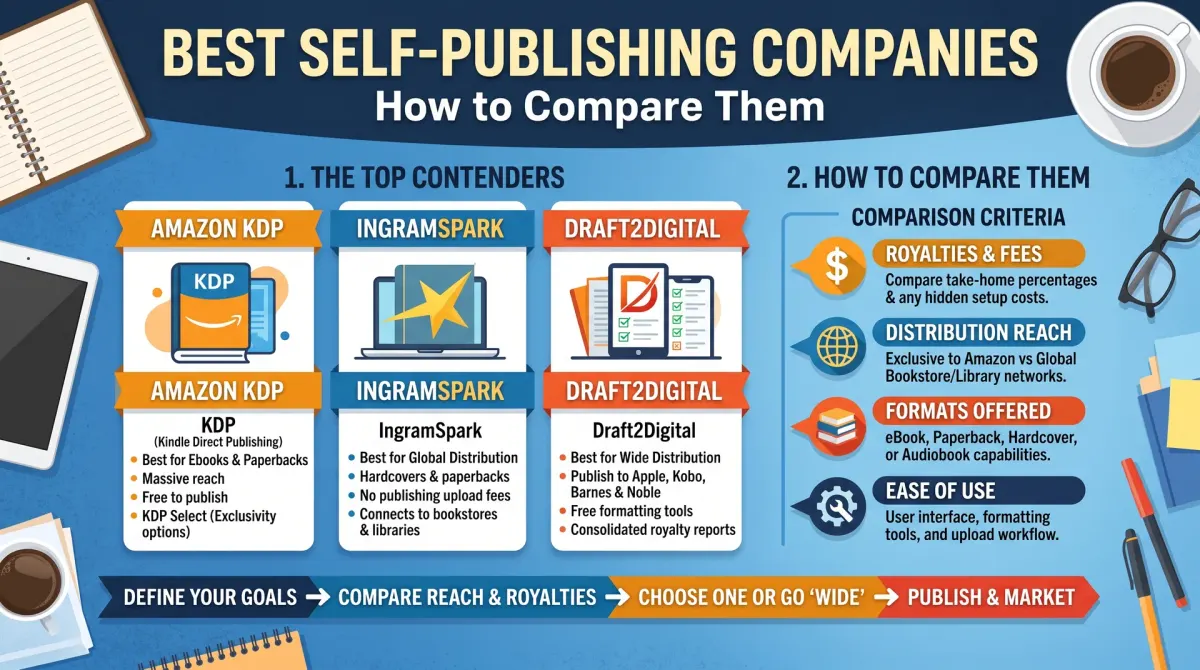
A platform lets you upload a book and sell it. It prints on demand, distributes to stores and pays you a royalty. You pay little or nothing upfront. Examples include Amazon KDP, IngramSpark, Draft2Digital and Lulu.
A service company sells editing, design, formatting, publishing packages and marketing. You pay the company, and the quality depends on the people doing the work. Some are excellent. Others charge a lot for little.
Many authors use both. They publish on a platform and hire freelancers or a company for the parts they cannot do.
What each platform is known for
Key takeaway: Platforms differ in reach, tools and control. Match them to where your readers shop.
| Platform | Known for | Check before you join |
|---|---|---|
| Amazon KDP | Largest single reader base, no setup fee | Free ISBN works only on KDP; Select exclusivity |
| IngramSpark | Bookshop and library distribution | Fees and return terms on the vendor page |
| Draft2Digital | Ebook distribution to many stores | Fees and store list on the vendor page |
| Lulu | Flexible print products and a direct store | Pricing and distribution options |
| Barnes & Noble Press | Access to B&N customers | Current terms and formats |
Do not trust a table, including this one, for prices or fees. Open each vendor's official page and read the current terms.
A scoring method you can copy
Key takeaway: Give every company a score from one to five on the same five questions. The total beats a gut feeling.
Score each company on these points.
- Cost. What do I pay upfront and per sale?
- Rights. Do I keep the copyright, the files and the ISBN information?
- Reach. Where will the book be sold?
- Control. Can I set the price, change files and leave?
- Support. Is there clear help and a real contact?
Here is an example. Company A scores 4, 5, 3, 5, 3, which totals 20 out of 25. Company B scores 2, 3, 5, 3, 4, which totals 17. Company A wins on this scoring, but Company B might win for an author who values reach above all else.
You can weight the points. If reach matters most, double its score and compare again.
Red flags
Key takeaway: A company that hides prices or pressures you is not a safe choice.
Be careful if a company:
- calls you before you have contacted them
- asks for large fees before reading your book
- promises bestseller status or fixed sales
- refuses to show a contract before you pay
- keeps your rights or files after you leave
- sells you "marketing" with no clear deliverables
- uses its own ISBN and keeps control of your listing
Search the company name with words like "complaints" and "reviews". Check author watchdog sites such as Writer Beware.
Questions to ask in writing
Key takeaway: Ask for answers by email. If they will not write them down, walk away.
- What exactly do I pay and what is included?
- Who owns the copyright, the cover and the interior files?
- Whose name is on the ISBN?
- What is the royalty and how is it calculated?
- How long is the contract and how do I leave?
- Where will the book be sold, and who sets the price?
- Can I see my sales reports?
Keep the replies with your contract.
How to decide
Key takeaway: Start simple. You can add platforms later, but moving away from a bad contract is hard.
If you are new, start with KDP, because it has no setup fee and the biggest reader base. Add IngramSpark if you want bookshop and library reach. Add an ebook distributor if you want many ebook stores. Hire freelancers one task at a time instead of buying a large package.
Only choose a full-service company if you have read the contract, compared at least three, and understood what you pay for.
What "best" depends on
Key takeaway: There is no single best company. The best choice is the one that matches your book, your goal and your budget.
A children's picture book needs good colour printing. A business book may need a quick launch and a price that leaves room for discounts. A novelist who wants to sell across many ebook stores needs an aggregator. A poet who wants a handful of copies for friends needs something simpler again.
Start by writing down what success means for this book. It might be a hundred copies sold to your community, a steady income from Amazon, a place in the local library or a book that supports your speaking work. Each goal points to a different company or mix of companies.
Then list your limits. How much can you spend before the book earns anything? How many hours a week can you give to the project? Are you happy to learn new tools, or do you want someone else to handle the details? Honest answers narrow the field quickly.
A first-book plan that keeps risk low
Key takeaway: Start with free platforms and hire help one task at a time. Do not buy a package before you know what you need.
Here is a low-risk plan for a first book. Publish the ebook and the paperback on KDP, using the free tools and the free ISBN if you only plan to sell there. Spend your money on a copy edit and a professional cover first, because these make the biggest difference to readers.
After a few months, look at your reports. If readers ask for the book in bookshops, add IngramSpark with your own ISBN. If readers ask for other ebook stores, add a distributor. If your sales are steady, you can then decide whether to pay for marketing.
This plan keeps your cash safe and your rights clear. It also gives you real data, which beats any sales page for deciding what to buy next.
Know the two kinds of company
There are platforms and there are services. A platform lets you upload files and sells or prints your book. It usually takes a share of each sale and charges no setup fee. A service does work for you, such as editing, design, formatting or marketing, and charges a fee.
Some companies are both. They offer a platform and sell packages. That mix is where confusion starts. Always separate the platform terms from the service terms.
Ask yourself which part you actually need. Many authors only need a platform and can buy single services from specialists.
Build a simple scoring sheet
Make a table with one row per company. Use the same columns for each. Include total cost, who owns the rights, who owns the files, how royalties are paid, quality samples, support, and exit terms.
Give each column a score from one to five. Weigh rights and exit terms most. A cheap deal that traps your rights is not cheap.
Write a note on every score. A year from now, you will want to know why you chose as you did. Share the sheet with a trusted author friend for a second opinion.
Read the contract slowly
A contract is where the truth lives. Look at the rights clause. Does the company get exclusive rights? For how long? In which formats and countries? Look at the termination clause. Can you leave? What does it cost?
Check how royalties are calculated and when they are paid. Look for fees that appear later, such as for changes, storage or reports.
If you do not understand a clause, ask for it in plain words in writing. If they will not explain it, that tells you something. Consider asking an author society or a publishing lawyer to review.
Check quality with real samples
Ask to see finished books, not just website images. Order one if you can. Look at the paper, the cover finish, the spine, the margins and the print sharpness.
Read author reviews from several places, not just the company's own site. Look for patterns. One angry review may be a one-off. Ten with the same complaint are a pattern.
Ask for the names of authors you can contact. A confident company will share them.
Plan an exit before you start
Choose a company that lets you leave. You should be able to take your files, your ISBN and your rights. If the company holds the ISBN as its own, you may not be able to move the book without losing reviews.
Keep your own copies of every file. Record the settings you used. If you need to switch, you can do it quickly.
Questions to ask a company in writing
Put your questions in an email and keep the answers. Ask: What is the total cost, with every fee listed? Who owns the ISBN? Can I take my files and leave? How are royalties calculated and paid? What rights do you ask for? What happens if the book is out of print? How do you handle changes after publication?
Ask for a sample contract before you share personal details. Ask for the names of authors who used the service. Ask how long they have been in business.
A good company answers clearly and without pressure. If you get vague replies or a push to sign today, step back.
People also ask about self-publishing companies
What is the best company for self-publishing?
It depends on your goals. Free platforms such as Amazon KDP suit most first books. Other platforms offer wider print distribution. Service companies add editing, design or marketing for a fee. Score each option on cost, rights, control and quality before you decide.
Are self-publishing companies worth the money?
Sometimes. A good company saves time and delivers quality work at a fair price. A poor one sells packages with little value. Ask what you get, who owns the files and rights, and what happens if you leave. Compare the quote with doing the work yourself.
How can I tell if a publishing company is a scam?
Warning signs include large fees before they read your book, promises of sales, pressure to sign fast and unclear rights. Search the company name with the word "reviews" and check author watchdog sites. Ask for a written contract and read every line before you sign.
A cautious next step
Start small. Publish one book on a free platform, buy one service you really need and see how it goes. You can add more as you learn.