The short answer
Key takeaway: The platform is free. Your spending depends on how many services you hire and how professional you want the result to be.
The cost to publish a book depends on the route and the services you buy. Self-publishing on KDP has no setup fee, but you may pay for editing, cover design, formatting, an ISBN, proof copies and marketing. Traditional publishers cover costs but take rights.
There is no single price for publishing a book. A writer who edits, formats and designs a cover alone can publish for close to nothing. A writer who hires an editor, a designer, a formatter and an ad manager will spend much more. Both can end up on the same shelf.
This guide does not quote service prices, because they change by freelancer, country and book length. It shows you every cost line, how to ask for a quote, and how to turn the total into a number of sales you need.
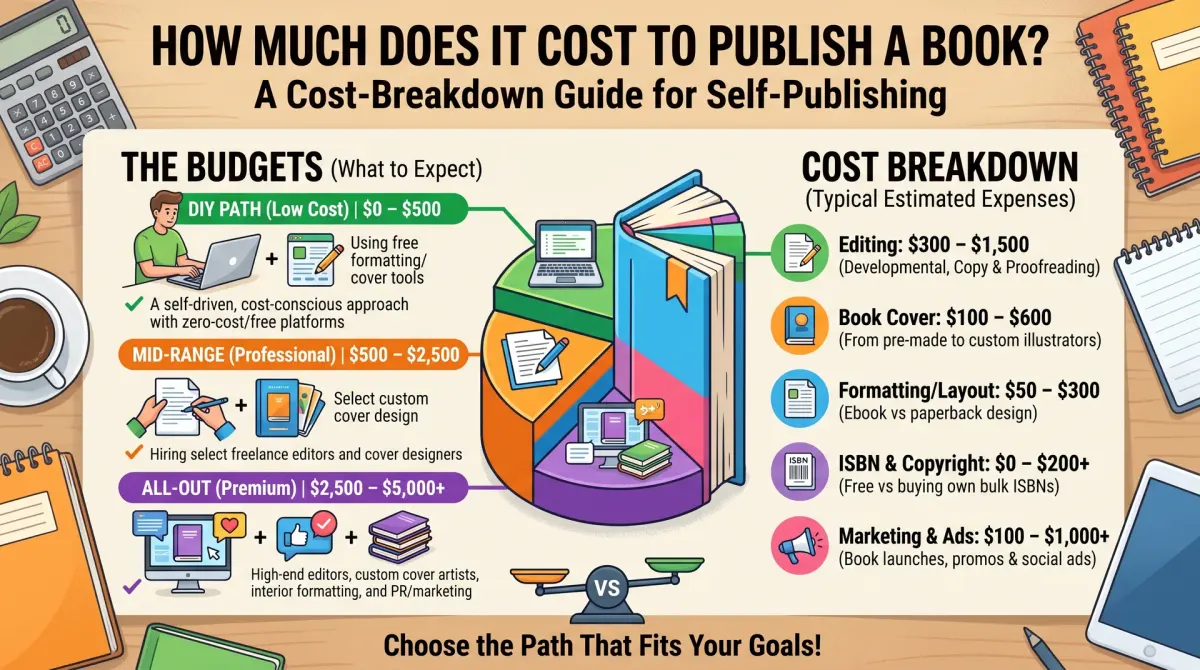
Every cost line, in one table
Key takeaway: Use this table as a worksheet. Fill in a quote for each line you need and leave the rest at zero.
| Cost line | Do you need it? | How to price it |
|---|---|---|
| Developmental edit | Often, for first books | Quote per word or per project |
| Copy edit | Yes, for most books | Quote per word |
| Proofread | Yes | Quote per word |
| Interior formatting | If you do not use software | Flat fee or per page |
| Cover design | Yes | Flat fee, ask for a portfolio |
| Own ISBN | Optional | Price from your national agency |
| Proof copy | Strongly advised | Printing cost + shipping + tax |
| Author copies | Optional | Printing cost + shipping + tax |
| Website and email tools | Optional | Monthly or yearly plan |
| Marketing and ads | Optional | Your own budget |
Ask each freelancer for a written quote that lists what is included, how many revisions you get, and how long it takes. Ask to see samples in your genre.
What KDP charges
Key takeaway: KDP charges per sale, not upfront. For print, the printing cost is taken from each sale.
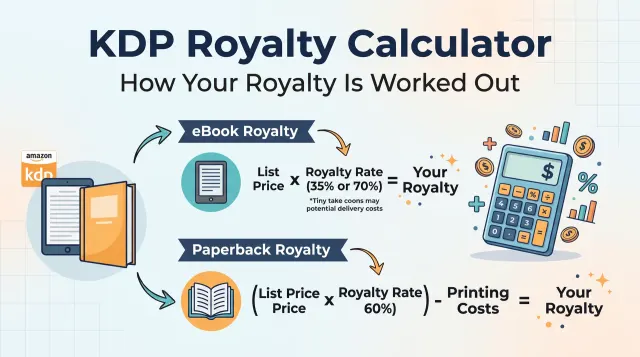
KDP has no listing fee. Print books earn a 60% royalty on the list price, minus the printing cost. Ebooks earn 35% or 70% depending on price, with a delivery cost on the 70% option.
Here is a worked example for a 6 x 9 black-and-white paperback with 300 pages on Amazon.com at a $14.99 list price.
- Printing cost: $1.00 fixed + 300 x $0.012 = $4.60.
- 60% of $14.99 = $8.99.
- Royalty per copy: $8.99 - $4.60 = $4.39.
A break-even example
Key takeaway: Divide your total spend by your royalty per copy. The result is the number of sales you need to get your money back.
Break-even tells you whether your budget makes sense. The formula is simple.
Break-even copies = total spend / royalty per copy.
Suppose you add up your own quotes and the total is $900. If your royalty is $4.39 per paperback, you need $900 / $4.39 = 205.01 copies, so 206 sales to break even. If you cut the spend to $450, you need 103 sales.
These numbers use your own quotes, not market averages. Replace the $900 with the real total from your table. If the number of sales looks unrealistic for your audience, lower the spend or raise the price.
Ways to lower the cost without lowering quality
Key takeaway: Spend where readers notice most: editing and the cover. Save on tools and extras.
- Self-edit first. Read the book aloud, fix what you hear, then pay for a copy edit on a cleaner draft. Editors often charge less when the text needs fewer fixes.
- Use free tools for formatting if your book is simple. Kindle Create is free, and word processors can export print PDFs.
- Use a free KDP ISBN if you plan to sell only on KDP.
- Order one proof copy at a time. Fix all the problems before you order again.
- Build an email list before launch. It costs little and helps more than ads on day one.
Costs people forget
Key takeaway: Small recurring costs add up. Put them in the table before you start.
- Taxes and bank fees. Royalties may be taxed in your country, and banks may charge for incoming transfers.
- Domain and hosting. An author website needs a domain name and a host.
- Software subscriptions. Writing, design and email tools may charge monthly.
- Rewrites and revisions. Extra rounds with an editor or designer may cost more.
- Time. Your own hours are a real cost, even when no money moves.
Three sample budgets
Key takeaway: A budget is a set of choices. These three shapes show how the same book can be published at very different spending levels.
These are shapes, not price lists. Fill each line with your own quotes.
Lean budget. You self-edit and use beta readers, format with free software, use a template cover, use the free KDP ISBN and order one proof. Your main cost is time. This works for testing a topic, but quality depends on your own skill.
Balanced budget. You pay for a copy edit and proofread, buy a professional cover, format with software, and order one or two proofs. This is the usual choice for a first serious book.
Full service budget. You add a developmental edit, a custom formatter, your own ISBNs, a website, an email tool and a launch ad budget. This suits authors who treat the book as a business asset.
Pick the shape, get quotes for each line, and run the break-even formula. If the result looks too high, move one line at a time down a level instead of cutting editing and the cover first.
How to compare quotes
Key takeaway: A cheap quote and a good quote are not the same thing. Compare what is included, not only the price.
Ask every provider the same questions so the quotes line up:
- What exactly is included?
- How many revision rounds do I get?
- How long will it take?
- Can I see work in my genre?
- Who owns the final files and the rights to the design?
- What happens if I am not happy?
Write the answers in your cost table. A quote that costs a little more but includes revisions and source files can be better value than a lower price with extras on top.
Separate must-have from nice-to-have
Divide your list into two columns. Must-have: a proofread, a readable cover, correct files and a proof copy. Nice-to-have: paid ads, a custom site, a video trailer and special editions.
Spend first on the must-haves. They protect your reviews. Spend on the others once the book earns.
This simple split also helps you say no to sales pitches. If a package does not match your list, you can skip it.
Editing: levels and choices
Editing comes in levels. A developmental edit looks at structure. A copy edit fixes grammar and consistency. A proofread catches the last errors. Not every book needs every level.
Ask editors for a sample edit of a few pages. Ask what they charge and how: per word, per hour or per project. Ask how long it takes and what they do not cover.
If your budget is tight, use beta readers and a proofread. A clean, clear text matters more than a perfect one.
Covers, formatting and files
Cover design costs vary from a template you adjust to a custom design. Check the designer's portfolio for your genre. Ask what files you receive and who owns them.
Formatting can be done with tools or a service. Compare the time and cost. Complex layouts cost more.
Proof copies are a real cost. Each costs printing, shipping and tax. Budget for at least one or two.
ISBNs and registration
On KDP you can use a free ISBN for print. If you buy your own, check the current price on the agency site. Ebooks on KDP do not need one.
Copyright registration, where available, has a fee set by the copyright office. Check the official site for the current amount.
Keep these costs in your list so nothing surprises you.
Marketing costs
Marketing can cost nothing or a lot. Free steps include a product page, an email list and an author page. Paid steps include ads, promotions and a website.
Set a budget you can lose. Track what each pound or dollar brings in. Stop what does not work.
Costs people forget
Authors often forget author copies, shipping, taxes, stock for events, software subscriptions, domain names and time. Add a small buffer of ten percent or so to your plan for surprises.
Also remember that prices change. Check vendor pages on the day you buy.
Compare quotes fairly
Use the same list for each quote: services included, number of revisions, files delivered, rights, timing and extras. Mark missing items.
Ask each provider to confirm in writing.
Plan a budget in three steps
Step one is to list every service you want and group them as must-have or nice-to-have. Step two is to collect quotes for the must-haves and compare them with the same rows. Step three is to add a buffer for proof copies, small changes and surprises.
Set a total limit before you start and track spending in a sheet. If a quote pushes you over, ask what you can do yourself.
Review the sheet after launch. You will see which costs paid off and plan your next book with real figures.
People also ask about publishing costs
Is it free to publish a book?
Platforms such as KDP charge no setup fee, so you can publish for free. You still pay indirect costs, such as proof copies and your own time. Many authors choose to pay for editing and a cover. Free publishing works best when you do the quality work yourself.
What is the biggest cost of self-publishing?
It is usually editing, design or marketing, depending on your book. Time is also a cost. Spend first on what readers notice most: a clear cover, clean text and an honest description. Compare quotes for each service before you decide.
Do traditional publishers charge authors?
Genuine traditional publishers do not charge authors to publish. They pay for editing, design and printing, and they take rights and share income. Be careful with companies that ask for fees and call themselves publishers. Ask for a written contract and check reviews.
Pick a budget, then review
Choose a total you are comfortable with. Divide it by priority. After the launch, review what paid off and adjust for your next book.