The three ways to publish
Key takeaway: The right route depends on your goal. Control and speed point to self-publishing. Bookshop reach points to traditional.
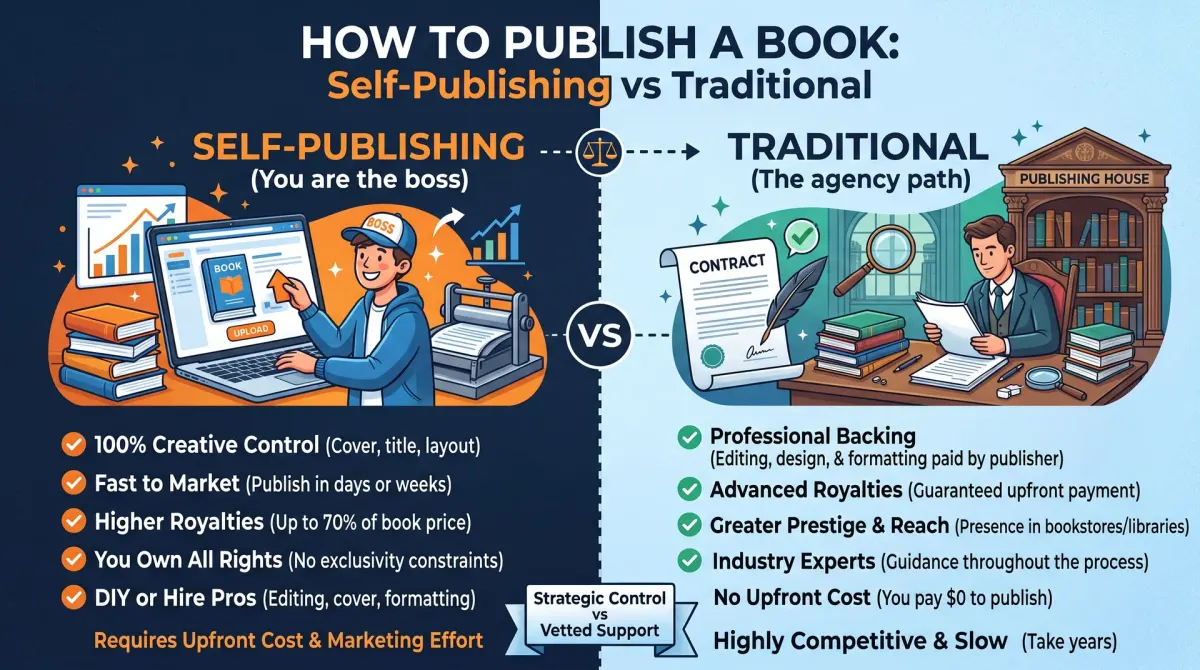
To publish a book, you choose a route and follow its steps. You can find an agent and a traditional publisher, publish it yourself on a platform such as Amazon KDP, or pay a hybrid or assisted publisher. Each route differs in cost, control, speed and royalties.
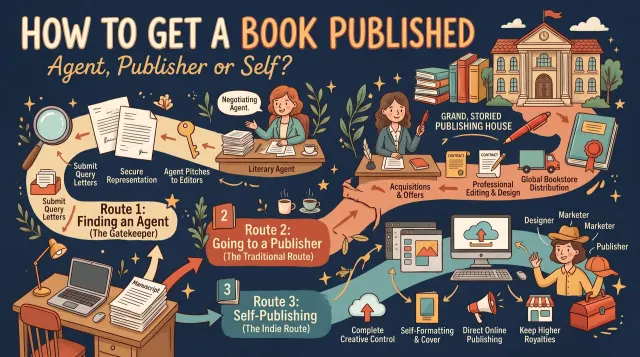
Traditional publishing. You send a query letter or proposal to a literary agent. The agent pitches the book to publishers. If a publisher buys it, they handle editing, cover, printing and sales. You earn royalties and sometimes an advance.
Self-publishing. You manage the whole process or hire help. You choose the cover, price and release date. You keep the rights and a higher share of each sale.
Hybrid publishing. You pay a company to produce and distribute your book. Quality and contracts vary widely. Be careful with any company that asks for large fees upfront or promises sales.
Compare the routes
Key takeaway: There is no single best route. Compare control, cost, time and reach against your own goal.
| Point | Traditional | Self-publishing | Hybrid |
|---|---|---|---|
| Upfront cost to you | None | Your choice | Often high |
| Control over cover and price | Low | Full | Shared |
| Time to publish | Often a year or more | Weeks to months | Months |
| Share of each sale | Smaller | Larger | Varies |
| Bookshop reach | Strong | Limited | Varies |
| Rights | Often licensed | You keep them | Check contract |
Steps to publish traditionally
Key takeaway: Traditional publishing is a sales process. Your job is to make an agent want to represent you.
Most large publishers accept books only through agents. The usual path is:
- Finish and polish the manuscript. For fiction, finish the whole book. For non-fiction, a proposal and sample chapters are often enough.
- Research agents who represent your genre.
- Send a short query letter that follows each agent's submission rules.
- If an agent signs you, they pitch publishers and negotiate the contract.
Expect many rejections and long waits. Rejection says little about the quality of your book. It may just not fit what that agent wants.
Steps to self-publish
Key takeaway: Self-publishing is faster, but you carry every task and cost.
- Edit the manuscript.
- Format the interior for print and ebook.
- Design or buy a cover.
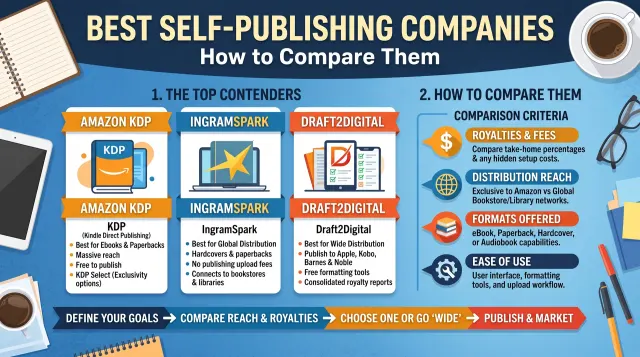
- Choose an ISBN and a platform such as Amazon KDP.
- Enter the details, set a price and publish.
- Plan how readers will find the book.
Which route should you pick?
Key takeaway: Ask what you want from the book. The answer usually picks the route for you.
Think about these questions:
- Do you want a bookshop presence? Traditional publishing helps most.
- Do you want full control and a fast release? Self-publish.
- Is the book for a business, course or niche audience? Self-publishing often fits, because you can reach your audience directly.
- Do you have a budget and want a done-for-you service? Look at hybrid, but compare at least three companies and read each contract.
You can also mix routes. Some authors self-publish first, build a readership, then pitch an agent with real sales to show.
Warning signs in publishing offers
Key takeaway: A legitimate publisher does not charge you to publish and does not promise sales.
Be careful if a company:
- asks for a large fee before it has read your book
- promises bestseller status or guaranteed sales
- takes your rights for a long time with no way out
- will not give you a clear list of services and costs
- pressures you to sign quickly
Read any contract carefully. Consider having a lawyer or an author organisation review it before you sign.
A simple path to decide
Key takeaway: Answer three questions in order. Your goal, your timeline and your budget will point to one route.
First, what is your goal? If you want a book on a shelf in many bookshops, or you want a publisher's name on the cover, traditional publishing is the better fit. If you want to reach a specific audience, sell a service through the book, or keep full control, self-publishing is usually better.
Second, what is your timeline? If you need the book out within a few months, self-publishing is the only realistic choice. Finding an agent alone can take many months, and a publisher adds a long production schedule on top.
Third, what is your budget? Traditional publishing asks for no money but a lot of patience. Self-publishing asks for the cash you choose to spend. Hybrid publishing asks for the most cash upfront, so it needs the most care.
Write your answers down. If they point in two directions, start with the faster route and keep the other open. A self-published book with real sales and reviews is a stronger pitch to an agent than a draft is.
Questions to ask any publishing company
Key takeaway: A fair company answers these questions clearly and in writing. A vague answer is a warning sign.
Before you sign anything, ask:
- What exactly do I pay, and what do I get for it?
- Who owns the rights, and for how long?
- Can I leave the contract, and what happens to my files?
- What is the royalty rate, and is it paid on list price or on net receipts?
- Who sets the price and the cover?
- How will the book be sold, and in which stores?
- Do I get my files, my ISBN and my sales data?
Keep a copy of every answer. If the company refuses to put these answers in the contract, walk away.
Costs to expect on each route
Key takeaway: Cost and risk are linked. The route with the lowest cash cost usually asks for the most of your time.
On the traditional route, you pay nothing to the publisher, but you spend months on queries and rewrites. You may also give up control over the title and the cover.
On the self-publishing route, you pay for what you choose to hire, and you can scale spending up or down. A first-time author can start with a self-edit, a template cover and a free ISBN, then improve the book later with real feedback. This is not the best result, but it keeps risk low.
On the hybrid route, you pay a package fee. Ask what is included, who does each task, and whether the company earns more from fees than from book sales. If it does, its income does not depend on selling your book.
How to compare the routes fairly
A fair comparison looks at more than the royalty rate. Use the same questions for every route.
- Who pays for editing, design and printing?
- Who owns the rights, and for how long?
- Who sets the price?
- How soon will the book be on sale?
- What marketing will the publisher really do?
- What happens if the book does not sell?
Write the answers in a table. Mark each answer as confirmed in writing or only said aloud. Only the first kind counts.
A traditional deal may carry an advance, but the author gives up control and usually waits a long time. Self-publishing gives control and speed, and the author pays for the work. Hybrid sits between them, and quality varies a great deal.
Matching the route to your goal
Your goal should pick the route. If you want a bookshop presence and a publisher's name, try the traditional route and be ready to wait. If you want to reach readers fast, own your rights and test a topic, self-publishing fits. If you have a business and want a quality book without managing the work, a transparent assisted service may suit you.
Some authors combine routes. They self-publish a first book, build a readership and then approach an agent with sales to show. Others keep their rights and publish every book themselves.
There is no shame in any route. The mistake is to pick one without knowing the trade-offs.
Steps and timing for each route
Timing differs a lot between routes. Self-publishing can take weeks once the book is finished. A hybrid service may take a few months. The traditional route often takes a year or more from a signed deal to the shelf, and finding an agent comes before that.
Plan your own time too. Writing, editing and revision take as long as they take, on any route. Do not let a publishing date rush the work.
If timing matters, such as a book tied to a business launch, choose a route that you control. Waiting on others is the biggest source of delay.
What to prepare before you approach anyone
Whatever route you choose, prepare the same core items. Have a finished manuscript or, for non-fiction, a strong proposal with sample chapters. Write a one-paragraph summary and a short author bio. Gather proof that readers want the book, such as an email list or past work.
Build a simple author page with your name, your books and a way to contact you. Agents and publishers often search for an author before they reply.
Keep your files tidy. A clean, consistent manuscript shows you are serious.
Rights, money and contracts
Rights are the core of any publishing deal. Ask which rights the other side wants, for how long and in which territories. Ask what happens if the book goes out of print. Ask how and when royalties are reported and paid.
Never pay a company that says it will "select" your book. Real publishers earn from selling books, not from selling packages to authors. If a contract is unclear, ask a publishing lawyer or an author society to review it.
Keep copies of all emails and signed papers. They protect you if a dispute comes up.
People also ask about publishing a book
What is the easiest way to publish a book?
Self-publishing on a free platform such as Amazon KDP is the quickest route. You upload files, set a price and publish without a gatekeeper. It is easy to start, but quality still takes work. Editing, formatting and a good cover decide how the book performs.
How do I publish a book with a traditional publisher?
Most publishers need a literary agent. You write a query letter, send samples and wait. For non-fiction, you usually send a book proposal. If an agent signs you, they pitch publishers. The process can take many months or longer, and many books are not accepted.
Is a hybrid publisher worth the money?
It can be, but check carefully. A good hybrid publisher is open about fees, rights and services. A poor one sells packages and promises sales. Ask for a written contract, samples of finished books and the names of authors you can contact before you pay.
Make a decision and write it down
Write a short note that says which route you chose and why. List the next three tasks. Set a date. A clear note keeps you from starting over each time a new offer arrives.
If you are unsure, begin with self-publishing a short book as a test. You will learn the process, and you can still seek a publisher for your next project.