Why starting is the hardest part
Key takeaway: Most people stall because the task feels huge. Shrink it into one small action.
A book is a large project, and a large project is easy to postpone. Starting is hard because you face three problems at once: you must choose an idea, a plan and a habit.
How to start writing a book means taking the first practical steps before you write chapter one. You choose one idea, define the reader, make a simple outline and set a daily word goal. Then you write a rough opening without trying to make it perfect.
Perfectionism is the biggest blocker. Beginners expect their first words to sound polished. They never do, and that is fine. Professional writers revise their drafts many times.
The solution is to separate two jobs. Drafting is for getting words down. Editing is for improving them. Do not mix them in the same session.
Here is a quick example of how small goals add up:
- 300 words a day × 30 days = 9,000 words
- 300 words a day × 100 days = 30,000 words
- 500 words a day × 100 days = 50,000 words
You can check each line by hand. Small, steady work builds a manuscript. A manuscript is the full text of your book before it is formatted for publishing.
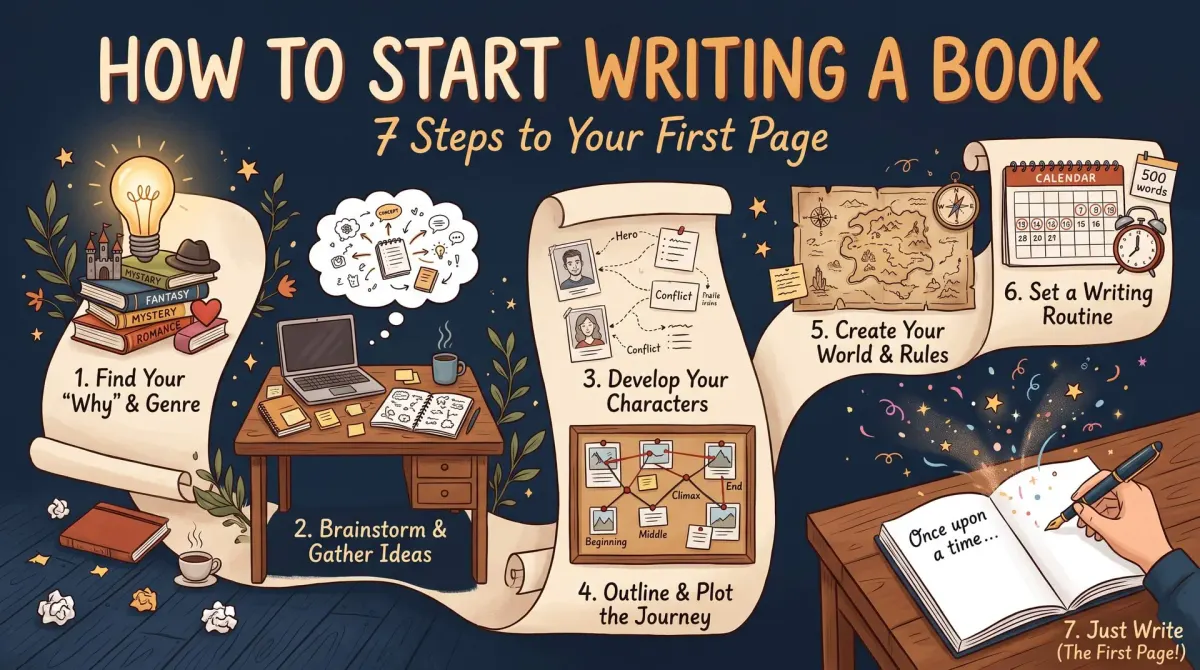
How to start writing a book: 7 steps
Key takeaway: Follow the steps in order. Each one removes a reason to delay.
Use this checklist from idea to first page:
- Choose one clear book idea.
- Name your reader in one sentence.
- Pick a book type and length.
- Make a simple chapter list.
- Set a daily word goal.
- Pick a place and time.
- Write the first page.
Now look at each step in more detail.
Step 1: Choose one idea. If you have five ideas, pick the one you can talk about longest. Write it as one sentence. For example: "A guide for new parents who want a calm morning routine."
Step 2: Name your reader. Describe one real person. Ask what they want and what they struggle with. This keeps you focused.
Step 3: Pick a type and length. Decide if you are writing fiction, non-fiction or a memoir. Check books in your category and note the typical length.
Step 4: Make a chapter list. Write 8 to 12 chapter titles. They can change later. See our outline guide for a ready format.
Step 5: Set a goal. Choose a number you can hit even on a bad day. Start small.
Step 6: Set your space. Pick a regular time and place. Turn off alerts.
Step 7: Write. Open a blank page and write for 20 minutes. Stop when the timer ends.
How do I start writing a book about my life?
Key takeaway: A memoir starts with one theme and one slice of your life, not your whole story.
Many people want to know how to start writing a book about your life. A memoir is a true story about a specific period or theme in your life. It is not a full autobiography.
Start with a theme. Ask what your story shows about a bigger idea, such as loss, courage or starting over. Then pick a time frame.
Follow these simple steps:
- List 20 key moments from your life.
- Circle the five that connect to your theme.
- Put them in order.
- Write the first scene as if telling a friend.
Do not begin with your birth. Begin with a moment of change. That gives the reader a reason to keep going.
Memory is imperfect. Write what you remember and mark gaps. You can check dates and details with family members or old records later.
Be mindful of other people in your story. Think about privacy and consider changing names. If you are unsure, ask a qualified lawyer.
Our memoir guide covers this in more depth.
Plan your first week
Key takeaway: A one-week plan turns a vague wish into a habit. Keep each day short.
A plan keeps you moving. Use this simple schedule. Each task takes 20 to 45 minutes.
| Day | Task | Output |
|---|---|---|
| 1 | Write one-sentence book idea | One sentence |
| 2 | Describe your reader | A short profile |
| 3 | List chapter titles | 8 to 12 titles |
| 4 | Write your why | One paragraph |
| 5 | Write first page | About 300 words |
| 6 | Write second page | About 300 words |
| 7 | Review and plan next week | A new goal |
By the end of day 6, you have about 600 words. That may feel small. However, it is more than most would-be authors ever write.
On day 7, check how you felt. Was the goal too big? Cut it. Was it too easy? Raise it a little.
Use simple tools. A word processor and a folder are enough. You do not need expensive software on day one. If you want to explore options later, read our comparison.
Write your first page without fear
Key takeaway: The first page is a test run. It will change. Write it badly and move on.
The first page scares people because it feels like a promise. It is not. You can rewrite it after you finish the book.
Try these tricks:
- Write the first page last. Start in the middle if you like.
- Use a timer for 20 minutes and do not stop.
- Begin with a question, a problem or a small scene.
- Write "[fix later]" instead of stopping to polish.
For fiction, open with a character who wants something. For non-fiction, open with the reader's problem. For a memoir, open with a moment of change.
Avoid long background sections at the start. Readers want to meet a person or a problem first. They can learn the background later.
Keep a "later" file. When you think of a good idea for another chapter, put it there. Then return to your page. This protects your focus.
When the timer ends, stop. Leaving a session while you still have ideas makes it easier to start the next day.
How do you start writing a book if you have no experience?
Key takeaway: You do not need a degree or past credits. You need a clear idea, a routine and willingness to revise.
Many beginners ask how do i start writing a book without any training. The answer is the same as for anyone else. Skill grows through practice.
Here is a simple route:
- Read widely in your category. Note how books open and end.
- Write every day, even for 10 minutes.
- Join a writing group or find one reader who will give honest notes.
- Revise after you finish, not before.
If you write non-fiction, you need to know your topic well, or be willing to research it. Keep a list of sources. If you use quotes or facts, record where they came from.
Tools such as AI assistants can help you brainstorm. They do not replace your voice, and you remain responsible for the text.
Writers' groups such as Poets & Writers offer free advice for beginners.
Know your options for publishing early. Self-publishing on Amazon KDP has no setup fee, and you keep control of your rights.
Keep going after week one
Key takeaway: Week two is where most plans fade. Make the habit easy to repeat.
A good start needs a good second week. Use these simple supports.
- Track your words on a simple chart or app. Seeing progress keeps you moving.
- Set one weekly check-in. Count your words and plan the next seven days.
- Tell a friend your goal. A little accountability helps.
- Reward milestones, such as your first 5,000 words.
Here is a 30-day check. At 300 words a day, you reach 9,000 words. At 500 words a day, you reach 15,000 words. Both are real progress.
If you miss a day, restart the next day. Do not try to catch up with a huge session. Return to your normal goal.
Join a writing group if you want company. Many groups meet online and welcome beginners.
People Also Ask
What should I do first when writing a book?
Write one sentence about your idea and name your reader. Then choose a type and length, such as fiction, non-fiction or memoir. These choices guide every later decision. After that, make a short chapter list and set a small daily word goal.
How many words should I write a day?
Pick a goal you can meet even on a busy day. Many beginners start with 300 to 500 words. At 300 words a day, you reach 9,000 words in a month. You can raise the target after a few weeks.
Do I need an outline before I begin?
An outline helps, but it can be short. A list of 8 to 12 chapter titles is enough to start. You can change it as you write. If you prefer to discover the story, at least know your ending. Keep it simple.
Common mistakes
- Waiting for the perfect idea. A good idea grows as you write.
- Setting a huge goal. A target of 3,000 words a day causes burnout. Start small.
- Editing too early. Fix the draft after you finish it.
- Skipping the reader. A book for everyone usually helps no one.
- Working without a schedule. Fixed times beat "when I feel like it."
Your next step: write today
Key takeaway: You have enough information. The next step is action.
Open a document and set a timer for 20 minutes. Write your one-sentence idea, your reader and your first page. Stop when the timer ends.
When you finish a full draft, you will need a plan to publish. Read our guide to self-publishing so you know what comes next.
Then check the official platform pages for current file and content rules.