What is a biography?
Key takeaway: A biography is a true account of a life, written by someone other than the subject.
Merriam-Webster gives the dictionary meaning.
A biography differs from a memoir or an autobiography. In those forms, the subject writes. In a biography, an outside writer tells the story. The writer uses research, records and interviews.
Types of biography include:
- Authorized biography. The subject or family cooperates and may give access.
- Unauthorized biography. The writer works without the subject's approval.
- Group biography. One book covers several linked lives.
- Short biography. A brief profile of a few pages, often for a website or book.
- Literary biography. A study of a writer's life and work.
Well-known examples show the range. Steve Jobs by Walter Isaacson was written with the subject's cooperation. Alexander Hamilton by Ron Chernow covers a historical figure. Team of Rivals by Doris Kearns Goodwin follows a group of political figures.
If you want to write your own life story, a memoir is the better path. The memoir guide on this site covers it.
Choose your subject and focus
Key takeaway: A strong biography has a subject with enough sources and a clear focus.
Not every life makes a good book. Test your idea with these questions.
- Do you care about this person? You will spend months with them.
- Do enough sources exist? Without records, you cannot build a story.
- Is there a gap in the market? Check what has been written.
- Can you get access? Some archives need permission or travel.
- Is there a focus? A life needs an angle.
The last point matters most. A bad biography says "this person was born, lived and died". A good one says "this person's work changed X" or "this person's choices cost them Y".
Write your focus in one sentence. For example, you might write: "This book follows a nurse who reformed hospital care and the cost to her family". That one sentence guides what you include.
Check the market before you commit. Look at existing biographies of your subject. Ask what they miss. Your book needs a reason to exist.
If you want a traditional publisher, you may need a proposal. A proposal sells the idea, the market and your platform.
Plan your research: a source ledger
Key takeaway: Track your sources by type. Primary sources carry more weight than secondary ones.
Research is the base of a biography. A ledger keeps it organized.
| Source type | Examples | Weight |
|---|---|---|
| Primary | Letters, diaries, interviews | Highest |
| Secondary | Books, articles, documentaries | Medium |
| Records | Birth, school, court files | High for facts |
Primary sources come straight from the subject or witnesses. Letters, diaries, speeches and interviews fall here. Secondary sources are written by others about the subject. Use them for context, but check their claims.
Here is a worked example. You plan to use 30 sources.
- Primary: 10
- Secondary: 15
- Records: 5
Check the total: 10 + 15 + 5 = 30 sources.
Now find the primary share: 10 ÷ 30 = about 0.33, or 33 percent.
A third from primary sources is a reasonable start for a first book. If the share is near zero, your book may only repeat what others said. If you can raise it to 40 percent or more, your work gains originality.
Next, estimate effort. Say each source takes 3 hours to read and note.
- Hours: 30 × 3 = 90 hours
- At 10 hours a week: 90 ÷ 10 = 9 weeks
These are examples. Archives, travel and interviews add time. Plan for more than you expect.
Keep a log of every fact and its source. A simple spreadsheet with columns for fact, source and page will save you later. Nonfiction readers and editors expect citations.
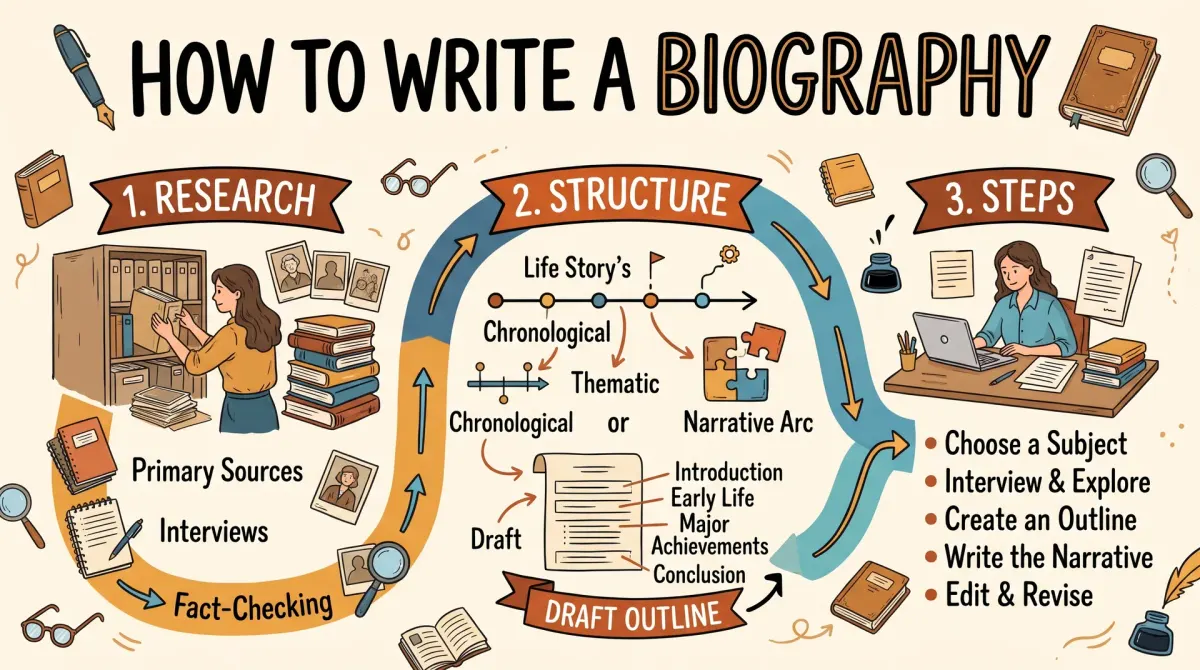
How to write a biography step by step
Key takeaway: Research, timeline, outline, draft, then check every fact.
Use these steps.
- Choose a subject and a focus.
- Check that enough sources exist.
- Gather primary and secondary sources.
- Build a timeline of key events.
- Outline chapters around turning points.
- Draft scenes and cite each fact.
- Fact-check, get permissions and revise.
Step four, the timeline, is a spine. List each event with a date and a source. Gaps and conflicts will show. Where two sources disagree, note it and look for a third.
Step five asks for choices. Not every event deserves a chapter. Pick turning points: a move, a loss, a decision, a breakthrough. Group the life around them.
Step six is the writing. Use scenes where you have detail. Use summary where you do not. Never invent dialogue or thoughts and present them as fact. If you must guess, say "probably" and explain why.
Step seven is the check. Ask a reader to flag any claim that lacks support. Re-read your notes for each chapter.
Structure: a chapter budget
Key takeaway: Split a life into parts by turning points, not by equal years.
Many biographies run in time order. Yet equal years do not mean equal chapters. A quiet decade may take one chapter. A single year of crisis may take three.
Here is a worked example for an 80,000-word biography with 16 chapters.
- Words per chapter: 80,000 ÷ 16 = 5,000 words
Now group the chapters by life stage.
| Part | Chapters | Words |
|---|---|---|
| Early life | 3 | 15,000 |
| Rise | 6 | 30,000 |
| Peak and crisis | 5 | 25,000 |
| Later years | 2 | 10,000 |
Check the totals: 3 + 6 + 5 + 2 = 16 chapters. And 15,000 + 30,000 + 25,000 + 10,000 = 80,000 words.
Notice the weight. The rise and the peak take 55,000 words, or 55,000 ÷ 80,000 = about 69 percent of the book. Early life takes just 19 percent. That is typical, because the reader wants the years when the subject made their mark.
Add a prologue or opening scene to hook the reader. Many biographies start with a dramatic moment, then go back to the beginning.
For help with chapter size, see the chapter length guide.
Interviews and archives
Key takeaway: Plan interviews and archive visits like projects, with a list of questions and a time budget.
Interviews add voice to a biography. They also add risk, since memory is imperfect. Treat each interview as one source and check it against records.
Prepare before you meet anyone.
- Read your notes so you can ask fresh questions.
- Write ten to fifteen open questions.
- Ask for permission to record.
- Ask for the names of others you should meet.
- Send a thank-you note afterward.
Here is a time budget. Say you plan 8 interviews of 90 minutes each.
- Interview time: 8 × 90 = 720 minutes, or 12 hours
- Transcribing at 3 hours per hour of audio: 12 × 3 = 36 hours
So the interviews cost 12 + 36 = 48 hours, before you read a single page of notes.
Archives take planning too. Call ahead, ask about rules for copies and photos, and book your visit. Some archives limit what you can copy. Bring a laptop and a list of the items you want to see.
Keep every file with a clear name: date, source and place. That habit pays off when you cite.
Legal and ethical care
Key takeaway: A biography involves real people. Check your facts, your quotes and your rights.
A biography carries duties. Think about these before you publish.
- Accuracy. A false statement about a real person can cause harm.
- Living subjects. Writing about living people raises risk. Laws on defamation and privacy vary by country.
- Quotes and letters. Letters and unpublished works may be protected by copyright. Check permissions.
- Photos. Do not use photos without the right to do so.
- Sensitive details. Weigh public interest against harm.
- Interviews. Get consent for recordings and note how you will use them.
Keep records of your sources and permissions. If a claim is uncertain, say so in the text.
Your own text is protected by copyright once written. A guide explains what that means and when to register.
This guide is not legal advice. For a book about a living person, consult a media lawyer.
Writing style and voice
Key takeaway: Use clear scenes, a steady voice and honest limits.
A biography should read well. Dry lists of dates tire readers.
- Open with a scene. Place the reader in a moment of the subject's life.
- Show, then explain. Give the event, then say what it meant.
- Be fair. Show strengths and flaws.
- Admit gaps. If records are missing, say so.
- Avoid hero worship. Readers trust an honest tone.
Keep your own voice light. The subject is the star. Use "I" only if you need to explain your method.
Vary your pace. Move fast through quiet years and slow down at turning points.
A good ending matters. Close with the subject's legacy, or with a final scene that echoes your opening.
People Also Ask
How do you start writing a biography?
Choose a subject and write your focus in one sentence. Check that enough sources exist, then gather primary and secondary sources. Build a timeline of key events and outline chapters around turning points. Research comes before drafting, so plan your sources first.
What is the difference between a biography and an autobiography?
A biography is written by someone other than the subject, using research and interviews. An autobiography is written by the subject, from memory. A memoir is also written by the subject but covers one theme or period. The author and the voice are the main differences.
Do you need permission to write a biography?
For a public figure, you generally do not need permission to write about public facts, but rules vary by country. Quoting unpublished letters or using photos may need permission. Writing about living people carries legal risk. Consult a media lawyer before you publish.
Common mistakes
- Starting to write before the research is done.
- Relying only on secondary sources.
- Writing a list of dates with no focus.
- Inventing dialogue or thoughts as fact.
- Ignoring permissions and legal care.
Your next step: build your source ledger
Write your focus in one sentence. List the sources you can reach, sorted into primary, secondary and records. Count them and find the primary share. Then build a timeline of ten key events.
When your research plan is set, plan your chapters with an outline.