What is a poem?
Key takeaway: A poem is short writing that uses sound, image and rhythm to carry feeling.
Merriam-Webster gives the dictionary meaning.
A poem packs meaning into few words. Where prose spreads across paragraphs, a poem condenses. It trusts images to do the work.
A poem differs from prose in a few ways:
- Lines. A poem is built in lines, and the writer chooses where each line ends.
- Compression. Every word counts, so filler words are cut.
- Sound. Rhythm, rhyme and repeated sounds shape the feel.
- Image. A poem shows with pictures rather than explaining.
A poem can be a few lines or several pages. It can rhyme or use free verse, which has no fixed rhyme or meter. Both are valid.
There are no strict rules about what a poem must be. Still, learning the tools makes your choices sharper.
Poetry forms at a glance
Key takeaway: Forms give you a frame. You can follow one or write in free verse.
Here are common forms.
| Form | Rule | Length |
|---|---|---|
| Haiku | Often 5-7-5 syllables | 3 lines |
| Limerick | AABBA rhyme, light tone | 5 lines |
| Sonnet | Rhymed, often 10 syllables a line | 14 lines |
| Free verse | No fixed rhyme or meter | Any |
More forms to know:
- Acrostic. The first letters of each line spell a word.
- Ballad. A story told in short, rhymed stanzas.
- Villanelle. A 19-line form with repeating lines.
- Ode. A poem of praise for a person, place or thing.
- Elegy. A poem of mourning.
A form is a set of rules that helps you choose. If you do not know where to begin, try a short form like the haiku. The limit forces you to focus.
Free verse is not easier. Without a frame, you must find your own rhythm. Many beginners start in free verse and add form later.
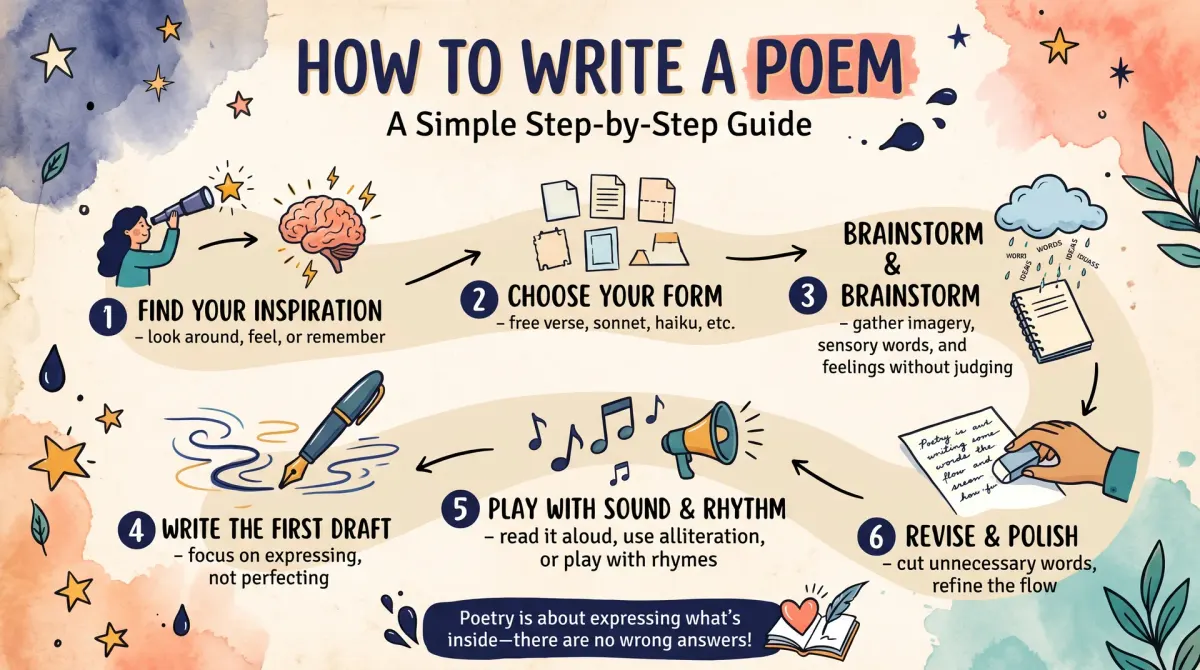
How to write a poem step by step
Key takeaway: Start small. One moment, a few details and a quick draft are enough.
Use these steps.
- Pick one moment, image or feeling.
- List concrete details using the five senses.
- Choose a form, or decide on free verse.
- Write a rough draft without stopping.
- Cut weak words and add vivid images.
- Read the poem aloud and fix the sound.
- Decide on line breaks and a title.
Step one is the key. Do not start with a big idea like "love" or "time". Start with a small moment: a cup of tea, a bus ride, a stranger's laugh. Small things carry big feelings.
Step two builds raw material. Sit with your moment for five minutes. Write what you see, hear, smell, taste and touch. Aim for at least ten details. You will not use all of them.
Step four is about speed. Write fast and do not judge. A rough draft gives you something to shape. Many poets write the first draft in minutes and revise for days.
Step six is a test. Say each line aloud. Where you stumble, the rhythm is off. Where a word sounds harsh, ask if it fits.
If you want to write for a long project later, the short story guide teaches similar habits of focus.
The tools of a poet
Key takeaway: Imagery, comparison, sound and line breaks are the main tools.
These tools appear in most strong poems.
Imagery. Imagery uses the senses. "The kettle screamed" is stronger than "the kettle made a loud noise". Choose images the reader can see or hear.
Metaphor and simile. A metaphor says one thing is another, as in "the moon is a coin". A simile uses "like" or "as", as in "the moon is like a coin". Use fresh comparisons, not worn ones.
Sound. Rhyme repeats the end sound of lines. Alliteration repeats the starting sound of words, as in "soft sand slips". Assonance repeats vowel sounds. Use these with care, since too much feels forced.
Rhythm. Rhythm is the beat of the line. Short words create quick rhythm. Long words slow it down.
Line breaks. A line break is where you end a line. A break can create a pause, a surprise or an emphasis. Break a line on a word you want the reader to hear.
White space. The blank space around a poem is part of it. Space gives the reader time to feel.
Practice one tool at a time. Write a short poem that uses only imagery. Then write one that uses only sound. Each exercise sharpens a skill.
A worked example: counting syllables in a haiku
Key takeaway: A syllable count turns a loose idea into a precise form.
Most pages mention the 5-7-5 pattern and stop. Here is a haiku with the count shown.
Morning rain begins Windows hold the gray city One cup warms my hands
Count the syllables line by line.
- Line one: Mor-ning (2) rain (1) be-gins (2). Total: 5
- Line two: Win-dows (2) hold (1) the (1) gray (1) cit-y (2). Total: 7
- Line three: One (1) cup (1) warms (1) my (1) hands (1). Total: 5
Add them: 5 + 7 + 5 = 17 syllables.
The haiku shows a small moment. It uses sight (gray city) and touch (warm hands). It does not say "I feel cozy". The images carry the feeling.
A note on the form: the 5-7-5 count is common in English. In Japanese, the traditional form counts sounds, not syllables, and many English poets treat the count loosely. Check the rules of any journal or contest.
Now try a longer form. A sonnet has 14 lines. If each line has 10 syllables, the total is 14 × 10 = 140 syllables.
You do not need to follow strict counts in free verse. But counting teaches you to feel rhythm. Many poets count while drafting, then loosen the rules in revision.
A worked example: revising a draft line
Key takeaway: Cut abstract words and replace them with an image.
Revision is where a poem comes alive. Here is a short before and after.
Draft:
The tree was very old and looked sad in the cold wind.
Count the words. The (1) tree (2) was (3) very (4) old (5) and (6) looked (7) sad (8). In (9) the (10) cold (11) wind (12). That is 12 words.
What is wrong? The words "very", "old" and "sad" are abstract. They tell the reader how to feel. The line has no picture.
Revision:
Bare oak, bent to the wind.
Count the words: Bare (1) oak (2) bent (3) to (4) the (5) wind (6). That is 6 words.
The revision cuts 12 − 6 = 6 words, or 50 percent. It adds two images: the bare branches and the bend. The reader sees the sadness without being told.
Use this method on your own draft:
- Circle every abstract word, such as sad, beautiful, lonely.
- Replace each with a concrete detail.
- Cut adverbs like "very" and "really".
- Check that each line adds something new.
Then read the poem aloud. If you stumble, adjust the rhythm.
Finding ideas and overcoming blocks
Key takeaway: Ideas come from small, real moments. A routine helps more than waiting for inspiration.
Many writers stall at the blank page. These habits help.
- Keep a notebook. Jot down images, overheard lines and odd words.
- Use a prompt. Write for ten minutes on "the smell of rain" or "a locked door".
- Borrow a form. A rule can free you from a blank page.
- Read poems. Read one poem aloud each day.
- Set a small goal. Write four lines, not a masterpiece.
- Revise old drafts. A rough poem from last month may spark a new idea.
Another trick is to write from a list. List ten objects in your room. Pick one and write four lines about it. The object gives your poem a base.
Do not wait for a mood. Poets who write often learn to start on cue. Ten minutes a day over a month adds up to 300 minutes. That is 10 × 30 = 300, or five hours of practice.
When you finish a poem, give it a title that adds meaning. A title can set the scene or add a twist. A title tool can help you test options.
Sharing and publishing your poems
Key takeaway: Start small. Share with a friend, then submit to magazines, and later think about a book.
Once you have a few polished poems, you have options.
- Share with a reader. Ask a friend what image stayed with them.
- Join a group. A local or online poetry group gives feedback.
- Submit to journals. Many literary magazines accept poems. Read their rules first.
- Enter contests. Some contests are free, and others charge a fee.
- Build a collection. A set of linked poems can form a book.
A poetry collection often needs a theme or a thread. If you plan to self-publish, a full guide covers the steps.
A checklist helps you catch details before you publish.
People Also Ask
How do you start writing a poem?
Start with one small moment or image, not a big idea. List ten concrete details using the five senses. Then write a rough draft fast, without stopping to judge. You can revise later. A short form like a haiku can help beginners focus.
Does a poem have to rhyme?
No. Many poems use free verse, which has no fixed rhyme or meter. Rhyme is one tool among many. Strong poems also rely on imagery, rhythm, sound and line breaks. If you do use rhyme, avoid forcing words just to match a sound.
How long should a poem be?
A poem can be any length. A haiku has three lines and about 17 syllables. A sonnet has 14 lines. Free verse may run a few lines or several pages. Let the idea decide the length, and cut any line that adds nothing new.
Common mistakes
- Starting with a big abstract idea.
- Forcing rhymes that change the meaning.
- Telling the reader how to feel.
- Using stale comparisons.
- Skipping revision and the read-aloud test.
Your next step: write a haiku today
Pick one small moment. Write three lines using the 5-7-5 count. Check the syllables, as in the example. Then revise by replacing any abstract word with an image.
When you have several poems, think about how they might fit together in a collection.