Memoir vs autobiography: the main difference
Key takeaway: Scope is the main difference. A memoir is a slice. An autobiography is the whole loaf.
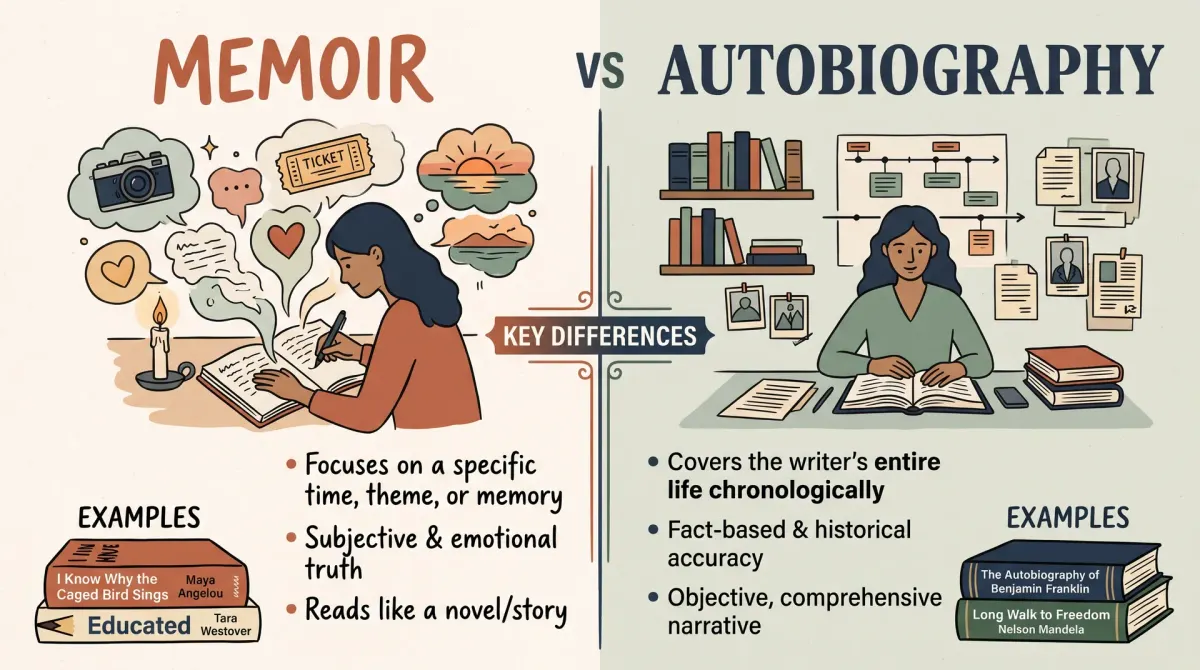
Memoir vs autobiography is a question of scope. An autobiography is an account of the author's entire life, told in order and rich in facts and dates. A memoir is an account of one chosen theme or period. It is told with feeling and reflection on what the events meant.
Merriam-Webster defines both words.
Think of a life as a long road. An autobiography drives the whole road. It starts at the first mile and stops where the author is today. A memoir stops at one stretch of road and looks closely at it.
This changes the whole book.
- Focus. An autobiography follows time. A memoir follows a theme.
- Tone. An autobiography often reports. A memoir often reflects.
- Structure. An autobiography runs in order. A memoir may jump around.
- Detail. An autobiography covers many events briefly. A memoir covers few events deeply.
Both are true. Both use "I". Both rest on the author's memory. The gap lies in what the author chooses to include.
For a full guide to writing a life story, the memoir guide on this site is a good starting point.
Comparison table: memoir, autobiography, biography and essay
Key takeaway: Four forms of life writing differ by author, scope and length.
Here is a side-by-side view.
| Form | Author | Scope |
|---|---|---|
| Memoir | The person | One theme or period |
| Autobiography | The person | The whole life |
| Biography | Someone else | A life or part of one |
| Personal essay | The person | One idea or moment |
A few more points:
- Voice. Memoir and autobiography use "I". A biography uses "he" or "she".
- Research. A biography needs outside research. A memoir rests on memory, though many authors check old letters and photos.
- Length. A personal essay may be a few pages. The other three are book-length.
- Shape. A memoir reads like a story with scenes. An autobiography may read like a chronicle.
The terms sometimes overlap. A book may be called an autobiography but read like a memoir. Many publishers now label life stories as memoir because the market prefers it.
Use the table to place your own project. Ask who writes it and how much of the life it covers.
Examples of each form
Key takeaway: Famous titles show the split in scope and tone.
Real books help make the difference clear.
Autobiography examples
- The Autobiography of Benjamin Franklin. It covers a long life and many roles.
- Long Walk to Freedom by Nelson Mandela. It covers his life from childhood to the presidency.
- The Story of My Experiments with Truth by Mohandas Gandhi. It follows his path across many years.
Memoir examples
- Educated by Tara Westover. It centers on her upbringing and path to education.
- Wild by Cheryl Strayed. It follows one long hike and the grief behind it.
- Angela's Ashes by Frank McCourt. It focuses on a childhood in poverty.
Notice how the autobiographies span decades and roles. The memoirs stay close to one theme.
A note on labels: some books blend both. A book may follow a whole life but still center on one idea. In that case, the author and publisher choose the label that fits the market.
How scope changes the book: a words-per-year test
Key takeaway: The more years you cover, the less room each year gets.
Most pages say "a memoir is narrower". Numbers show how much narrower.
Take the same length for both books: 70,000 words. Compare the years covered.
- Autobiography: 70 years of life.
- Memoir: 2 years of life.
Now divide words by years.
- Autobiography: 70,000 ÷ 70 = 1,000 words per year
- Memoir: 70,000 ÷ 2 = 35,000 words per year
The memoir gives each year 35 times as many words, because 35,000 ÷ 1,000 = 35.
At 250 words per page, that works out as follows.
- Autobiography: 1,000 ÷ 250 = 4 pages per year
- Memoir: 35,000 ÷ 250 = 140 pages per year
So the autobiography can give a whole year only four pages. The memoir can give a single year 140 pages. This is why memoirs read like stories and autobiographies read like summaries.
The numbers help you plan. If you want scenes, dialogue and feeling, you need room. That means a narrow span.
Here is a quick rule of thumb. If the span of your book is more than about 10 years, you will likely summarize more than you show. That is a planning idea, not a rule.
For help with length targets, see the word count guide.
Which should you write? A five-question score
Key takeaway: Answer five questions. Your score points to the right form.
Use this short test. Give one point for each "memoir" answer.
- Do you have one clear theme? Yes points to memoir.
- Can you tell the story in under ten years? Yes points to memoir.
- Do you want scenes and feeling more than facts? Yes points to memoir.
- Do you want readers outside your family? Yes points to memoir.
- Is your goal a record of every life stage? Yes points to autobiography.
Score the first four. Add one point for each yes.
Here is a worked example. A retired nurse wants to write about her career.
- One clear theme: yes (caring for others). 1 point
- Under ten years: no (40 years). 0 points
- Scenes and feeling: yes. 1 point
- Readers outside the family: yes. 1 point
Total: 1 + 0 + 1 + 1 = 3 out of 4.
A score of 3 or 4 points to a memoir. A score of 0 to 2 points to an autobiography. Our nurse scores 3. She should write a memoir. She might choose one case or one hospital year as her focus, instead of the full 40 years.
If your goal is a family record for relatives only, an autobiography may serve you well. It does not need to grip strangers. It needs to be complete and clear.
This test is a guide, not a verdict. Use it to start a conversation with yourself about what the book is for.
How the same event reads in each form
Key takeaway: An autobiography reports the event. A memoir puts the reader inside it.
Take one event: the author's first day at a new school, at age eleven.
An autobiography might say:
In 1985, when I was eleven, my family moved to a new town. I started at the local school in September and made two friends by the end of the month.
A memoir might say:
The classroom smelled of chalk and wet coats. I held my bag in both arms like a shield. A girl in the back row moved her books so I could sit, and I almost cried.
The two passages differ in three ways.
- Time. The first covers a month in two sentences. The second stays in one moment.
- Detail. The first gives facts. The second gives sights, smells and a gesture.
- Feeling. The first states no emotion. The second lets the reader feel it.
Neither is wrong. They serve different goals. An autobiography records. A memoir recreates.
You can mix the two. Some autobiographies slow down at turning points and use scenes there. Some memoirs use a few lines of summary to move past dull years. Most good life writing blends both, with one mode in the lead.
When you draft, notice which mode you are in. If every page reads like the first sample, ask where the reader should feel something. Slow down there and write the scene.
Market and publishing view
Key takeaway: Memoir is easier to sell to strangers. Autobiography suits well-known figures and family records.
The market matters if you plan to publish.
- Memoir. Readers pick memoirs for story and theme. Unknown authors can sell them, if the story is strong.
- Autobiography. Readers pick autobiographies for the person. They suit public figures, whose lives already draw interest.
- Family record. A private autobiography can be printed for relatives. Sales are not the goal.
Agents and publishers often treat memoir as a story-driven form. Nonfiction authors may need a book proposal. A proposal outlines the theme, the market and sample chapters.
For self-publishing, choose your categories with care. Memoir and autobiography may sit under different subject headings. A guide covers how to pick categories and keywords.
Last, the title helps readers see the form. Words such as "a memoir" in the subtitle set the right expectation.
People Also Ask
Is a memoir the same as an autobiography?
No. A memoir covers a chosen theme or period and leans on feeling and reflection. An autobiography covers the whole life in order and often leans on facts and dates. Both are true stories written by the person who lived them. Scope is the main difference.
Which is better to write, a memoir or an autobiography?
It depends on your goal. A memoir suits readers who want a story with a clear theme, and it sells better for unknown authors. An autobiography suits a complete life record or a well-known figure. Use a short score of five questions to decide.
Can a memoir cover a whole life?
It can, but it is rare. A memoir usually centers on one theme. If it spans a whole life, the author often threads one idea through every stage. Past about ten years of span, most books summarize more than they show, so the focus matters.
Common mistakes
- Using the two terms as if they mean the same thing.
- Trying to cover every life stage in a memoir.
- Writing an autobiography as a dry list of dates.
- Picking a label that does not match the book.
- Ignoring the market when choosing the form.
Your next step: run the five-question score
Answer the five questions about your own project. Add your points. If you land on memoir, write your theme in one sentence. If you land on autobiography, list the life stages you want to cover.
Then plan the structure with an outline.