What is a graphic novel?
Key takeaway: A graphic novel is a book-length story told through panels of art and text.
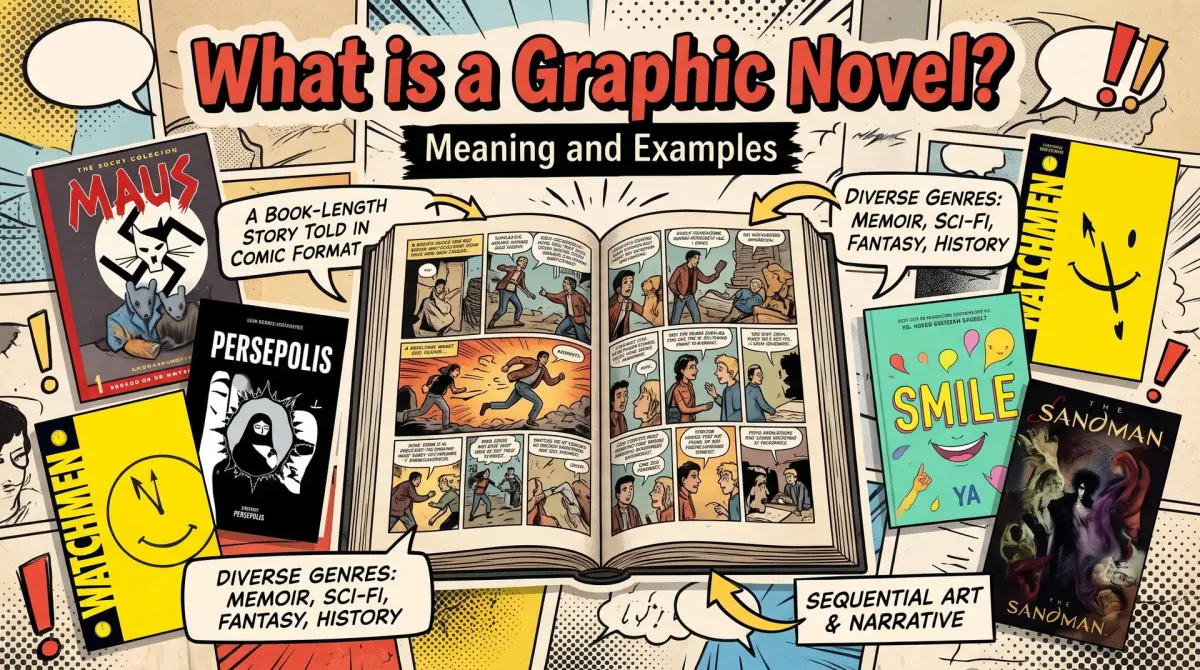
A graphic novel is a book-length story told through illustrated panels and text, such as dialogue and captions. It is published as a bound book and tells a complete story or a long arc. The form covers fiction and nonfiction in many genres.
Merriam-Webster lists the dictionary meaning.
Will Eisner's A Contract with God, from 1978, helped popularize the term. Since then, the form has grown into a large part of the book market.
A graphic novel has a few key parts:
- Panels. Boxes that hold one moment of the story.
- Gutters. The gaps between panels, where the reader fills in time.
- Speech balloons. Bubbles that hold dialogue.
- Captions. Boxes that hold narration.
- Sound effects. Lettered noises that add energy.
The key idea is that the reader assembles the story. The reader looks at the art, reads the text and links one panel to the next. That gives the form a special rhythm.
A graphic novel is a format, not a genre. It can hold romance, horror, history or memoir. The genre comes from the story, and the format comes from the way it is told.
Graphic novel vs comic book vs manga
Key takeaway: The three forms differ in format and reading habits, though they share tools.
These terms are often mixed up. The table shows the main split.
| Form | Usual format | Story length |
|---|---|---|
| Comic book | Thin serial issue | Part of a longer story |
| Graphic novel | Bound book | A full story or long arc |
| Manga | Japanese comics | Serial chapters, then volumes |
A comic book is a thin, serial publication. Each issue holds one chapter of a larger tale. Readers collect issues over months.
A graphic novel is a bound book. It is meant to be read in one go. Some graphic novels collect a run of comic issues into one volume.
Manga are comics from Japan. They are usually read from right to left. Many appear first as serial chapters in magazines, then as volumes. They have their own styles and genres.
The lines blur. A collected volume of a comic series may be sold as a graphic novel. A long manga volume looks much like a graphic novel. Publishers use the labels that suit their market.
For a writer, the key point is scope. A graphic novel needs a complete shape. The story should have a beginning, a middle and an end within one book.
Types of graphic novel
Key takeaway: The format holds almost every kind of story.
Graphic novels cover many kinds of content.
- Fiction. Fantasy, science fiction, romance, mystery and horror.
- Superhero. Stories of heroes with powers, a large branch of the form.
- Memoir. True stories of the author's life, told in pictures.
- Nonfiction. History, science, biography and explainers.
- Middle-grade and young adult. Stories for young readers, often about school and friendship.
- Adaptations. Classic books retold in panels.
- Wordless. Stories told only in pictures.
Memoir is a strong branch. Pictures can show what words struggle to say, such as fear or loss. If you want to tell a life story, the memoir guide on this site covers theme and scope.
Educational graphic novels are growing too. A hard topic can become clear when it is drawn. Many readers find a diagram in a panel easier than a page of text.
Graphic novel examples
Key takeaway: Famous titles show the range of the form.
These books are widely known.
- Maus by Art Spiegelman. It tells a father's story of surviving the Holocaust, using animals to stand for groups of people. It won a special Pulitzer Prize in 1992.
- Persepolis by Marjane Satrapi. It is a memoir of growing up in Iran during and after the revolution.
- Watchmen by Alan Moore and Dave Gibbons. It is a superhero story that questions the genre.
- Fun Home by Alison Bechdel. It is a memoir about family, memory and identity.
- Bone by Jeff Smith. It is a fantasy adventure with humor and heart.
- American Born Chinese by Gene Luen Yang. It weaves three tales about identity and belonging.
Notice the range. Two are memoirs. One is a superhero deconstruction. One is a family fantasy. The format does not limit the story.
Notice also how each uses art. In Maus, animals carry meaning. In Persepolis, bold black-and-white art conveys memory. In Watchmen, the grid of panels creates rhythm. The art choices are part of the story.
If you want to read one before writing, pick a title from your own genre. Study how the panels pace the scenes. Pick one chapter and count its panels per page and the words per panel. Compare your counts with the budget below. This gives you real numbers for your own genre.
How to plan a graphic novel: a page-and-panel budget
Key takeaway: Count your pages and panels early. The numbers decide your time and your cost.
Most pages say "plan your pages" and stop. A simple budget gives you real numbers.
Many graphic novels run about 100 to 200 pages. Say you plan 128 pages.
Panels. Assume an average of 5 panels per page.
- Panels: 128 × 5 = 640 panels
Text. Assume an average of 40 words per page.
- Words: 128 × 40 = 5,120 words
So your whole script has about 5,120 words. That is a short text, because the art carries much of the story.
Time. Say the artist can finish one page in two days, including sketching, inking, color and lettering.
- Days: 128 × 2 = 256 days
- Months: 256 ÷ 30 = about 8.5 months
If you work with an artist, that time may be their work, not yours. Ask for a schedule early.
Story shape. Split the pages into three acts.
| Act | Share | Pages |
|---|---|---|
| Setup | 25% | 32 |
| Struggle | 50% | 64 |
| Resolution | 25% | 32 |
Check: 32 + 64 + 32 = 128 pages. And 128 × 0.25 = 32, 128 × 0.50 = 64.
These numbers are examples. Your project may differ. Still, the exercise shows why scope matters. A 128-page book is months of work. A 300-page book is far more.
For a general plan of your story beats, an outline helps.
How to make a graphic novel step by step
Key takeaway: Write the story, plan the pages, then draw, letter and prepare for print.
Use these steps to make one.
- Write a one-page summary of the story.
- Break the story into scenes and pages.
- Write a script with panel descriptions.
- Draw thumbnail sketches of each page.
- Pencil, ink and color the final pages.
- Add lettering for speech and sound effects.
- Export print files to your printer's specs.
Step three is the script. A graphic novel script describes each panel: the setting, the action and the words. Keep descriptions short. The artist needs to know what to draw, not every detail.
Step four, thumbnails, saves time. These small sketches show the layout of each page. Fix pacing problems here, not in the final art.
If you are not an artist, you can partner with one. Agree on pay, credit and rights in writing before work starts. A short contract avoids hard talks later.
Last, keep a consistent style. The characters should look the same from page to page. Make a model sheet for each main character.
Preparing a graphic novel for print
Key takeaway: Art-heavy books have strict print needs. Check size, bleed and page count before you export.
If you plan to self-publish, plan for print from the start.
- Trim size. Choose a size before you draw. Changing it later can mean redrawing.
- Bleed. Art that touches the page edge needs extra image beyond the trim line.
- Resolution. Print files need high-resolution images.
- Color or black and white. Color printing usually costs more than black and white.
- Page count. Your print cost and spine width depend on it.
Two tools on this site help. One checks your interior file for size, pages and bleed. The other calculates cover and spine width.
Lettering and layout also affect print quality. If you need help with files, a service guide explains what to expect and what to ask.
People Also Ask
What is the difference between a graphic novel and a comic?
A comic book is usually a thin serial issue that holds one part of a longer story. A graphic novel is a bound, book-length work that tells a complete story or a long arc. Collected comic series are often sold as graphic novels, so the line is soft.
Are graphic novels only for kids?
No. Graphic novels span all ages and genres. Many are for adults, including memoirs, history and literary fiction. Others are written for middle-grade and teen readers. The format is a way of telling a story, so the audience depends on the content.
How long is a graphic novel?
Many graphic novels run about 100 to 200 pages, though length varies. A 128-page book with 5 panels per page has about 640 panels. At 40 words per page, the script is about 5,120 words. Plan your pages early, since they set your time and cost.
Common mistakes
- Starting to draw before the script and thumbnails are done.
- Packing too much text into each panel.
- Changing the trim size after the art is drawn.
- Skipping bleed in the print files.
- Working with an artist without a written agreement.
Your next step: build your page budget
Pick a page count. Multiply by your panels per page to find your panel total. Multiply by your words per page to find your script size. Split the pages into three acts.
Then turn your idea into a full plan with an outline.