What is a memoir?
Key takeaway: A memoir is a true story about one part of a life, told with reflection.
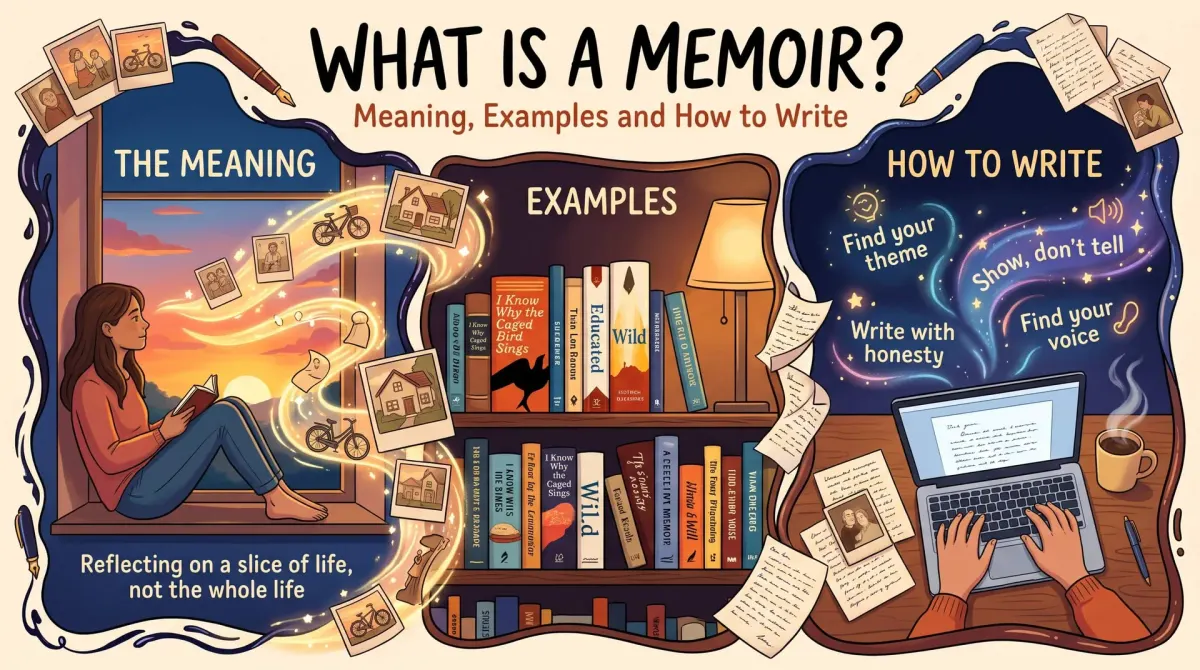
A memoir is a nonfiction account of a chosen part of the author's life. It is told from the author's own memory and viewpoint. It centers on a theme, such as grief or a move abroad, not a full life story. The writer shares events and reflects on their meaning.
The word comes from the French word for memory. That fits the form. A memoir rests on what the author remembers, and on how the author makes sense of it.
Merriam-Webster gives the dictionary meaning.
Four features set a memoir apart:
- It is true. The events happened, as the author recalls them.
- It is focused. One theme or period holds the book together.
- It is reflective. The author looks back and finds meaning.
- It has a voice. The reader feels a real person speaking.
Memory is not perfect. Two people can recall the same day in different ways. Readers know this. They accept the author's version if the author is honest about it.
A memoir also reads like a story. It has scenes, dialogue and a shape. The author is the lead character. Other real people play the supporting roles.
If you want a step-by-step path for a life story, the memoir guide on this site covers it.
Memoir vs autobiography vs biography
Key takeaway: A memoir is a slice of a life. An autobiography is the whole life. A biography is written by someone else.
These three forms are often mixed up. The table shows the main split.
| Form | Who writes it | Scope |
|---|---|---|
| Memoir | The person | One theme or period |
| Autobiography | The person | The whole life, in order |
| Biography | Someone else | A whole life or a part |
The key word is scope. An autobiography walks through a life from birth to the present. A memoir picks one thread and follows it.
Tone also differs. An autobiography often lists facts and dates. A memoir leans on feeling and meaning. The reader should learn why the events mattered, not only what they were.
A biography is told by an outside writer. The writer uses research, interviews and records. The subject may or may not take part.
Many people use "memoir" and "autobiography" as if they were the same. The line is soft. Still, the scope test below shows why the choice matters. A narrow focus gives a stronger book.
Types of memoir
Key takeaway: Memoirs cluster by theme. Pick the theme before you pick the events.
Memoirs come in many kinds. The theme is the common thread.
- Coming-of-age memoir. It covers growing up and the lessons of youth.
- Travel memoir. It follows a journey and what the trip changed.
- Illness and recovery memoir. It covers a health struggle and its aftermath.
- Family memoir. It centers on a parent, a sibling or a family secret.
- Work memoir. It tells the story of a career, a craft or a place of work.
- Food memoir. It links meals and recipes to key moments.
- Faith memoir. It follows a path of belief, doubt or change.
- Celebrity memoir. It shares a public figure's private side.
The type shapes the reader's promise. A travel memoir promises a place. A recovery memoir promises a turning point. Meet that promise by the end.
Some memoirs mix types. A family memoir can also be a coming-of-age story. That is fine. Choose one main theme and let the rest support it.
Try a simple test. Finish this sentence: "This is a book about ___." If you need three answers, the focus is too wide.
Memoir examples
Key takeaway: Famous memoirs each cover one slice of life with a clear theme.
Reading memoirs helps you see how focus works. These six are well known.
- Angela's Ashes by Frank McCourt. It tells of a childhood in poverty in Limerick, Ireland.
- I Know Why the Caged Bird Sings by Maya Angelou. It covers her childhood years and the struggles she faced.
- The Glass Castle by Jeannette Walls. It shows a childhood with parents who moved the family often.
- Wild by Cheryl Strayed. It follows a long hike on the Pacific Crest Trail after loss.
- Educated by Tara Westover. It tells of a childhood in a survivalist family and her later path to university.
- Born a Crime by Trevor Noah. It looks at growing up in South Africa during and after apartheid.
Each book has one theme. None tries to cover a full life. Each uses scenes, not summary. And each lets the author reflect on what the events meant.
Notice the pattern. The setting is vivid. The stakes are personal. The author is honest about flaws.
You do not need a famous life to write a strong memoir. You need a clear theme and honest scenes. A quiet story told well can beat a dramatic one told flat.
How to choose your memoir's scope
Key takeaway: Test every event against your theme. Keep what serves it and cut the rest.
Most pages say "focus on a theme" and stop. This test gives you numbers.
Step one: write your theme in one sentence. For example: "The year I cared for my father and learned to ask for help."
Step two: list every event that comes to mind. Do not judge yet.
Step three: test each event. Ask whether it moves the theme forward. If not, mark it for cutting.
Here is a worked example.
- Events listed: 40
- Events that serve the theme: 24
- Events cut: 40 − 24 = 16
Share kept: 24 ÷ 40 = 0.60, or 60 percent.
Cutting 40 percent of your material may feel painful. It is normal. A memoir is not a diary. A diary keeps everything. A memoir keeps what matters.
Now turn the scenes into a plan. Say each scene runs 2,500 words.
- Scenes: 24
- Words: 24 × 2,500 = 60,000 words
Split the scenes into three parts.
| Part | Scenes | Words |
|---|---|---|
| Setup | 6 | 15,000 |
| Struggle | 12 | 30,000 |
| Change | 6 | 15,000 |
Check the totals: 6 + 12 + 6 = 24 scenes, and 15,000 + 30,000 + 15,000 = 60,000 words.
At 250 words per page, 60,000 ÷ 250 = 240 pages. That is a normal book size.
Many memoirs run about 60,000 to 90,000 words. These numbers are planning aids, not rules. For length norms by genre, see the word count guide.
How to write a memoir step by step
Key takeaway: Theme first, then scenes, then reflection, then care.
Use these steps to write your memoir.
- State your theme in one sentence.
- List the events that serve that theme.
- Cut events that do not move the theme.
- Outline your scenes in three parts.
- Draft each scene with detail and feeling.
- Add reflection on what each event meant.
- Revise for truth, pace and privacy.
Step five is the heart of the work. A scene should place the reader in a room. Use sights, sounds and small details. Let people speak in their own words, as best you recall them.
Step six sets memoir apart from a diary. After a scene, step back. Say what you understand now that you did not then. Keep reflection short. A line or a paragraph is often enough.
Step four goes faster with a template. An outline shows where tension rises and where it rests.
Last, write the first draft fast. Fix it later. Many writers stall because they edit as they go.
Truth, privacy and care
Key takeaway: A memoir involves real people. Handle truth and privacy with care.
A memoir names real people, so it carries real duties. Think about these before you publish.
- Tell your truth, not theirs. Write what you saw and felt. Avoid guessing what others thought.
- Be honest about memory. An author's note can say that dialogue is recalled, not recorded.
- Consider changing names. Many authors change names and details to protect privacy.
- Avoid false claims. A statement of fact about a real person can cause legal trouble if it is untrue.
- Ask for a read. Some authors share key chapters with people in the story.
Laws on privacy and defamation differ by country. This guide is not legal advice.
Your own text is protected by copyright once you write it. Registration adds benefits in some countries. A separate guide explains what happens and when to register.
People Also Ask
What is the difference between a memoir and an autobiography?
A memoir covers a chosen theme or period of the author's life. An autobiography covers the whole life in order, usually from birth to the present. A memoir leans on feeling and reflection. An autobiography often leans on facts and dates. The scope is the main difference.
Does a memoir have to be 100 percent true?
A memoir is a nonfiction form, so the events should be true as the author remembers them. Memory is imperfect, and authors often note that dialogue is recalled. Some change names or merge minor details to protect privacy. Inventing major events turns a memoir into fiction.
How long is a memoir?
Many memoirs run about 60,000 to 90,000 words, though this varies. A 60,000-word memoir has 24 scenes of 2,500 words each. At 250 words per page, that fills about 240 pages. Check the norms for your market before you set a target.
Common mistakes
- Trying to cover a whole life in one book.
- Telling events as summary instead of showing them in scenes.
- Skipping reflection, so the events feel pointless.
- Painting other people as villains with no nuance.
- Ignoring privacy and legal care.
Your next step: run the scope test
Write your theme in one sentence. List every event that comes to mind. Mark each one keep or cut, then count the shares. Group the kept events into three parts and give each a word budget.
When your scenes are set, shape them into a full plan with an outline.