What is an audiobook?
Key takeaway: An audiobook is a spoken version of a book, delivered as audio files.
Merriam-Webster lists the dictionary meaning.
An audiobook usually follows the text of the book. A narrator reads it aloud. The result is split into files, often one per chapter. Listeners play it on a phone, a car system or a smart speaker.
There are a few formats:
- Single-voice narration. One narrator reads the whole book.
- Multi-voice or full-cast. Different actors voice different characters.
- Dramatized. Music and sound effects are added.
- Abridged. The text is shortened. Most modern audiobooks are unabridged.
Most authors start with single-voice narration. It is the simplest to plan and to produce.
If you want to become a narrator yourself, see the narrator guide on this site.
How long will your audiobook be? A word-to-hours calculation
Key takeaway: Convert your word count to finished hours. It sets your time and cost.
Most pages skip this step. Yet audiobook work is priced and planned by finished hour.
The industry rule of thumb is about 9,300 words per finished hour. That is roughly 155 words per minute, a normal reading pace. ACX uses this figure, and Findaway-style estimates run slightly lower at about 9,000. Treat 9,000 to 10,000 as the realistic range, because narration speed varies with the text and the narrator.
Say your book has 80,000 words.
- Finished hours: 80,000 ÷ 9,300 = about 8.6 hours
Round up to 9 hours for planning.
Now estimate recording and editing time. ACX states that most producers need 5 to 7 hours of work to produce one finished hour of audio. That covers recording, retakes, editing, mastering and checking. First-time narrators should plan for the upper half of that range. Say you plan 6 work hours per finished hour.
- Work hours: 8.6 × 6 = about 52 hours
- Range at ACX's 5 to 7 hours: 8.6 × 5 = 43 hours, up to 8.6 × 7 = about 60 hours
If you work 6 hours a week, that is 52 ÷ 6 = about 9 weeks. If you work 2 hours a week, it is 52 ÷ 2 = 26 weeks. Plan your schedule with these numbers.
Chapter count matters too. Say your book has 24 chapters.
- Average chapter length: 8.6 hours × 60 ÷ 24 = about 21.5 minutes
Knowing the length per chapter helps you plan recording sessions. A first-time narrator may manage about 3 chapters in a 3-hour session, including retakes.
For chapter planning, see the chapter length guide.
Self-narrate or hire a narrator?
Key takeaway: Compare cost, quality and time before you choose.
You have three main choices.
| Option | Cost to you | Notes |
|---|---|---|
| Self-narrate | Gear and time (about 52 work hours for an 8.6-hour book) | Full control |
| Hire a narrator (pay for production) | Per finished hour; often about $200 to $400 | Skilled voice, less effort |
| Royalty share | No upfront fee | Narrator shares future earnings |
Self-narrate. You save fees and keep control. You also need a quiet room, basic gear and a lot of patience. A strong reading takes practice.
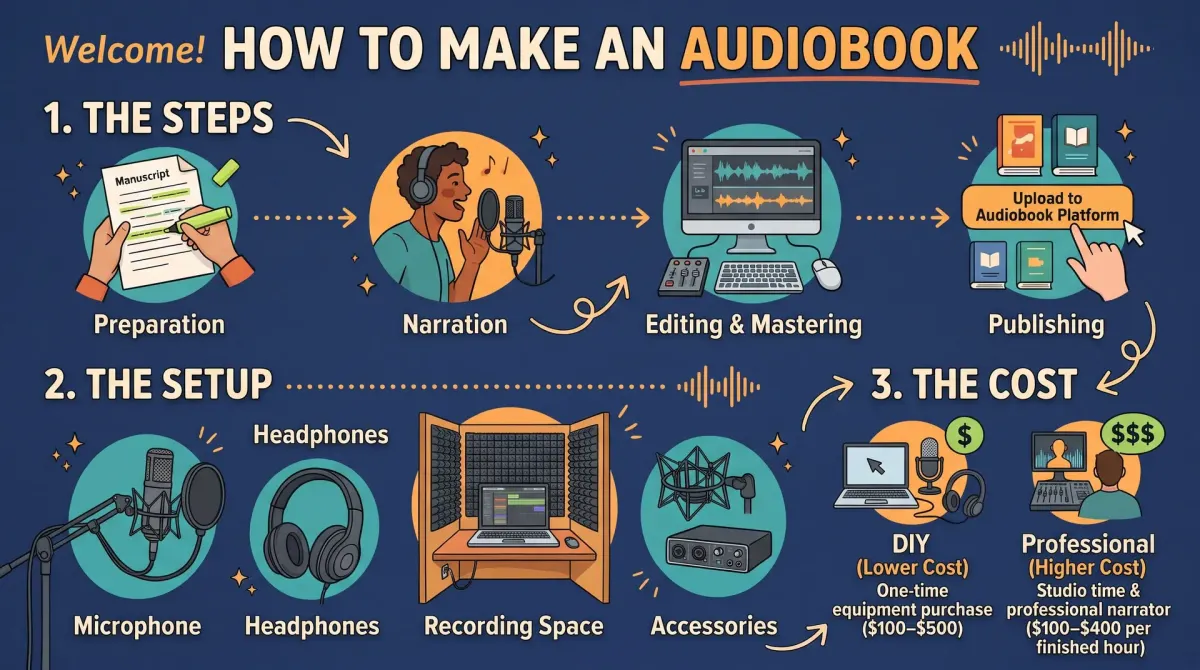
Hire a narrator. A pro brings skill, gear and speed. Narrators set rates per finished hour. Rates vary widely: newer narrators may start near $100, many working narrators quote about $200 to $400, and top or union narrators charge more. ACX lets the rights holder and narrator agree any rate that suits both.
Say a narrator charges $250 per finished hour.
- Cost: 8.6 × $250 = $2,150
- Range at $200 to $400: 8.6 × $200 = $1,720, up to 8.6 × $400 = $3,440
Add costs for editing or mastering if not included. A proofing pass may add a few hundred dollars.
Royalty share. On ACX, you pay the narrator nothing up front and split the royalties 50/50 with them. The deal runs for 7 years, and it requires you to give ACX exclusive distribution, so you cannot sell the audiobook in other stores. Under ACX's new royalty model (from May 26, 2026), an exclusive title earns 50%, so you and the narrator each receive 25%. Under the legacy model, the rates are 40% and 20% each. A hybrid called Royalty Share Plus pays the narrator a reduced fee up front on top of the 50/50 split. Read the contract with care, because the exclusivity lock can be hard to undo.
Which should you choose? Self-narrate if you have a good voice, a quiet space and time. Hire if you want polish or if you have a long book. For a short nonfiction book, many authors read their own work, since readers like the author's voice.
Run an audition. Read a chapter aloud and listen back. If you cringe, consider hiring.
The setup: gear and room
Key takeaway: A quiet room beats an expensive microphone.
You do not need a pro studio. You do need quiet.
Gear list
- Microphone. A USB microphone is the easiest start. An XLR microphone with an audio interface gives more control.
- Pop filter. It softens harsh "p" and "b" sounds.
- Headphones. Closed-back headphones help you hear detail.
- Recording software. Audacity is free. Paid options add features.
- Stand. A boom arm or desk stand keeps the mic steady.
- Script holder. A tablet or a printed script on a stand.
Room tips
- Choose a small room with soft surfaces. A closet full of clothes works well.
- Turn off noise sources. Fans, fridges and phones make noise.
- Record at quiet times. Avoid traffic and neighbors.
- Add soft items. Blankets, rugs and cushions cut echo.
- Do a test. Record 30 seconds of silence and listen for hiss or hum.
The test matters. ACX rejects files whose background noise is louder than -60 dB RMS. Listen through headphones at a high volume. If you hear a hum, fix it before you record the whole book.
A basic setup can cost a modest sum. Costs vary by gear and country.
How to make an audiobook step by step
Key takeaway: Check rights, prepare the script, record, edit and then upload.
Use these steps.
- Check your rights to the book.
- Decide to self-narrate or hire.
- Prepare the script and pronunciation notes.
- Record chapters in a quiet room.
- Edit and master the audio files.
- Check files against platform specs.
- Upload and set price and metadata.
Step one is key. If you self-published, you likely own the audio rights. If you have a publisher, check your contract. A guide explains copyright basics.
Step three saves time. Mark names, places and hard words. Add notes on how to say them. Remove text that does not work aloud, such as tables, photo captions or "see below". Add short audio-friendly lines in their place.
Step four is the long step. Record in short sessions of one to two hours. Take breaks. Drink water. Read each chapter once, then fix errors by re-recording the lines.
Step five turns raw audio into a polished file. Cut mistakes, breaths and long pauses. Even out volume. Reduce noise. Keep a short gap of room tone at the start and end of each file, as the platform requires.
Step six is a check. Listen to every file. ACX offers a free audio analysis tool that checks a finished file against its standards before you submit the whole book.
Step seven is the upload. To start on ACX, you claim your title using the ASIN of your ebook, so the ebook must already be on sale on Amazon.
A sample recording schedule
Key takeaway: Plan sessions by chapters, not by hours alone.
A schedule keeps you moving. Say your book has 24 chapters of about 21.5 minutes each.
You record 3 chapters per session.
- Sessions: 24 ÷ 3 = 8 sessions
- Finished audio per session: 3 × 21.5 = about 65 minutes
Say each session takes 3 hours with retakes and breaks.
- Recording time: 8 × 3 = 24 hours
Editing, mastering and checks take the rest of your 52-hour plan.
- Editing and checks: 52 − 24 = 28 hours
- Total work: 24 + 28 = 52 hours
That matches the earlier estimate of about 52 work hours, or 6 hours per finished hour. If you book two sessions a week, the recording phase takes 8 ÷ 2 = 4 weeks. Editing and checks come after, or alongside, the recording weeks.
File specs and quality checks
Key takeaway: Platforms reject files that miss their technical rules. Check before you upload.
Each platform sets rules for file format, volume and noise. ACX publishes these requirements, and its quality team can reject files that miss them. Always read the latest rules for your platform before you master.
The current ACX requirements are:
- File format. MP3, 192 kbps or higher, constant bit rate (CBR), 44.1 kHz.
- Channels. All files mono or all files stereo. Do not mix them.
- One chapter or section per file. Opening and closing credits go in separate files, and each file runs no longer than 120 minutes.
- Loudness. Between -23 dB and -18 dB RMS.
- Peak level. No higher than -3 dB.
- Noise floor. No higher than -60 dB RMS.
- Room tone. 1 to 5 seconds at the start and end of each file. It must not exceed 5 seconds.
- Consistent sound. Same room, same mic, same distance.
- Credits. The opening credits state the title, author and narrator. The closing credits restate them and end with "The End".
- Retail sample. Up to 5 minutes, ideally the first five minutes of the book.
- Human narration. ACX requires human narration unless it has authorized otherwise.
Listen for these flaws:
- Mouth clicks and heavy breaths
- Pops and hisses
- Changes in volume between chapters
- Room echo
- Mispronounced names
Keep a log with one row per chapter. Note the length, the date recorded, the edit status and the check result. A simple spreadsheet works.
An audiobook also needs a cover. ACX requires a square image, 1:1, in JPG, PNG or TIF format. It must be at least 2400 x 2400 pixels, at least 72 dpi, 24-bit RGB (not CMYK) and no larger than 8 MB. The title and author name must be clearly visible. Voices by INaudio also asks for a square cover of at least 2400 x 2400 pixels, so one cover can serve both.
Where to publish and how to price
Key takeaway: Pick a platform that fits your reach and rights plans.
Audiobook platforms include marketplaces that connect authors, narrators and retailers. Some offer exclusive deals with higher royalties. Others let you publish widely to many stores. Terms change, so read the current rules.
ACX (Audible, Amazon and Apple Books). ACX has two distribution options. Exclusive distribution pays 50% of sales under the new royalty model, which began on May 26, 2026. Non-exclusive pays 30% and lets you sell elsewhere too. Legacy rates were 40% and 25%, and ACX says the legacy model ends at the end of 2026, after which all titles move to the new model. ACX sets the retail price based on the length of the audiobook.
Wide distribution. Findaway Voices, the best-known wide distributor, was rebranded as Voices by INaudio on August 1, 2025. Distribution to Spotify no longer runs through it. Authors now publish to Spotify through Spotify for Authors, and use Voices by INaudio for retailers and libraries. INaudio takes 20% of net royalties on its channels, and you choose which stores to include.
Think about these points:
- Exclusive or wide. Exclusive deals can pay more per sale but limit other stores. A royalty-share deal on ACX requires exclusivity.
- Pricing. ACX sets the price by length. Wide platforms let you set a suggested list price.
- Territories. Check which countries you can reach.
- Library sales. ACX does not distribute to libraries. Wide distributors do.
- ISBN. See the rules below.
ISBN rules by platform
- ACX: no ISBN needed. Amazon assigns its own ASIN when the audiobook goes live.
- Spotify for Authors: an ISBN is not required, and Spotify does not assign one. You can add your own.
- Voices by INaudio: an ISBN is optional but recommended. It can supply a free one, which works only on its own platform. For libraries and many retailers, an ISBN of your own is the safer choice.
Each audiobook counts as its own edition, so it needs its own ISBN, separate from your print and ebook numbers.
A guide explains ISBN options for books in general.
Plan the launch too. Prepare a sample clip of about a minute for social media. Send review copies to listeners and bloggers. A book launch guide helps.
For a wider view of the whole publishing workflow, a complete guide covers it.
People Also Ask
How long does it take to make an audiobook?
It depends on length and experience. An 80,000-word book is about 8.6 finished hours. ACX says producers need 5 to 7 work hours per finished hour. At 6 hours, that is about 52 hours of recording and editing. At 6 hours a week, that is about 9 weeks. Add time for checks and uploads.
How much does it cost to make an audiobook?
Self-narration costs gear and time. Hiring a narrator is often priced per finished hour, commonly about $200 to $400. As an example, 8.6 finished hours at $250 per hour costs $2,150. Add editing, mastering and cover costs if not included. A royalty-share deal on ACX removes the upfront fee, but you split royalties 50/50 for 7 years and must stay exclusive.
Can I narrate my own audiobook?
Yes. You need a quiet room, a microphone, software and patience. Practice by reading a chapter aloud and listening back. If the sound or the performance is not at a good standard, consider hiring a narrator. Many nonfiction authors narrate their own books.
Common mistakes
- Recording in a noisy or echo-filled room.
- Skipping the pronunciation list.
- Ignoring platform file specs.
- Changing mic distance between sessions.
- Forgetting to check audio rights.
- Signing a royalty-share deal without understanding the 7-year exclusivity.
Your next step: run your word-to-hours math
Divide your word count by 9,300 to estimate finished hours. Multiply by your work hours per finished hour, using 5 to 7 as ACX's range and 6 as a safe plan. Then price a hired narrator at your chosen rate and compare with your time and gear.
When your plan is set, test your room with a 30-second silence recording.
Sources
- Merriam-Webster: Audiobook
- ACX Help: ACX audio submission requirements
- ACX Help: Cover art requirements
- ACX Help: How royalties work
- ACX Help: Claim my title
- Author's Republic: Your Audiobook Production Budget
- Reedsy: Voices by INaudio and Spotify for Authors review
- Spotify Support: Using ISBNs for audiobooks on Spotify