What makes a poetry book different?
Key takeaway: A poetry book is short, theme-led and sensitive to layout.
Poetry books differ from prose books in several ways.
- Length. Many collections are short, often under 100 pages.
- Layout. Each poem needs space. White space is part of the art.
- Order. Poems must be arranged to build meaning, not just collected.
- Market. Poetry readers are a smaller, loyal group. Presses, journals and contests serve them.
- Credits. Many presses like to see poems published in journals first.
A poetry book may be a collection of varied poems with a shared theme. It may be a chapbook, a short collection of about 15 to 30 pages. It may also be a book-length poem.
Merriam-Webster defines the terms.
If you are still building your poems, a writing guide helps you sharpen them first. A polished set sells better than a rushed one.
Choose your path
Key takeaway: Pick the path that matches your goals, budget and patience.
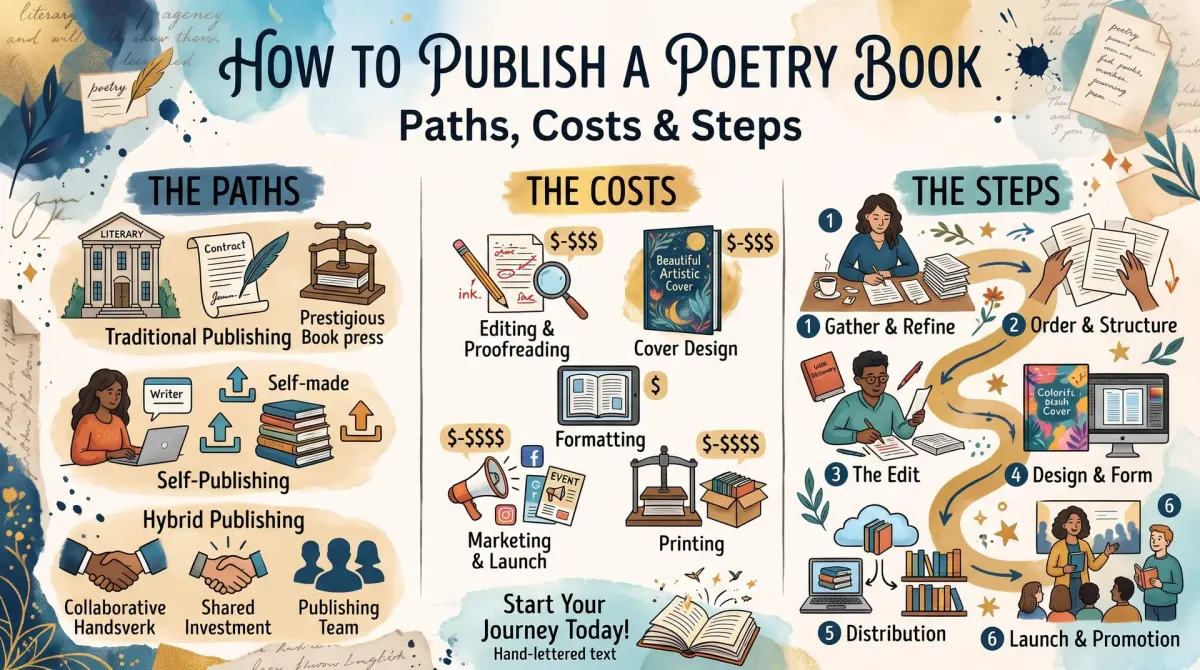
There are three main routes.
| Path | How it works | Cost to you |
|---|---|---|
| Press or contest | Submit to a poetry press or first-book contest | Reading fees possible |
| Small press | Query or submit to a small publisher | Usually none |
| Self-publishing | You produce and sell the book | You pay for all services |
Press or contest. Many poetry presses run open reading periods or contests. Winners are often published and may receive prizes. Contests may charge a reading fee. Read the rules, and be careful with fees.
Small press. Small presses publish short print runs. They may offer editing, design and distribution. Check the contract. Ask about rights, royalties and who pays for what.
Self-publishing. You control every step. You also pay for editing, design and formatting. This path is fast and gives you full control. A full guide explains how it works.
For a wider look at all the routes, a comparison guide helps.
Many poets use a mix. They publish poems in journals, then self-publish a chapbook, then submit a full book to presses. There is no single correct path.
Build credits first: submitting to journals
Key takeaway: Journal credits help a press trust your work and build your first readers.
Many poets start with single poems. Literary journals publish them and give you a credit line. Presses often look for those credits in a submission.
Keep a simple tracker. List each poem, each journal and the date sent.
Here is an example. You have 20 poems ready and send 3 poems at a time.
- Batches: 20 ÷ 3 = about 7 batches
- If a journal replies in 8 weeks, one batch at a time takes 7 × 8 = 56 weeks
That is more than a year. This is why many poets send to several journals at once, where the rules allow. Tell a journal at once if a poem is accepted elsewhere.
Also keep a record of the rights each journal holds. Many take first rights only. Read each contract.
Build your manuscript: a page budget
Key takeaway: Count your poems and pages before you format. The number decides your cost and your spine.
Most pages say "collect your best poems". Numbers help you plan.
Say you have 60 poems. Most take one page each. Some run longer.
- Poems on one page: 52
- Poems that run two pages: 8
- Pages for poems: 52 + (8 × 2) = 52 + 16 = 68 pages
Add the other pages.
- Front matter: 6 pages (half title, title, copyright, dedication, contents, blank)
- Section title pages: 3 pages
- Back matter: 3 pages (acknowledgments, about the author, blank)
Front and back matter and section pages: 6 + 3 + 3 = 12 pages.
Total: 68 + 12 = 80 pages.
Print books often need an even number of pages, and that works here. The printer may also set a minimum page count.
Now group the poems into sections. Say you have three sections of 20 poems.
- Section total: 3 × 20 = 60 poems
This matches the 60 poems above.
The order is the poet's art. Open with a strong poem. Place similar tones apart. End with a poem that leaves a mark. Read the book aloud from start to finish.
Add a list of acknowledgments. Name the journals where poems first appeared. This is a standard courtesy and may be required by the journals.
For front and back matter, see the guide on this site.
Estimate spine width and print cost
Key takeaway: Run the numbers for your page count before you design the cover.
Page count sets your spine width and your print cost. Here is a worked example for an 80-page paperback.
Spine width. Print platforms use a spine factor per page. For white paper, a common factor on KDP is 0.002252 inches per page.
- Spine: 80 × 0.002252 = about 0.18 inches
A spine this thin may be too narrow for text. Many printers advise leaving spine text off books under about 100 pages. In this case, put the title on the front and back covers.
Print cost. Say the printer charges a fixed fee plus a cost per page.
- Fixed fee: $1.00
- Per page: $0.012
- Page cost: 80 × $0.012 = $0.96
- Total print cost: $1.00 + $0.96 = $1.96
Now think about price. Say you set the list price at $12.99. You earn a share of the price after the print cost.
- Royalty share at 60 percent: $12.99 × 0.60 = $7.79
- Royalty after print cost: $7.79 − $1.96 = $5.83
These are examples. Check the platform's current rates and rules. Use a calculator for exact spine and cover size.
Then check your interior file before you upload it.
How to publish a poetry book step by step
Key takeaway: Collect, order, edit, format and then publish.
Use these steps.
- Collect your strongest poems.
- Choose a theme and a title.
- Group poems into sections and order them.
- Edit and proofread every line.
- Format the interior and design the cover.
- Choose a publishing path.
- Launch with readings and reviews.
Step one asks for a hard look. Cut weak poems. A book of 40 strong poems beats a book of 70 mixed ones.
Step two ties the book together. A theme can be an image, a place, a time or a question. Test your title by saying it aloud. A title tool can help you try ideas.
Step four is vital. Poetry shows every error. A typo in a short line stands out. Read the manuscript aloud. Then ask a friend to proofread.
Step five needs care. Poems need generous margins and clear fonts. Avoid justified text, which can create odd gaps. Keep line breaks as you wrote them. If a poem runs over a page, break at a stanza if you can.
Step seven is the launch. Poetry thrives on live events. Hold a reading at a local bookstore, library or cafe. Record a short video of a poem to share online.
Formatting a poetry interior
Key takeaway: Layout is part of the poem. Protect line breaks and white space.
Poetry formatting has its own rules.
- One poem per page. Start each poem on a new page when you can.
- Keep line breaks. Do not let the software reflow lines.
- Use a clean font. A readable serif works well.
- Indent with care. Use consistent tab settings.
- Avoid orphan lines. Do not leave a single line alone on a page.
- Add page numbers. Place them at the bottom, away from the poem.
- Check margins. Leave extra space on the inside edge for the binding.
Long lines may wrap. Choose a trim size wide enough for your longest line. A narrow page can break lines in the wrong place.
If you plan to format the file yourself, a Word guide on this site covers the basics.
Test the finished file as a printed proof. Order a proof copy and check every poem on the page.
Promoting a poetry book
Key takeaway: Poetry sells through readings, community and steady sharing.
A poetry launch looks different from a novel launch.
- Hold readings. Read at open mics, bookstores and libraries.
- Share on social media. Post a line, an image or a short video.
- Join a community. Poetry groups and literary events help.
- Send review copies. Reach out to poetry blogs and journals.
- Sell at events. Bring copies to every reading.
- Build an email list. Offer a free poem for sign-ups.
Plan a launch with clear steps. A launch guide helps you map the weeks before and after your release.
Be patient. Poetry sells slowly. A steady presence over months and years builds readers.
People Also Ask
How many poems do you need for a poetry book?
Many collections have about 40 to 80 poems, though it varies. A chapbook may have 15 to 30 pages. Focus on quality and a clear theme rather than a set number. A tight book of 40 strong poems beats a loose book of 70.
How do you self-publish a poetry book?
Collect and order your poems, then edit and proofread. Format the interior with care for line breaks, design a cover and choose a platform. Check the page count, spine width and print cost. Upload your files, order a proof and launch with readings and sharing.
Should I publish poems in journals first?
It is a common step. Journal credits show presses that others value your work. They also build an audience. Keep a list of where each poem appeared and credit the journals in your acknowledgments. Check each journal's rights rules, since some limit reprints.
Common mistakes
- Including every poem instead of the best ones.
- Ordering poems at random.
- Letting software reflow line breaks.
- Skipping a printed proof.
- Paying a reading fee without checking the contest.
Your next step: run your page budget
Count your poems and mark the long ones. Add front and back matter. Find your total pages. Then calculate your spine width and print cost.
Before you publish, run through a checklist.