What is a book report?
Key takeaway: A book report tells the reader what a book is about and what you learned from it.
A book report is a short piece of writing that describes a book. It states the title, author, main idea, key events and your analysis of themes or characters. A book report mostly informs the reader, while a book review also judges how well the book works.
A report answers a simple question: what is this book about? A review goes one step further and asks whether the book is good. Teachers usually ask for a report. Newspapers and blogs usually run reviews.
| Feature | Book report | Book review |
|---|---|---|
| Main goal | Explain the book | Judge the book |
| Opinion | Light, tied to the text | Central |
| Audience | Teacher or class | General readers |
Both forms share some tools. Both give a short summary. Both use examples. Both avoid long quotes.
A report also differs from a plain book summary. A summary retells the story in short form. A report adds analysis, such as what the theme is or how the lead changes.
If you need the review form, see the full guide on reviews. For word meanings such as theme, plot or genre, a school dictionary helps.
Always check the assignment. Your teacher may ask for a set length, a set format or specific parts. Follow those first. The advice here fits most school reports, but your rubric comes first.
Before you write: read with a purpose
Key takeaway: Take notes while you read so the writing step is easier.
Good reports start before the first draft. Read with a pen or a note app. Mark things you may want to use.
Take notes on:
- The setting: where and when the story takes place
- The main characters: who they are and what they want
- The main problem: what goes wrong
- Three key events: the start, the turning point and the end
- The theme: the big idea behind the story
- Two short quotes, with page numbers
For non-fiction, change the list. Note the main claim, three key facts and the author's purpose.
Set a time for reading, too. A book of 250 pages at 25 pages a day takes 250 ÷ 25 = 10 days. Start early enough to finish with a day or two to spare.
If you have to pick a book, choose one that fits the rules of the class. A short, clear book is easier to report on than a long, complex one. A reading list can help you choose.
Book report structure
Key takeaway: A report has four parts. Each has one clear job.
Here is the standard structure for most reports.
- Introduction. State the title, author, genre and main idea.
- Summary. Retell the plot in short form, without small details.
- Analysis. Explain a theme, a character or a choice the author made.
- Closing. Sum up your view and say who might enjoy the book.
You can add a short fifth part for a personal response if your teacher asks for one.
Here is a worked word budget for a 500-word report.
- Introduction: 75 words
- Summary: 150 words
- Analysis: 200 words
- Closing: 75 words
Add them up: 75 + 150 + 200 + 75 = 500 words.
Notice the share for each part. The analysis gets the most space: 200 ÷ 500 = 0.4, or 40 percent. The summary gets 150 ÷ 500 = 0.3, or 30 percent. This matters. Many weak reports spend most of the words on summary.
For a 300-word report, scale each part by 0.6. The introduction becomes 45 words, because 75 × 0.6 = 45. The summary becomes 90, the analysis 120 and the closing 45. These add up to 300.
Use the same method for any length. The shares stay the same.
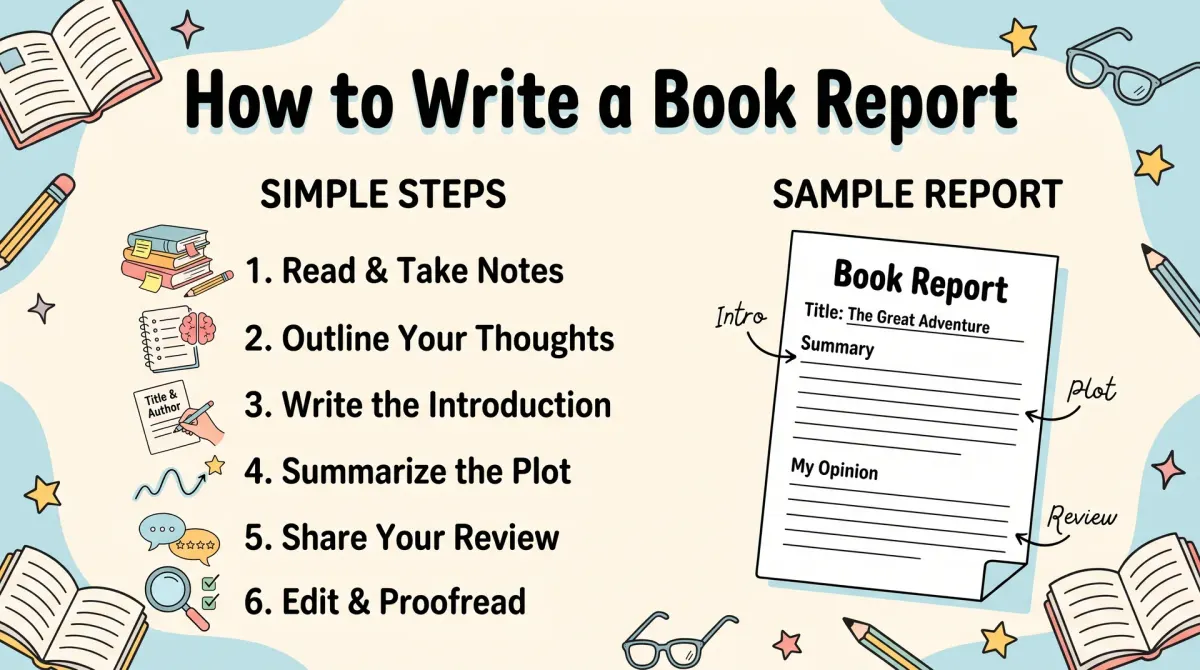
How to write a book report step by step
Key takeaway: Seven short steps take you from notes to a clean final report.
Follow these steps in order.
- Read the book and take notes.
- Write one sentence on the main idea.
- Draft the introduction.
- Write the summary in your own words.
- Write the analysis with two examples.
- Write the closing paragraph.
- Edit for length, spelling and clarity.
Step two is the key. If you cannot state the main idea in one sentence, you may need to reread the end of the book. A clear sentence makes the rest of the report easier.
Step four is where many students slip. Do not retell every scene. Pick three key events. Write one sentence for each. This keeps the summary short.
Step five asks for two examples. An example can be a short quote or a described scene. Always explain why it matters. A quote with no explanation is just filler.
Sample paragraphs for each part
Key takeaway: Short samples show how each part sounds in plain language.
Here are short samples for an invented book called The Lighthouse Key.
Introduction sample
The Lighthouse Key is a mystery novel by Jane Doe. It follows a girl named Mara who searches for her missing father. The book shows how trust can be broken and rebuilt.
Summary sample
Mara finds a key in her father's coat. She follows clues to an old lighthouse. There she learns that her brother hid the truth. In the end, the family agrees to face the problem together.
Analysis sample
The key is a symbol of trust. Early in the book, Mara holds it tight. Later, she hands it to her brother. This change shows that she has learned to share a burden. The author uses the key to carry the theme without stating it.
Closing sample
The Lighthouse Key is a quick, warm mystery. It will suit readers who like family stories with a puzzle. The ending is gentle, but the lesson about trust feels real.
Notice that each sample is short and plain. Each stays in its job.
If the book you report on has a prologue or an epilogue, you may want to note what it adds. Our guide on prologues explains the role of that section.
Book report vs book summary vs synopsis
Key takeaway: A summary retells. A report analyzes. A synopsis is a pitch tool for authors.
Three terms often get mixed up.
A book summary retells the main events in short form. It is neutral and tells what happens. A book report adds analysis and sometimes opinion. A synopsis is a short plot summary that authors send to agents. It includes the ending.
For a school task, you want a report. If your teacher asks for a summary, keep it plain and skip analysis. If you write a synopsis for a book you wrote, follow agent guidelines.
The synopsis guide explains that form in more detail.
Tips for a stronger report
Key takeaway: Be specific, use short quotes and cut anything that does not serve the main idea.
A few habits raise the quality of any report.
- Use the present tense for the plot. "Mara finds a key" reads cleaner than "Mara found a key."
- Name the author and title once, then use the character names.
- Avoid spoilers if the report is for a reader who has not finished the book. Ask your teacher what is expected.
- Keep quotes under one line each. Add the page number in parentheses.
- Do not copy blurbs or online summaries. Write every sentence in your own words.
- Read the report aloud. Fix any sentence that is hard to say.
Keep the tone formal but plain. Avoid slang and contractions if your class expects a formal style.
Proofread twice. Read once for meaning and once for spelling. A report with clean grammar earns more trust. If you have time, ask a friend to read it. A fresh reader will spot gaps in the summary that you no longer see.
For citations, follow your teacher's style guide. Many schools use MLA format. The Purdue Online Writing Lab explains MLA and other styles for students.
People Also Ask
What are the parts of a book report?
A standard book report has four parts: an introduction, a summary, an analysis and a closing paragraph. The introduction names the book and main idea. The summary retells key events. The analysis explains a theme or character. The closing sums up your view of the book.
How long should a book report be?
It depends on the assignment. Many school reports run from 300 to 1,000 words, or one to three pages. Always follow your teacher's rule first. If none is given, 500 words is a safe choice. Give the analysis about 40 percent of the words.
What is the difference between a book report and a book review?
A book report explains what a book is about and what it shows. A book review also judges the book and says whether it works. Reports are mostly for teachers. Reviews are for general readers. A report keeps opinion light and tied to the text.
Common mistakes
- Retelling every event instead of picking three key ones.
- Skipping analysis, so the report is only a summary.
- Using long quotes with no explanation.
- Copying text from a blurb or website.
- Ignoring the teacher's format and length rules.
Your next step: draft from your notes
Open your reading notes. Write the one-sentence main idea first. Then use the 500-word budget to draft each part. Scale it up or down to fit your assignment.
Finish by reading the draft aloud and fixing weak lines. If you plan to turn the report into a public review later, add a clear verdict and a star rating.