What is dialogue in a story?
Key takeaway: Dialogue is the spoken words of characters, and it must do work for the story.
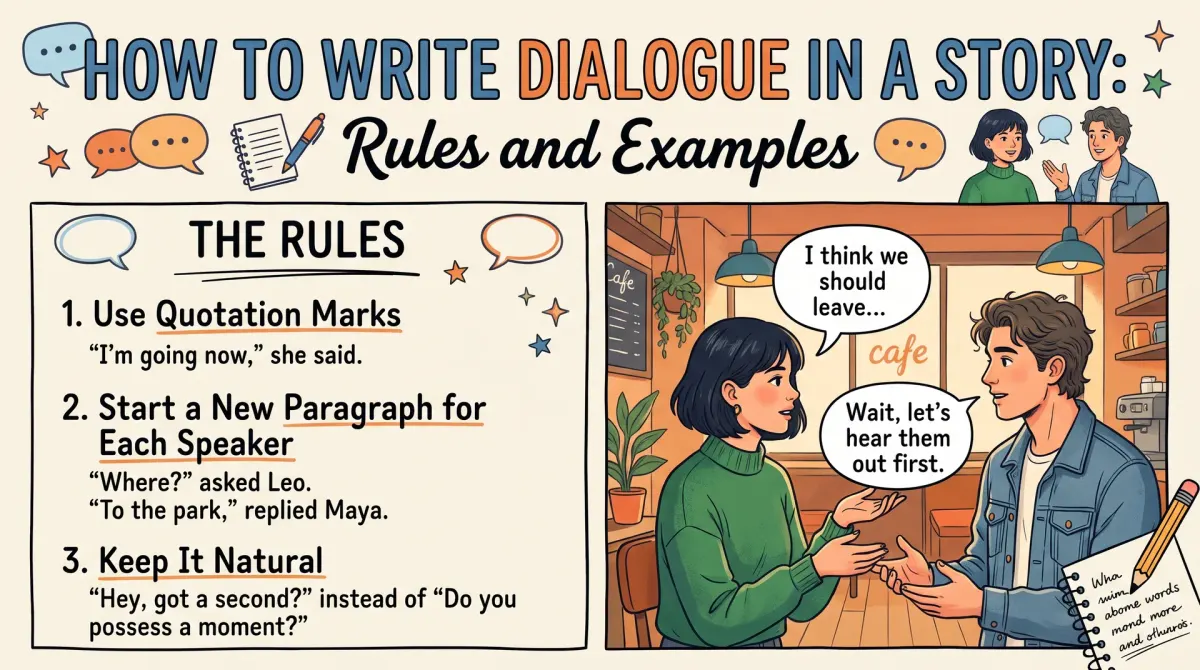
Dialogue is the spoken exchange between characters in a story, set apart by quotation marks. It shows how characters speak, what they want and how they relate to each other. Good dialogue moves the plot, reveals character and sounds like real speech without copying it.
Dialogue is not a transcript. Real talk is full of pauses, repeats and filler words. Story dialogue trims those away. It keeps the rhythm of speech and cuts the waste.
Dialogue has four jobs. A line should do at least one of them:
- Move the plot. A line shares news, makes a threat or sets a plan.
- Reveal character. A line shows how someone thinks, hides or fears.
- Build conflict. A line pushes against another speaker's goal.
- Set the scene. A line hints at place, time or mood.
If a line does none of these, cut it. "Hello. How are you? Fine, thanks" does no work in most scenes.
Dialogue is also different from internal thought. Thought is what a character thinks and is often written without quotes. Dialogue is what they say out loud.
The Chicago Manual of Style is a trusted guide on quotation marks and dialogue in American publishing.
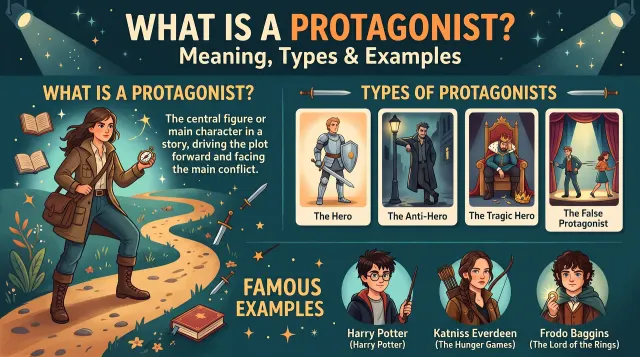
Good dialogue also depends on who is speaking. A strong lead has a voice you can spot without a tag. A guide on character roles can help you plan each speaker.
Dialogue punctuation rules
Key takeaway: Use double quotes, a new paragraph for each speaker, and commas or periods inside the closing quote.
Punctuation is where most mistakes happen. The rules below follow American style. British style differs in small ways, such as single quotes. Pick one style and keep it.
| Situation | Example | Rule |
|---|---|---|
| Tag after speech | "I'm leaving," she said. | Comma inside the quote |
| Tag before speech | She said, "I'm leaving." | Comma, then quote |
| Question | "Are you leaving?" he asked. | Question mark inside, lowercase tag |
A few more rules matter just as much:
- Start a new paragraph when the speaker changes.
- Use a period at the end when the line has no tag: "I'm leaving."
- Use an em dash to show a line cut off: "Wait, I didn't—"
- Use an ellipsis for a trailing voice: "I thought we could..."
- Put thoughts in italics or plain text, not in quotation marks.
- Use single quotes inside double quotes: "She said, 'run.'"
Here is a short example with the new-paragraph rule:
"Did you take the key?" Mara asked.
"No." Leo looked away.
"Then who did?"
Each speaker gets a line. The reader never wonders who is talking.
If a speaker gives a long speech, keep the quote open at the start of each new paragraph. Close it only at the end of the last paragraph. This is a small rule, but it helps readers follow.
Dialogue tags and action beats
Key takeaway: Use "said" most of the time, and use short action beats to show movement or mood.
A dialogue tag tells who spoke. Examples are "she said" and "he asked." An action beat is a small action in the same paragraph. It shows who is speaking without a tag.
Compare the two:
- Tag: "I don't know," Mara said.
- Beat: "I don't know." Mara rubbed her neck.
The beat shows body language and replaces the tag. Use a mix of both. Too many tags sound flat. Too many beats slow the pace.
Many editors suggest plain tags like "said" and "asked." Readers skim over them. Fancy tags such as "he exclaimed" or "she hissed" draw attention and can sound forced.
Avoid adverbs on tags. "She said angrily" tells the reader what the line should already show. Write the line so the anger is clear.
Compare these two versions:
- Weak: "Get out," he said angrily.
- Strong: "Get out." He slammed the door behind her.
The second version shows anger through action. The reader feels it.
You can also drop tags when only two people speak. After a few lines, the reader knows who is who. Add a tag again when the pattern breaks.
A word of care: a tag should come at a natural pause. Put it after the first clause of a long line, not in the middle of a phrase.
How to format dialogue step by step
Key takeaway: A short checklist turns messy dialogue into clean dialogue in a few minutes.
Use these steps on any scene you have already drafted.
- Put every spoken line in double quotes.
- Start a new paragraph at each speaker change.
- Add a tag or beat to every unclear line.
- Place commas and periods inside the closing quote.
- Check each line for a job: plot, character, conflict or scene.
- Cut greetings, filler and repeated facts.
- Read the scene aloud and fix any line that sounds stiff.
Step five is the one most writers skip. Run it line by line. If a line does no job, cut or combine it.
Step seven works because your ear catches what your eye misses. Stiff lines often have long sentences or full formal words, such as "do not" in place of "don't."
A scene should also have a point. Before you polish the lines, check the scene's goal. If you still plan your chapters, a book outline can help you set a goal per scene.
The dialogue ratio check
Key takeaway: Compare dialogue words with total words. This shows whether a scene leans too much on talk.
Most articles give rules for punctuation. They do not tell you how much dialogue a scene should have. A simple ratio check gives you a rough answer.
Here is a worked example. Take a scene of 1,000 words.
- Words inside quotation marks: 420
- Words outside quotation marks (narration, tags, beats): 580
Dialogue ratio: 420 ÷ 1,000 = 0.42, or 42 percent.
Narration ratio: 580 ÷ 1,000 = 0.58, or 58 percent.
A ratio of 42 percent is a balanced scene. A ratio near 80 percent may read like a script with no setting. A ratio near 10 percent may bury the voices.
There is no official target. Genres differ. Thrillers and romance often lean on talk. Literary fiction may use less. Treat the ratio as a mirror, not a law.
Use the check in two ways. First, run it on a scene that feels slow. If the ratio is low, add a short exchange. Second, run it on a scene that feels thin. If the ratio is very high, add a few lines of setting or thought.
A related tool is the word count. A 3,000-word chapter at 42 percent dialogue holds about 1,260 words of speech, because 3,000 × 0.42 = 1,260.
A before and after example
Key takeaway: Cut greetings, show feeling through action, and let each speaker want something.
Here is a weak draft. It has filler, adverbs and no conflict.
"Hello, Mara," said Leo happily. "How are you today?"
"I am fine, thank you," said Mara. "I wanted to talk to you about the key."
"What about the key?" Leo said nervously.
Now the rewrite. It cuts the greeting and puts the conflict first.
"Where's the key?" Mara asked.
Leo studied his boots. "What key?"
"Don't."
He took a long breath. "Dana has it."
What changed:
- The greeting is gone, so the scene starts at the point of conflict.
- The adverbs are gone, and body language replaces them.
- Mara wants the key, and Leo hides it. The two want opposite things.
- The last line gives new plot information.
The rewrite is shorter. The first draft has 32 words. The rewrite has 20 words. The cut is 32 − 20 = 12 words. That is 12 ÷ 32 = 0.375, or about 38 percent. It also reads faster.
Common dialogue problems and fixes
Key takeaway: Most dialogue problems come from info dumps, sameness of voice and missing conflict.
Look for three problems in your own draft.
- Info dumps. Characters tell each other facts they both already know. Fix it by giving the listener a reason to ask, or move the facts to narration.
- Same voice for everyone. All speakers sound alike. Give each a habit: short sentences, slang, a favorite word or silence.
- No conflict. Everyone agrees. Fix it by giving each speaker a goal that clashes.
Dialect and accent also need care. A few word choices show an accent better than heavy spelling. Heavy phonetic spelling can be hard to read.
Last, check the setting. A line that works in a kitchen may fail in a crowded room. Add small details such as noise or interruptions.
People Also Ask
How do you start a dialogue in a story?
Start with a line that carries conflict or a question. Skip greetings and small talk. Put the line in double quotes and add a short tag or action beat so the reader knows who speaks. A strong first line pulls the reader into the scene.
How do you punctuate dialogue?
Use double quotation marks around spoken words. Put commas and periods inside the closing quote. Start a new paragraph for each speaker. Use an em dash for a cut-off line and an ellipsis for a trailing voice. Keep one style, American or British, across the book.
How much dialogue should a story have?
There is no fixed rule. Many scenes land between 30 and 60 percent dialogue, depending on genre. Count the words inside quotes and divide by the total scene words. If a slow scene shows a low ratio, add a short exchange.
Common mistakes
- Starting with greetings and small talk.
- Using fancy tags and adverbs in place of "said" and strong lines.
- Forgetting a new paragraph for each speaker.
- Packing a line with facts the listener already knows.
- Making every character talk the same way.
Your next step: fix one scene
Pick one scene from your draft. Run the seven steps above. Then run the ratio check on it. Cut one greeting, add one action beat and read the scene aloud.
If you are still building the draft, read the novel guide. It shows how to plan scenes and keep a word goal.