What is point of view in writing?
Key takeaway: Point of view is the angle of the telling. It controls what the reader knows.
Point of view is the perspective from which a story is told. It sets who narrates, which pronouns appear and how much the reader knows about each character's thoughts. The three main types are first person, second person and third person.
Point of view is not the same as theme or tone. It is a craft choice about the narrator. The choice affects three things:
- Voice. How the narrator sounds, with word choice and attitude.
- Access. Whose thoughts and feelings the reader can see.
- Distance. How close or far the reader feels from the action.
A related term is narrator. The narrator is the voice that tells the story. In some books the narrator is a character. In others it is an outside voice that is not part of the plot. Point of view is the setting that decides which kind of narrator you have.
The word "perspective" often means the same thing. Some teachers also use "narrative mode." Merriam-Webster lists the dictionary meaning of the phrase.
You do not have to choose forever. You can try a scene in two or three views before you commit. This test costs only a few minutes.
If you want to know who your story follows first, a guide on the lead role can help.
First person point of view
Key takeaway: First person puts the reader inside one character's head, using "I" or "we."
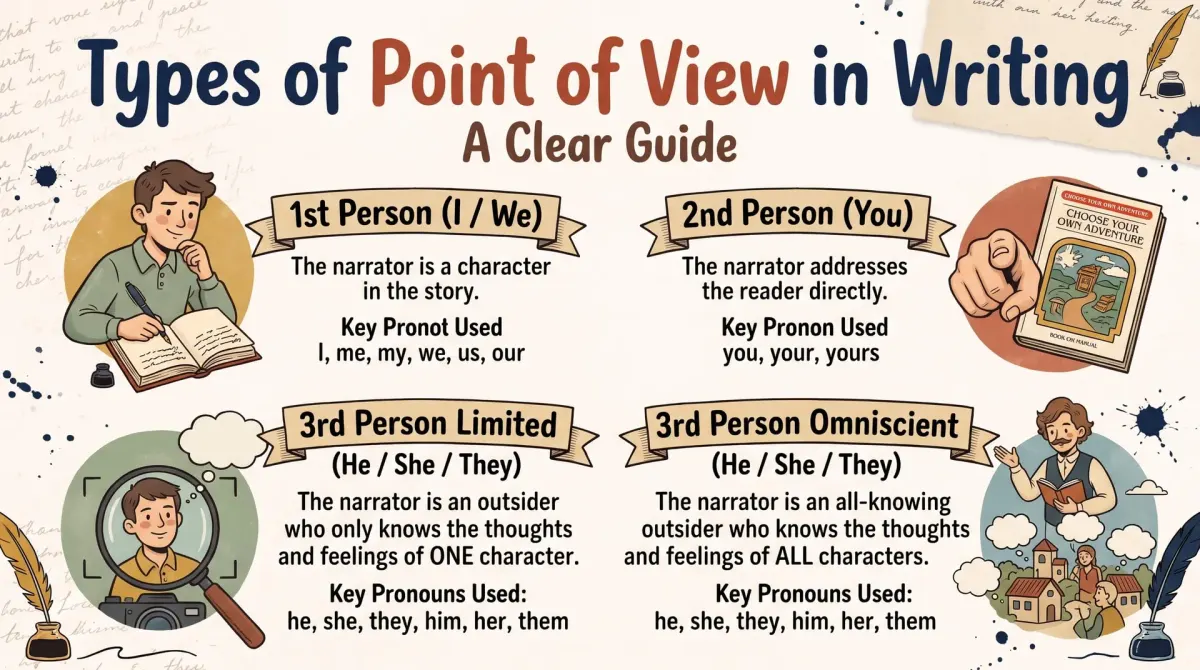
First person uses "I" for a single narrator or "we" for a group. The narrator is a character in the story. The reader sees only what that character sees, thinks and feels.
Here is a short example:
I knew the door was wrong the moment I touched it. The brass felt warm, as if someone had just let go.
First person has clear strengths:
- It builds a strong voice.
- It creates fast closeness with the reader.
- It is easy to show feelings.
It also has limits:
- The reader cannot know what the narrator does not know.
- Every scene must include the narrator.
- Long stretches can feel heavy if the voice is not interesting.
First person works well in memoir, young adult fiction and thrillers. The Hunger Games and The Catcher in the Rye are well-known examples.
A related idea is the unreliable narrator. This is a first-person narrator who may lie, forget or misread events. The reader must read between the lines. It is a popular device in mystery and psychological fiction.
If you write a book about your own life, first person is the natural choice. The memoir guide explains how to shape that voice.
Second person point of view
Key takeaway: Second person speaks to "you" and is rare in fiction, but strong in guides and games.
Second person addresses the reader as "you." The reader becomes the lead.
Here is a short example:
You walk into the kitchen and find the note. You read it twice. Your hands are shaking.
This view is rare in novels. It can feel odd if it runs for hundreds of pages. Still, it has real uses:
- Instruction guides and self-help books use it all the time.
- Interactive fiction and choose-your-own-adventure books use it.
- Short pieces can use it for a strong, direct effect.
Because the form is bold, it works best in short stories or in single chapters. If you try it in a long book, keep scenes short and vary the rhythm.
Second person also appears in this very kind of article. Phrases like "you will see" are second person, because the writer speaks to the reader directly.
Third person point of view
Key takeaway: Third person uses "he," "she" and "they," and it comes in limited and omniscient forms.
Third person is the most common view in fiction. The narrator stands outside the story. It names the characters and describes what they do.
Two main forms matter.
Third person limited. The narrator stays close to one character at a time. The reader sees that character's thoughts and feelings, but not those of others.
Mara stared at the lamp. She wondered whether Leo had lied. His face gave nothing away.
Third person omniscient. The narrator knows everything. It can enter many minds and describe events that no character sees.
Mara stared at the lamp and wondered if Leo had lied. Leo, behind her, wished she would stop asking. Far away, the storm was already turning.
Some writers also name a third form, third person objective. Here the narrator shows only what a camera could see. It never enters a mind. This view is rare in novels but appears in news writing and some short stories.
Third person limited gives a good mix of closeness and range. It is the default choice in many genres, including fantasy, romance and crime. Omniscient works well for epic stories with large casts.
A common mistake is head-hopping. This happens when a limited narrator slips into another character's thoughts inside one scene. It confuses readers. Fix it by moving the shift to a new scene or chapter.
Comparing the main options
Key takeaway: Each point of view trades closeness for range. Pick the balance that serves your story.
Here is a comparison of the four main options.
| View | Pronouns | Best for |
|---|---|---|
| First person | I, we | Voice and closeness |
| Second person | You | Short, bold pieces |
| Third limited | He, she, they | Close focus with range |
| Third omniscient | He, she, they | Large casts, epic scope |
A few points are worth noting. First person gives the strongest voice but the narrowest view. Omniscient gives the widest view but the least closeness. Third limited sits in the middle, which is why so many authors choose it.
The tense also matters. Past tense is the most common in fiction. Present tense feels immediate and can raise tension. Do not mix tenses by accident. Pick one and keep it for the whole scene.
For more on voice and narration, the Purdue Online Writing Lab has free guides for students and writers.
You can also mix views across a book. Some novels use first person for one lead and third person for another. Others give each chapter to a different narrator. If you use many narrators, label each chapter with the name.
Here is a balance check for a book with three narrators and 24 chapters. If each narrator gets an equal share, each has 24 ÷ 3 = 8 chapters. If one narrator has 14 chapters, the share is 14 ÷ 24 = 0.583, or about 58 percent. That narrator becomes the lead. The other two become support. Decide on purpose.
How to choose the right point of view
Key takeaway: Choose by what your story needs: closeness, range, voice or mystery.
Most pages only describe each type. A better step is to choose with a test. Answer these five questions about your story. Score a point for each yes.
- Is a strong, personal voice central to the story?
- Does the plot depend on what one person knows?
- Do you need to show events the lead cannot see?
- Is the cast large, with several threads?
- Do you want the reader to doubt the narrator?
Then map your answers.
- Voice and doubt (questions 1, 2, 5): first person fits.
- Range (questions 3, 4): omniscient or multiple third limited fits.
- A mix: third limited gives balance.
Here is a worked example. Your story is a mystery about a missing father. You answer yes to questions 1, 2 and 5. That is 3 out of 3 for first person. You answer no to questions 3 and 4. That is 0 out of 2 for a wide view. The score is 3 to 0, so first person is the best fit.
Next, write the first page in two views. Compare them. Read each aloud. Pick the one that feels most natural and holds the most tension.
Finally, think about your genre. Readers of young adult fiction often expect first person. Fantasy readers often expect third person. Check three recent books in your genre before you decide.
One paragraph in each view
Key takeaway: Rewrite one paragraph in each view to see how the voice and distance change.
Here is the same event told in four ways.
First person.
I opened the letter and my stomach dropped. Dana had sold the farm. I read the line again, hoping I had missed a word.
Second person.
You open the letter and your stomach drops. Dana has sold the farm. You read the line again, hoping you missed a word.
Third person limited.
Mara opened the letter and felt her stomach drop. Dana had sold the farm. She read the line again, hoping she had missed a word.
Third person omniscient.
Mara opened the letter, and her stomach dropped. Dana, watching from the porch, knew what the letter said. Neither of them yet knew that the buyer was their father.
Notice how the distance changes. The first version is closest. The omniscient version reveals a fact that Mara cannot know. That fact adds irony.
This kind of exercise takes ten minutes. It will teach you more than a long list of rules.
People Also Ask
What are the three types of point of view?
The three main types are first person, second person and third person. First person uses "I" or "we." Second person uses "you." Third person uses "he," "she" and "they." It splits into limited and omniscient. Most fiction uses first person or third person limited.
What is the difference between third person limited and omniscient?
Third person limited stays with one character's thoughts at a time. The reader knows only what that character knows. Omniscient knows everything and can enter any character's mind. It can also describe events that no character sees. Limited feels closer, while omniscient feels wider.
Which point of view is best for a novel?
No single view is best. Third person limited is the most common because it balances closeness and range. First person suits stories with a strong voice or a doubtful narrator. Omniscient suits epic stories with large casts. Test the first page in two views before you decide.
Common mistakes
- Switching point of view inside one scene without a clear break.
- Writing first person but describing things the narrator cannot know.
- Using second person for a whole novel without varying the rhythm.
- Mixing past and present tense by accident.
- Picking a view because it feels easy, not because it fits the story.
Your next step: test your first page
Choose one page from your draft. Rewrite it in a second view, using the examples above as a model. Compare the two pages. Keep the one with the stronger voice and clearer tension.
If you have not set your plot yet, an outline can help you decide who needs to tell which part.