What is a protagonist in a story?
Key takeaway: The protagonist is the character whose goal and choices drive the main plot.
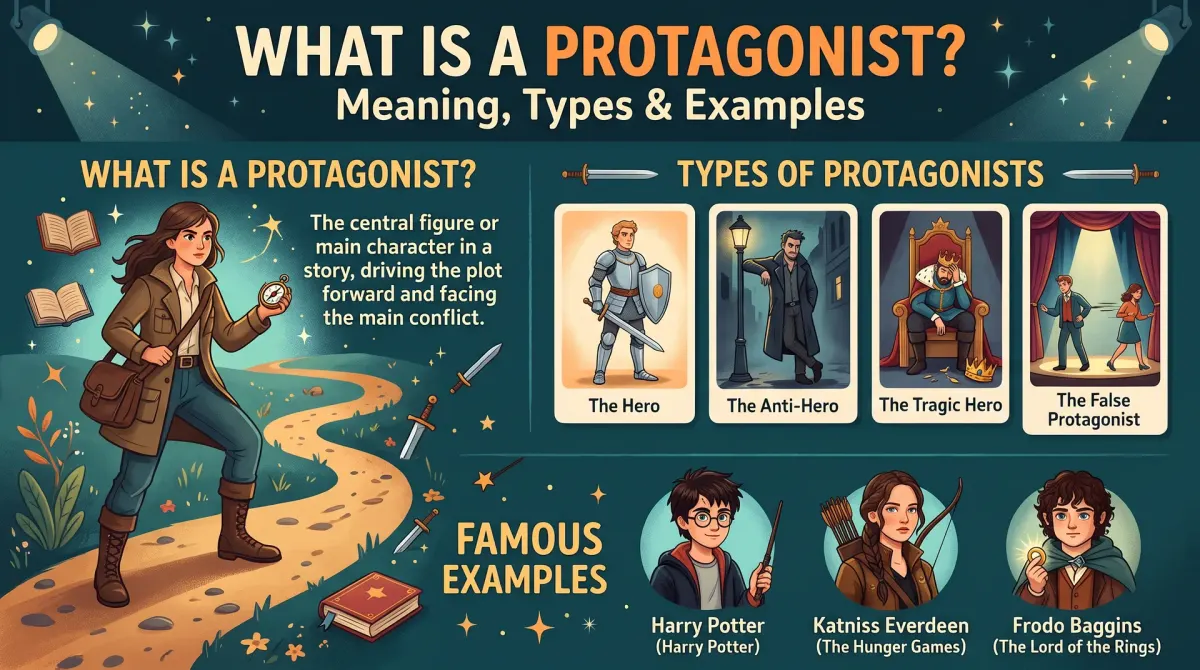
A protagonist is the central character in a story, play or film. The plot follows this character's goal, choices and struggle from start to end. Readers usually care most about what happens to the protagonist. The role is about plot, not about being good or likeable.
The word comes from the Greek for "first actor." In early Greek theatre, one actor played the lead part. Later writers used the word for the lead character in any story.
The protagonist wants something. The story puts obstacles in the way. How the character responds is the plot.
Three ideas often get mixed up with the protagonist:
- Main character. In most books this is the same person. Some stories have several main characters.
- Hero. A hero is a moral label. A protagonist can be brave, selfish or even cruel.
- Narrator. The narrator is the voice that tells the story. In The Great Gatsby, Nick Carraway narrates, but Jay Gatsby drives the plot.
That last point matters. A narrator who watches events is not always the protagonist.
Merriam-Webster gives a short dictionary entry for the word.
A protagonist is also not the same as a "round" or "flat" character. Those terms describe how deep a character is, not what role the character plays.
Protagonist vs antagonist
Key takeaway: The protagonist pursues the main goal. The antagonist is the force that blocks it.
The protagonist vs antagonist pair sits at the heart of most plots. The two roles pull against each other.
An antagonist is the person or force that stands in the protagonist's way. It is often a villain. It can also be a rival, an institution, nature or the protagonist's own fear.
| Feature | Protagonist | Antagonist |
|---|---|---|
| Role in plot | Pursues the main goal | Blocks the main goal |
| Reader focus | Gets most of the page time | Appears when needed |
| Can be a person? | Yes | Yes, or a force |
Two points are worth stating. First, the antagonist does not have to be evil. A parent who forbids a dream can be an antagonist. Second, the antagonist needs a reason. A villain with a clear motive makes the protagonist's choices harder.
In The Hunger Games, Katniss Everdeen is the protagonist. The Capitol is the main antagonist. In Pride and Prejudice, Elizabeth Bennet is the protagonist. Her own pride and prejudice work against her as much as any person does.
Some stories have no single villain. In those books, the antagonist is a setting or a social rule. The pairing still holds, because something always resists the protagonist.
Types of protagonist
Key takeaway: The five common types of protagonist differ by morals, motive and how they act.
Writers sort protagonists into types. The labels help you plan the character's arc. They are guides, not strict rules.
- The hero. This protagonist acts for good and faces danger. Harry Potter fits this type.
- The antihero. This protagonist lacks classic heroic traits. The character may be selfish, cynical or ruthless. Walter White in Breaking Bad is a well-known example.
- The tragic protagonist. This character has a flaw that leads to a fall. Macbeth is the usual example.
- The reluctant protagonist. This character does not want the quest. Frodo Baggins starts that way.
- The ensemble protagonist. A group shares the lead role. Several friends or family members drive the plot together.
Some writers also name a deuteragonist. This is the second most important character. It is often a close ally or partner.
A protagonist can change type during a story. A reluctant lead may become a hero. A hero can slide into a tragic fall.
Pick a type early. It helps you decide what your protagonist wants, fears and will refuse to do.
How to tell who the protagonist is
Key takeaway: Count scenes and choices. The protagonist is the character who drives the most plot decisions.
Most articles stop at the definition. A better method is to test a real story. The test below takes ten minutes.
Run these checks:
- Whose goal does the plot follow?
- Whose choices change what happens next?
- Who changes the most by the end?
- Whose loss would hurt the story most?
Then count scenes. Here is a worked example for a draft with 36 scenes.
- Scenes with Mara: 27
- Scenes with her brother Leo: 14
- Scenes with the rival, Dana: 9
Share of scenes for Mara: 27 ÷ 36 = 0.75, or 75 percent. Share for Leo: 14 ÷ 36 = about 0.39, or 39 percent. Share for Dana: 9 ÷ 36 = 0.25, or 25 percent.
The shares add up to more than 100 percent. That is normal, because characters share scenes.
Mara appears in three out of four scenes. She is the protagonist. Leo is a strong second character. Dana is the antagonist.
This count is a rule of thumb. It is not a law. A protagonist can be absent from many scenes and still drive the plot. Still, if your intended protagonist is in fewer scenes than a side character, review the plan.
Next, trace the decisions. List the five biggest plot turns. Write who caused each one. The protagonist should cause most of them.
Here is a short decision log for the same draft. Mara causes three of the five biggest turns.
- Turn 1: Mara leaves the farm. Cause: Mara.
- Turn 2: Leo hides the letter. Cause: Leo.
- Turn 3: Mara confronts Dana. Cause: Mara.
- Turn 4: Dana burns the barn. Cause: Dana.
- Turn 5: Mara forgives Leo. Cause: Mara.
Share of turns caused by Mara: 3 ÷ 5 = 0.6, or 60 percent. That backs up the scene count. Two different checks point to the same character, so you can trust the result.
If the two checks disagree, look closer. A character may fill many scenes but never decide anything. That character is a witness, not a protagonist. Another character may appear rarely but cause every major turn. That character may be the real lead, or may be the antagonist.
What makes a strong protagonist
Key takeaway: A strong protagonist has a clear want, a real flaw and a cost for every choice.
Readers do not need a perfect lead. They need a lead who wants something badly and pays for it.
Build the character from four parts:
- A want. This is the outer goal, such as winning a race or saving a farm.
- A need. This is the inner lesson the character must learn.
- A flaw. This is the trait that gets in the way.
- A cost. This is what the character risks by acting.
Take the want and need apart. In many good stories, they pull in different directions. A character wants to win, but needs to trust a friend.
Next, give the protagonist agency. Agency means the character makes choices that move the plot. A protagonist who only reacts feels passive. Readers lose interest fast.
Finally, let the protagonist change. The change is called an arc. A short arc may be small, like a shift from fear to calm. A long arc can span a series.
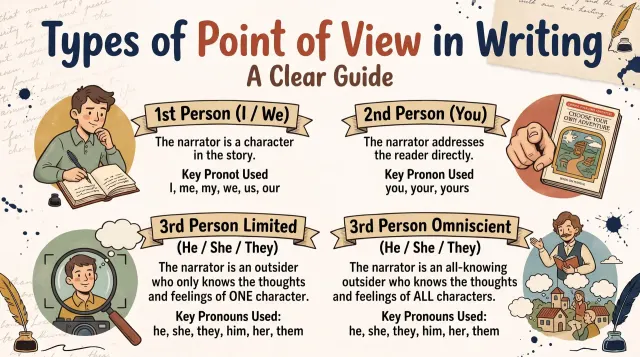
Your protagonist also shapes your choice of point of view. A close first-person voice keeps readers inside one mind. A third-person voice can show more of the world.
Protagonists in different forms
Key takeaway: The protagonist role works the same way in novels, short stories, plays and films.
A novel has room for a long arc. A short story has room for one turning point. A play must show the lead's goal through speech and action. A film must show it on screen.
In a short story, one protagonist is usually enough. There is no time for a large cast. The protagonist should want one thing and face one main obstacle.
In a series, the protagonist may change across books. The first book can end with a small win. The final book often tests the lead's biggest flaw.
In memoir, the writer is the protagonist. The narrator is also the author. The same rules apply: a want, an obstacle and a choice.
Picture books and children's stories use simple leads. A child or an animal often wants one clear thing. The story ends when that want is met or lost.
People Also Ask
What is the difference between a protagonist and a main character?
In most stories they are the same person. A protagonist is defined by the plot: the character whose goal drives it. "Main character" is a looser term for whoever gets the most focus. Stories with several leads can have many main characters but one protagonist.
Can a story have more than one protagonist?
Yes. Ensemble stories give the lead role to a group. Some novels split the plot between two or three leads, each with a goal. Readers follow each arc in turn. The writer must make sure every protagonist has a clear want and real stakes.
Is the protagonist always good?
No. The protagonist is the lead of the plot, not a moral label. An antihero or a tragic protagonist can be selfish, cruel or flawed. Readers may still follow the character because the goal is clear and the choices are interesting.
Common mistakes
- Making the protagonist passive, so the plot happens to them.
- Giving the lead a want but no flaw.
- Confusing the narrator with the protagonist.
- Adding so many leads that no one has a clear goal.
- Making the antagonist weak, so the protagonist's choices cost nothing.
Your next step: test your protagonist
Open your draft and count scenes for each major character. Use the 36-scene method above. Then list the five biggest plot turns and mark who caused each one.
If the same character appears most, you have your protagonist. If not, adjust the outline before you write more.
A clear outline helps with this check.