What is a cliffhanger?
Key takeaway: A cliffhanger ends a section at a moment of tension and holds back the answer.
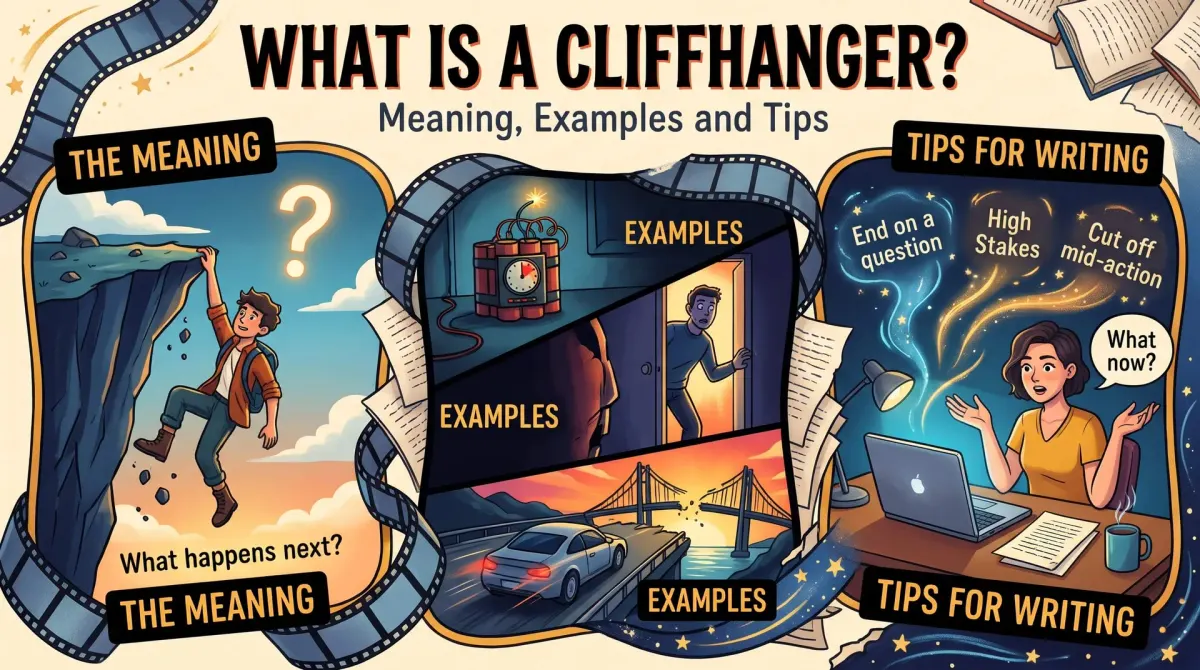
A cliffhanger is a story ending that leaves a crisis or question unresolved, so readers want to know more. It may close a scene, chapter, episode or book. The name comes from early serials where a hero was left hanging from a cliff.
The term has a long history in serial stories. Magazines and early film serials ended each part at a moment of danger. The audience had to return for the next part to learn the outcome.
Merriam-Webster lists the dictionary meaning.
A cliffhanger needs three parts:
- A tension point. Danger, doubt or surprise.
- A held-back answer. The text stops before the outcome.
- A reason to care. The reader wants the lead to be safe.
The last part is key. A cliffhanger about a character no one cares for falls flat. The reader must be invested first.
Cliffhangers are a pacing tool. They shape where readers pause. A chapter that ends in a calm moment lets the reader rest. A chapter that ends in danger pushes them on.
Planning the pace of your story is easier with an outline. It shows where tension peaks and where it can rest.
Types of cliffhanger
Key takeaway: Cliffhangers differ in kind. Mix them so readers do not learn the pattern.
Writers use several types.
| Type | What it leaves open | Example feel |
|---|---|---|
| Danger | Will the lead survive? | A rope snaps |
| Reveal | What does it mean? | A name on a note |
| Decision | What will they choose? | A hand on a lever |
More types are worth knowing:
- The arrival. Someone unexpected walks in.
- The question. A line raises a puzzle: "That was not the first body."
- The loss. A key person disappears or dies.
- The false end. The scene seems to close, then a last line changes it.
- The ticking clock. Time runs out before the answer.
There is also the soft cliffhanger. This is a chapter ending that raises a quiet question, not a crisis. A character smiles at a letter and hides it. The reader wonders why.
Soft hooks are good for quiet books. They keep readers curious without constant crisis. A thriller may use hard cliffhangers. A family drama may use soft ones.
The type should fit the genre and the voice. A cozy mystery that ends every chapter with a death may feel out of tone.
Cliffhanger examples
Key takeaway: The best cliffhangers rise from character and plot, not from tricks.
Here are examples from known stories.
- Serial novels of the 1800s. Many works by Charles Dickens first appeared in parts. Each part ended with a pull to buy the next.
- Early film serials. Weekly adventure serials left the hero in peril at each episode's end.
- Modern thrillers. Many short chapters end on a turn: a message, a door, a call.
- TV season finales. A show may end a season with a character's fate unknown.
In these cases, the pattern is the same. The audience cares about a character. A crisis hits. The text stops. The audience returns.
A book-length example of a quiet cliffhanger is a last-page line that raises a question. A character finds a key and wonders what it opens. The story ends, and the sequel begins with the answer.
Notice the difference between a chapter cliffhanger and a book cliffhanger. A chapter cliffhanger resolves in a page or two. A book cliffhanger may take a year. The second type tests reader patience.
How often should you use a cliffhanger?
Key takeaway: Use hard cliffhangers on a minority of chapters and vary the rest.
Most articles say "do not overuse" and give no numbers. A chapter-ending ledger helps you plan.
Label each chapter ending with a code:
- H for a hard cliffhanger (danger, reveal, loss)
- S for a soft hook (a quiet question)
- R for a resolved or restful ending
Here is a worked example for a thriller with 30 chapters.
- Hard cliffhangers (H): 9
- Soft hooks (S): 12
- Resolved endings (R): 9
Check the total: 9 + 12 + 9 = 30 chapters.
Now find the shares.
- Hard: 9 ÷ 30 = 0.30, or 30 percent
- Soft: 12 ÷ 30 = 0.40, or 40 percent
- Resolved: 9 ÷ 30 = 0.30, or 30 percent
So 70 percent of chapters, which is 30 percent plus 40 percent, end with some pull. Only 30 percent end in rest. That fits a fast thriller.
For a quieter novel, the mix might flip. Say 3 hard, 9 soft and 18 resolved in 30 chapters. Hard share: 3 ÷ 30 = 10 percent. Resolved share: 18 ÷ 30 = 60 percent.
Neither plan is correct. They set different rhythms. The key is to look for runs. Five hard cliffhangers in a row can feel like noise. Break a run with a restful ending.
Spacing matters too. Place the biggest cliffhanger near the midpoint and near the climax. These mark turning points. Smaller hooks can fill the space between.
A chapter-length guide can help you plan how many chapters your book will have.
The fairness check for book-end cliffhangers
Key takeaway: A book that ends on a cliffhanger must still give the reader a complete arc.
A cliffhanger at the end of a book is a bigger risk. Readers have given hours of time. If the story simply stops, many feel cheated.
Use a fairness check.
- Does the book have its own arc? The main question of this book should be answered.
- Is the open question new? The cliffhanger should raise a fresh question, not leave the main one hanging.
- Is the wait short? If the next book is far off, a hard cliffhanger can sour readers.
- Is the sequel promised? Say so in the back matter, if you can.
Score one point for each yes.
Here is a worked example. Your book answers its main question (1). It raises a new question at the end (1). But the sequel is a year away (0), and you have not announced it (0).
Total: 1 + 1 + 0 + 0 = 2 out of 4.
A score of 2 is a warning. You could soften the ending or set a closer release date. If you write a series, finishing several books before you launch the first removes the wait.
This is a point many self-published authors use. Releasing books close together can ease the pain of a cliffhanger. A reader who finishes book one can start book two at once.
Each book should feel like a full story. Think of a series as a set of arcs, not a single story chopped into pieces.
How to write a cliffhanger step by step
Key takeaway: Build the stakes, cut at the peak and keep the promise to resolve.
Use these steps to write one.
- Choose the moment of highest tension.
- Make sure the reader cares about the outcome.
- End one beat before the answer.
- Use a short, sharp last line.
- Open the next chapter with a shift.
- Resolve the question within a few pages.
- Check that the answer is fair.
Step three is the art. Stop just before the outcome, not after. If the rope snaps, end on the snap. Do not show the landing.
Step four is about rhythm. A short line lands hard. "The door was already open." Avoid long, tangled endings.
Step five is a trick used by many writers. After a cliffhanger, switch to another character or scene. The reader waits for the answer, which builds more tension. Then return to the cliffhanger a chapter later.
Step six is a promise. Do not leave the question hanging for too long. A cliffhanger that never resolves feels like a lie.
Also avoid the fake-out. A cliffhanger that turns out to be a dream or a joke can anger readers. Make sure the danger is real.
People Also Ask
Why are cliffhangers used?
Cliffhangers keep the audience engaged. They raise a question or crisis and hold back the answer, so readers want to continue. They suit serial stories, thrillers and long series. Used in moderation, they build pace. Used too often, they can feel like a trick and wear readers out.
Do all chapters need cliffhangers?
No. A story needs a mix of tension and rest. A common plan is to use hard cliffhangers on about a third of chapters. Soft hooks and restful endings fill the rest. The right mix depends on the genre. Test with readers to find a rhythm that works.
Is it bad to end a book on a cliffhanger?
It can be risky. Many readers dislike a book that ends without closing its main question, especially if the next book is far away. A fair ending resolves the book's own arc and raises a fresh question. Releasing the sequel soon after eases the problem.
Common mistakes
- Using a hard cliffhanger on every chapter.
- Ending on a fake-out, such as a dream.
- Leaving the question open for too long.
- Ending a book without closing its main arc.
- Ending on a crisis about a character the reader does not care about.
Your next step: fill in your ledger
Label every chapter ending in your draft as H, S or R. Count each type and find the shares. Look for runs of five or more hard endings and break them. Then check your book's last chapter with the fairness check.
For an extra tool, practice on a short story with one cliffhanger.