What is a flashback in writing?
Key takeaway: A flashback is a break in the timeline that shows an earlier event.
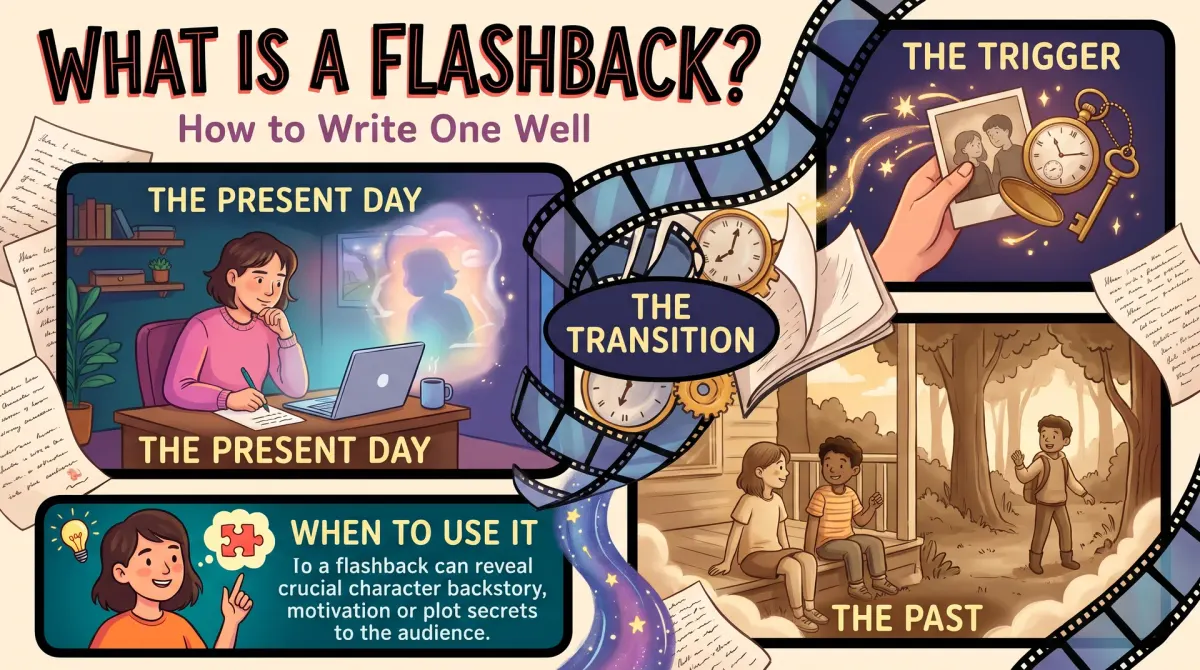
A flashback is a scene or memory that interrupts the main timeline to show an event from the past. It supplies background, explains a character's choices or adds emotion. A good flashback has a clear trigger, stays short and returns to the present with new meaning.
Merriam-Webster lists the literary meaning of the word.
A flashback is a form of non-linear narrative. The story does not move in time order. It jumps back and then returns. The order is a choice by the writer.
Flashbacks do three jobs:
- Give background. They show what happened before.
- Explain a choice. They show why a character acts as they do.
- Add emotion. They show a loss or a joy that shapes the present.
A flashback is not the same as backstory. Backstory is the full past of a character or world. A flashback is one way to deliver part of it, in scene form. Backstory can also be shared in a line of dialogue or a short note.
Flashbacks appear in all forms. Novels, films, plays and even songs use them. Film often marks a flashback with a change of color or sound. A novel must mark it with words.
Because a flashback pauses the plot, it should earn its place. Planning where the main events fall helps you see where a pause may fit.
Types of flashback
Key takeaway: Flashbacks vary in length and form. Pick the shortest one that does the job.
Writers use a few kinds of flashback.
| Type | Length | Use |
|---|---|---|
| Quick memory | A line or two | A fast hint of the past |
| Short scene | A few paragraphs | A key moment |
| Full chapter | Many pages | A major reveal |
More forms are worth knowing:
- Triggered flashback. A sound, smell or word sets off a memory.
- Dream flashback. The character sees the past in a dream. Use this one with care, as it is a known cliche.
- Told flashback. A character tells the story aloud to another.
- Frame flashback. The whole book is a memory told from a later time.
- Alternating timeline. The book switches between past and present in turns.
The quick memory is the safest. It adds color with little cost. A single line can do the work: "She remembered her father's hands, rough from the nets."
A full chapter flashback is the boldest. It stops the plot, so the reveal must be worth it. Many novels use this form once or twice, at a turning point.
An alternating timeline is a structural choice. Both timelines carry the plot. The past story builds toward a secret that the present story needs. This works well in mystery and family sagas.
Pick by asking what the reader needs. If a hint will do, use a line. If the moment shapes the character, use a scene.
How to enter and exit a flashback
Key takeaway: Use a trigger, shift the tense, and return with a clear cue.
Many writers struggle with the mechanics. The reader must know when the story jumps and when it returns.
Step one: the trigger. Start with something in the present that calls up the past. A smell, a photo or a name works.
Step two: the tense shift. English uses past perfect to signal an earlier time. This tense uses "had" plus the past participle, such as "had learned." Use it for the first sentence or two. Then switch to simple past ("learned") for the rest of the scene. Using "had" in every line sounds heavy.
Step three: the return. End with a line that points back to the present. A short return in past perfect can signal the end.
Here is a short example:
The smell of smoke stopped Mara at the door. She had last smelled it ten years ago, the night of the fire. Her father had pulled her from the window. He shouted her name, and she heard nothing else. The roof fell behind them. He never spoke of it after.
Now the smoke curled from the neighbor's chimney, and Mara's hands shook on the latch.
Notice the shift. "Had last smelled" and "had pulled" use past perfect to enter. Then "shouted," "heard" and "fell" use simple past inside the memory. The last line returns to the present.
A section break or a blank line can also mark a flashback. Some novels use a chapter heading with a date. Pick one method and keep it.
Do not rely on italics for long flashbacks. Long italic text is hard to read. Save italics for a line or two.
How many flashbacks can a book hold?
Key takeaway: Keep flashbacks to a small share of the book. Space them so the present story leads.
Most pages say "use flashbacks sparingly" and stop. A budget gives you a starting point.
Here is a worked example for a 90,000-word novel with four flashbacks.
- Flashback 1: 800 words
- Flashback 2: 1,500 words
- Flashback 3: 1,200 words
- Flashback 4: 2,500 words
Add them up: 800 + 1,500 + 1,200 + 2,500 = 6,000 words.
Share of the book: 6,000 ÷ 90,000 = about 0.067, or 6.7 percent.
That is a small share. The present story still carries more than 93 percent of the book, because 100 − 6.7 = 93.3 percent.
Now check the spacing. Place the four flashbacks about 20,000 words apart.
- Positions: about 20,000, 40,000, 60,000 and 80,000
The gap is 90,000 ÷ 4 = 22,500 words on average. At 250 words per page, that is 90 pages between flashbacks. Readers have time to settle into the present.
Put the largest flashback near a turning point. In the example, the 2,500-word flashback falls near the 80,000-word mark, close to the climax. Its reveal feeds the final choice.
For an alternating timeline, the numbers change. Both timelines carry the plot, so a split of 60 percent present and 40 percent past is possible. The same rule holds: both threads must keep tension.
These figures are planning ideas, not rules. Some books use many flashbacks and succeed. The point is to count and to know why each one is there.
A guide to chapter length can help you plan spacing.
The three-question flashback test
Key takeaway: Keep a flashback only if it passes three questions.
Before you keep a flashback, ask three things.
- Does the reader need it now? If the fact can wait, move it later.
- Does it add something a line cannot? If a sentence will do, cut the scene.
- Does it change how the present reads? If not, it is only history.
Score one point for each yes.
Here is a worked example. You have a 1,500-word flashback of a childhood trip.
- Needed now? No, the fact is not used until chapter 20. Score 0.
- More than a line? Yes, the scene shows a bond. Score 1.
- Changes the present? Yes, it explains a fear. Score 1.
Total: 0 + 1 + 1 = 2 out of 3.
A score of 3 means keep it. A score of 2 means keep it but move it. In the example, move the flashback closer to chapter 20, where the fear matters. A score of 0 or 1 means cut or shrink it to a line.
This test also helps with order. A flashback that comes too early is often background the reader does not yet care about. A flashback that comes at a moment of need lands hard.
Last, watch your openings. A flashback in the first chapter is risky. The reader has not bonded with the lead. Many editors advise starting in the present and adding the past later. This is advice, not law.
How to write a flashback step by step
Key takeaway: Plan the trigger, write the scene in the past, and return with new meaning.
Use these steps to write one.
- State what the reader must learn.
- Choose the shortest form that works.
- Pick a trigger in the present.
- Enter with past perfect tense.
- Write the scene in simple past.
- Return with a cue and a change.
- Reread for pace.
Step one keeps the scene focused. If you cannot state what the reader will learn, the flashback may not be needed.
Step six matters most. The return should carry something new. A character acts differently, or the reader sees a clue. If the return shows no change, the flashback was a detour.
Also keep sensory detail. A flashback should feel as real as the present. Use sight, sound, smell and touch to ground it. Keep dialogue short and sharp.
Finally, vary your methods. If all your flashbacks are dreams, readers will notice. Mix quick memories with one or two full scenes.
People Also Ask
How do you write a flashback in a story?
Start with a trigger in the present, such as a smell or a name. Enter with past perfect tense for the first sentence or two. Then switch to simple past for the scene. End with a cue that returns to the present. Keep the flashback short and tie it to a change in the present story.
How long should a flashback be?
It depends on its job. A quick memory can be a line or two. A key moment may take a few paragraphs. A major reveal may take a full chapter. In a 90,000-word novel, four flashbacks totaling 6,000 words is about 6.7 percent. Keep them a small share of the book.
What is the difference between a flashback and backstory?
Backstory is the full past of a character or world. A flashback is one way to share part of it, in scene form. Backstory can also appear in dialogue, narration or a short note. A flashback pauses the timeline, while other forms of backstory may not.
Common mistakes
- Placing a flashback in the first chapter before readers care.
- Using past perfect for every line of the flashback.
- Using a dream as the trigger every time.
- Letting the flashback run too long.
- Returning to the present with no change.
Your next step: score your flashbacks
List each flashback in your draft with its word count. Add the totals and find the share of the book. Then run the three-question test on each one. Cut, shrink or move those that score low.
For a short project, a story with one flashback is a good place to practice.