What is a stock character?
Key takeaway: A stock character is a familiar type used as shorthand, with few traits and little depth.
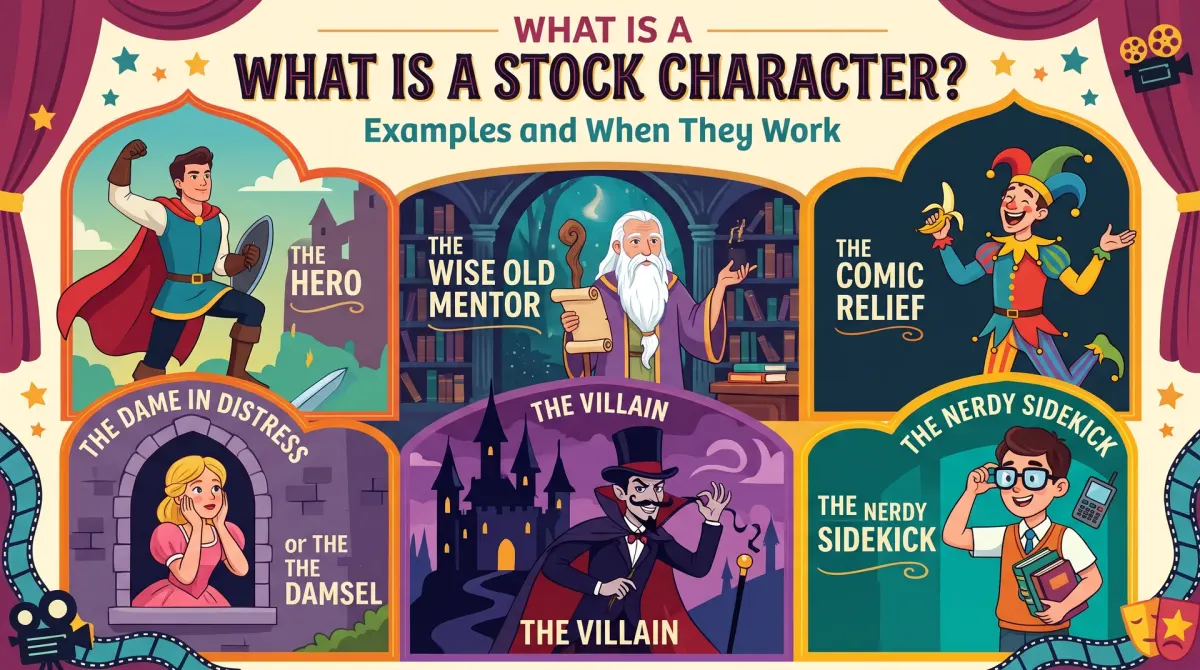
A stock character is a familiar type found across many stories, such as the wise mentor or the bully. It is defined by one or two traits and has little personal depth. Writers use it as shorthand to fill roles quickly.
The idea is very old. Roman comedies used set types, such as the boastful soldier and the clever slave. The Italian commedia dell'arte, a stage tradition from the 1500s, used masked types such as Harlequin. Audiences knew the types, so the plot could move fast.
Merriam-Webster lists the term under its entry for stock.
Stock characters share a few traits:
- They are easy to spot. One look or one line tells you who they are.
- They stay the same. They rarely change over the story.
- They serve the plot. They exist to do a job, such as give a clue or block a door.
- They are shared. The same type appears in many works.
A stock character is close to a flat character. A flat character has one main trait and does not change. Most stock characters are flat. Yet a flat character can be new, while a stock character is a known type.
If you want to see how flat and round characters differ, a guide can help.
Stock character vs archetype vs stereotype
Key takeaway: An archetype is deep and universal. A stock character is a quick type. A stereotype is a harmful shortcut.
These three terms are often mixed up. They overlap but differ in depth and effect.
| Term | Meaning | Risk |
|---|---|---|
| Archetype | A universal pattern | Can feel vague |
| Stock character | A familiar story type | Can feel flat |
| Stereotype | A fixed image of a group | Can cause harm |
An archetype is a deep, old pattern found across cultures, such as the hero, the mentor or the trickster. It describes a role in the human story.
A stock character is a more specific type built on such patterns. "The wise old wizard" is a stock character built on the mentor archetype.
A stereotype is a fixed, simple image of a group of people, often based on race, gender, age or origin. A stereotype can be unfair and hurtful. A stock character becomes a stereotype when the type is based on a group, not on a story role.
For example, "the nosy neighbor" is a stock character defined by behavior. "The lazy foreigner" is a stereotype defined by a group. The first is a role in a story. The second is a harmful claim.
Writers should watch the line. Ask whether the type is defined by what the person does or by who they are. Types defined by action are safer. Types defined by group identity deserve a second look.
Common stock characters
Key takeaway: Stock types cluster by role. Knowing them helps you spot them in your draft.
Lists vary, but these types appear again and again.
Helpers and guides
- The wise mentor
- The loyal sidekick
- The comic relief
- The kind innkeeper
Blockers and threats
- The bully
- The corrupt official
- The mad scientist
- The evil stepmother
Romantic and social types
- The damsel in distress
- The femme fatale
- The charming rogue
- The gossip
Genre types
- The hard-boiled detective in crime fiction
- The final survivor in horror
- The chosen one in fantasy
- The absent-minded professor in comedy
Some of these, such as the damsel in distress, are now seen as outdated. Many readers want stronger roles. Think before you use one.
Stock characters differ by genre. A mystery relies on the red-herring suspect. A fantasy relies on the magic guide. A school story relies on the bully and the nerd.
They also appear in film and TV. A sitcom may feature the grumpy boss and the quirky neighbor. A fast-moving show uses types to save time.
Stock characters are not wrong. They are tools. The trouble comes from using them in the wrong place.
When stock characters work
Key takeaway: Use stock types in minor roles and short scenes. Give depth to the cast that carries the story.
Stock characters earn their place in three cases.
- Minor roles. A waiter, a guard or a clerk needs only a quick sketch.
- Comedy and satire. Types are the base of many jokes.
- Fast pacing. In a short story or a thriller, speed matters more than depth.
They fail when they fill a role that needs depth. A lead who is a pure type feels like a copy. A villain who is only "evil" lacks a motive. A love interest who is only "the girl next door" feels flat.
A cast-depth budget helps you plan. Sort your cast into three tiers.
- Tier 1: full depth. Leads and key opponents.
- Tier 2: partial depth. Supporting characters with a goal and a quirk.
- Tier 3: stock. Minor roles that need only a type.
Here is a worked example for a cast of 14 characters.
- Tier 1: 3 characters
- Tier 2: 6 characters
- Tier 3: 5 characters
Check the total: 3 + 6 + 5 = 14 characters.
Now find the share of stock roles: 5 ÷ 14 = about 0.36, or 36 percent.
Next, look at page time. In a 90,000-word novel, Tier 3 characters might each take about 1 percent of the book.
- Per stock character: 90,000 × 0.01 = 900 words
- All five: 5 × 900 = 4,500 words
- Share of the book: 4,500 ÷ 90,000 = 0.05, or 5 percent
So the stock roles take only 5 percent of the page space. That is a good sign. Many stock roles can fill a cast if they take little room.
These shares are planning ideas, not rules. The key is to keep stock roles small and keep depth where the story needs it.
How to upgrade a stock character step by step
Key takeaway: Add a want, a contradiction and a specific detail to lift a stock type.
You can give life to a stock character without writing a long backstory. Use these steps.
- Name the stock type.
- Give the character a small want.
- Add one trait that clashes with the type.
- Add a specific detail only they would have.
- Give them one line only they would say.
- Let them make one surprising choice.
- Check that the change serves the scene.
Take the stock type "the nosy neighbor." Add a want: she wants someone to need her. Add a clashing trait: she keeps secrets better than anyone. Add a detail: she waters her plants at midnight. Add a line: "I never listen. I just happen to hear."
Now she is not just a gossip. She is a lonely woman with a hidden skill. The change took five lines.
Not every stock character needs an upgrade. Use this method on the ones that appear in more than one scene or that affect the plot.
A single surprising choice is the strongest tool. A bully who helps a younger child gains a human edge. So does a guard who lets a stranger pass. The reader will remember it.
Also avoid piling on traits. Two or three details are enough. Too many make a minor role heavy.
Stock characters in different forms
Key takeaway: Short forms lean on types. Long forms need more depth.
The right balance depends on the form.
- Short stories. There is little room. Types are common and useful. One strong detail can lift a minor role.
- Novels. A long book needs more depth. A cast made only of types feels thin.
- Children's books. Clear types help young readers follow the story. The mean stepmother and the helpful animal are classic cases.
- Films and TV. Fast pacing relies on types, but long series need depth over time.
- Games. Non-player characters are often stock types, such as the shopkeeper or the guard.
In a series, a stock character can grow. A minor figure in book one may gain depth by book three. Readers enjoy seeing a type turn into a person.
Satire often uses stock characters on purpose. The writer wants the reader to see the type and laugh. A stuffy official or a vain actor works well here.
If you are starting a short piece, the short story guide shows how to build a small cast.
People Also Ask
What is the difference between a stock character and a stereotype?
A stock character is a familiar story type defined by a role or behavior, such as the nosy neighbor. A stereotype is a fixed, often unfair image of a group of people. A stock character becomes a stereotype when the type rests on group identity rather than on a story job.
Are stock characters bad?
No. Stock characters are tools that fill minor roles quickly. They are common in comedy, short stories and fast-paced plots. The trouble comes when a stock type fills a role that needs depth, like the lead. Used with care, they help the story move.
Is a stock character the same as a flat character?
They overlap but are not the same. A flat character has one main trait and does not change. A stock character is a known type that appears across many works. Most stock characters are flat, but a flat character can be new and not a familiar type.
Common mistakes
- Using a stock type for a lead or a main opponent.
- Building a type on a group stereotype.
- Giving a minor role too many traits.
- Filling a whole cast with types.
- Using outdated types without a fresh take.
Your next step: sort your cast
List every named character in your draft. Place each in Tier 1, 2 or 3. Check the share of stock roles and the page space they take. Then upgrade the stock characters who appear in more than one scene.
When your cast is set, plan how each fits the plot with an outline.