What is a setting in a story?
Key takeaway: The setting is when and where a story takes place, plus the mood around it.
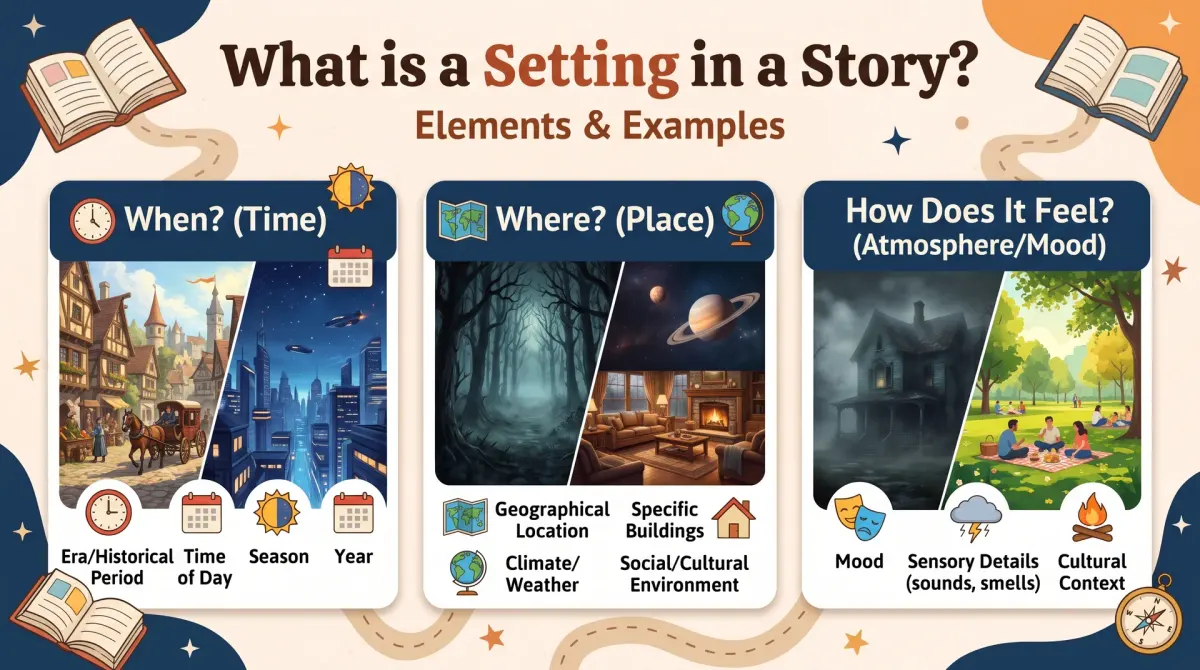
The setting is the time and place in which a story happens. It includes the era, location, weather, social world and mood. The setting tells readers where and when events occur. It can shape the plot, the characters and the emotions of the story.
Setting answers two plain questions: where are we, and when are we? But it goes further. It also covers how the place feels and what rules the society follows.
Merriam-Webster lists the literary meaning of setting.
A setting can be large or small. The setting of a whole novel might be a country in the 1920s. The setting of one scene might be a kitchen on a rainy morning.
Setting is one of the core elements of a narrative. The others are character, plot, conflict, theme and point of view. They work as a team.
You can think of the setting as a stage. The stage shapes what the actors can do. A character in a desert faces thirst. A character in a city faces crowds.
If you want to see how setting fits with the rest of your story plan, an outline helps.
Elements of setting
Key takeaway: A setting has four parts: time, place, mood and social context.
Writers often break setting into four elements.
| Element | What it covers | Example |
|---|---|---|
| Time | Era, season, hour | 1920s, winter, dawn |
| Place | Location and surroundings | A village by the sea |
| Mood | The feeling of the place | Eerie, warm, tense |
The fourth element is social context. This covers the customs, rules and beliefs of the society. A story set in a strict school feels different from one set in a free-spirited town.
Each element can be small or large:
- Time. It can be a year, a decade or an hour. It can also include how time passes, such as a single night.
- Place. It can be a country, a town, a house or a room. It includes climate and terrain.
- Mood. It is the emotional tone. It comes from word choice, light, sound and weather.
- Social context. It includes class, culture, religion, law and everyday habits.
Weather and season belong to place and time. A storm adds tension. A spring morning adds hope. Writers often use weather as a quiet echo of the plot.
Setting can shift. A story might move from a farm to a city, or from summer to winter. Each shift can mark a change in the lead.
What a setting does for a story
Key takeaway: Setting can set mood, create conflict, reveal character and carry theme.
A strong setting does more than decorate the page. It works.
- Sets the mood. A fog-filled street makes readers uneasy.
- Creates conflict. A flood, a blizzard or a strict regime blocks the lead's goal.
- Reveals character. What a character notices, or chooses to keep in a room, shows who they are.
- Carries theme. A crumbling mansion can echo a family's decline.
- Grounds the reader. Clear detail makes events feel real.
- Shapes the plot. The rules and limits of a place decide what can happen.
In some books, the setting acts like a character. It has moods and effects. It pushes the plot. The moors in Wuthering Heights are a common example. They shape the tone and the people.
Setting also matters in genre. A fantasy book sets rules for a magic world. A historical novel needs period detail. A thriller may rely on a tense, closed place, such as a snowed-in lodge.
A good test is to move your scene to another place. If nothing changes, the setting is doing little. If the scene falls apart, the setting is doing real work.
Setting examples from well-known stories
Key takeaway: The best settings are specific and tied to the story's theme.
Here are examples that many readers know.
- The Great Gatsby. Long Island and New York in the 1920s. The rich homes and the grey valley of ashes mark the gap between wealth and want.
- Lord of the Flies. A remote island with no adults. The setting removes rules, so the boys' choices show.
- 1984. A grim, watched city under a controlling state. The setting is the main antagonist.
- Wuthering Heights. The windswept moors of northern England. The harsh land mirrors the harsh passions.
- The Hunger Games. A divided nation with a lavish capital and poor districts. The setting shows the theme of power.
Notice the pattern. Each setting ties to theme. The place is not random. It supports the story's main idea.
Setting is key in non-fiction, too. A memoir set in a small village in a certain decade pulls the reader into a world. The details make the life real.
Short stories use setting with care. With few words, one or two details carry the mood. A single image, such as a cracked window, can be enough.
How much setting does a scene need?
Key takeaway: Setting should take a small, steady share of each scene, and be woven into action.
Most articles say "balance setting with action" but give no numbers. A simple budget gives you a start. It is a planning idea, not a rule.
Here is a worked example for a 3,000-word scene.
- Setting share: about 10 to 15 percent
- Low end: 3,000 × 0.10 = 300 words
- High end: 3,000 × 0.15 = 450 words
So the scene can hold about 300 to 450 words of setting. The rest should be action, dialogue and thought.
Now check a draft. Say your opening scene has 900 words of scenery.
- Share: 900 ÷ 3,000 = 0.30, or 30 percent.
- Excess over the high end: 900 − 450 = 450 words.
That is double the upper budget. You can trim 450 words or spread them across the next scenes.
New places need more setting than familiar ones. A first visit to a castle may need 450 words. A return visit may need 100. Readers carry the picture with them.
Weave setting into action. Skip the line "The room was cold". Write "She pulled her sleeves over her hands". The reader gets the cold and the character in one line.
Chapter length also limits setting. A short chapter has less room for scenery. A guide to chapter length can help you plan.
The five-sense setting check
Key takeaway: Cover at least three senses in each major setting so readers feel the place.
Many writers describe only what the eye sees. A fuller setting reaches the other senses.
Use a five-sense tally on a key scene. Mark each sense used.
- Sight. Light, color, shape, movement.
- Sound. Voices, wind, silence, traffic.
- Smell. Smoke, rain, food, damp.
- Touch. Heat, cold, texture, wind on skin.
- Taste. Salt in the air, bitter coffee, dust.
Here is a worked example. In a 600-word scene, you find:
- Sight: 8 details
- Sound: 3 details
- Smell: 1 detail
- Touch: 2 details
- Taste: 0 details
Count the senses used: 4 of 5. Count the details: 8 + 3 + 1 + 2 + 0 = 14.
Share of sight: 8 ÷ 14 = about 0.57, or 57 percent.
Sight leads, which is normal. But taste is missing, and smell is thin. You can add one smell and one taste to deepen the scene. Aim for at least three senses per major scene.
Do not stack details. Pick the few that fit the mood. A tense scene may need cold, a sharp sound and a smell of smoke. A calm scene may need warmth, birdsong and the smell of bread.
How to write a strong setting step by step
Key takeaway: Choose a few telling details, tie them to mood and let characters notice them.
Use these steps for any scene.
- State the time and place in one line.
- Decide the mood you want.
- Pick three to five telling details.
- Include at least three senses.
- Let a character notice the details.
- Tie one detail to the scene's conflict.
- Trim any detail that adds nothing.
Step five is the secret. A character's view filters the setting. A thief sees locks and exits. A painter sees color and light. The same room reads differently through each.
Step six keeps the setting alive. A detail that matters later is better than one that only decorates. If a window sticks in chapter two, it can trap someone in chapter twenty.
Research helps when your setting is real. Visit the place, if you can. If you cannot, use maps, photos, books and first-hand accounts. For a historical setting, check period details, such as food, dress and speech.
For an invented world, keep notes. A short list of rules, places and names helps you stay consistent.
People Also Ask
What are the four elements of setting?
The four elements are time, place, mood and social context. Time covers era, season and hour. Place covers location and surroundings. Mood is the feeling of the place. Social context covers the customs, rules and beliefs of the society. Together they form a full picture of the story world.
What is the difference between setting and mood?
Setting is the time and place of a story. Mood is the feeling the story creates in the reader. Setting is one tool that builds mood. A dark, foggy street is a setting that can create a tense mood. The two work together but are not the same thing.
Can a story have more than one setting?
Yes. Many stories move between places and times. A novel might shift from a village to a city. Each setting should have a clear purpose and be easy to follow. Label shifts with a chapter heading or a clear first line so readers always know where they are.
Common mistakes
- Opening with long scenery before anything happens.
- Describing only what the eye sees.
- Using settings that have no link to the theme.
- Forgetting to ground readers when the scene changes.
- Adding details that never matter.
Your next step: run the budget on one scene
Pick one scene from your draft. Count the words of setting and divide by the scene's total. Compare the share with the 10 to 15 percent guide. Then tally the five senses and add one missing sense.
If you are still building the draft, the novel guide helps you plan scenes and settings.