What is an anti-hero?
Key takeaway: An anti-hero is a lead without classic heroic traits whom readers still follow.
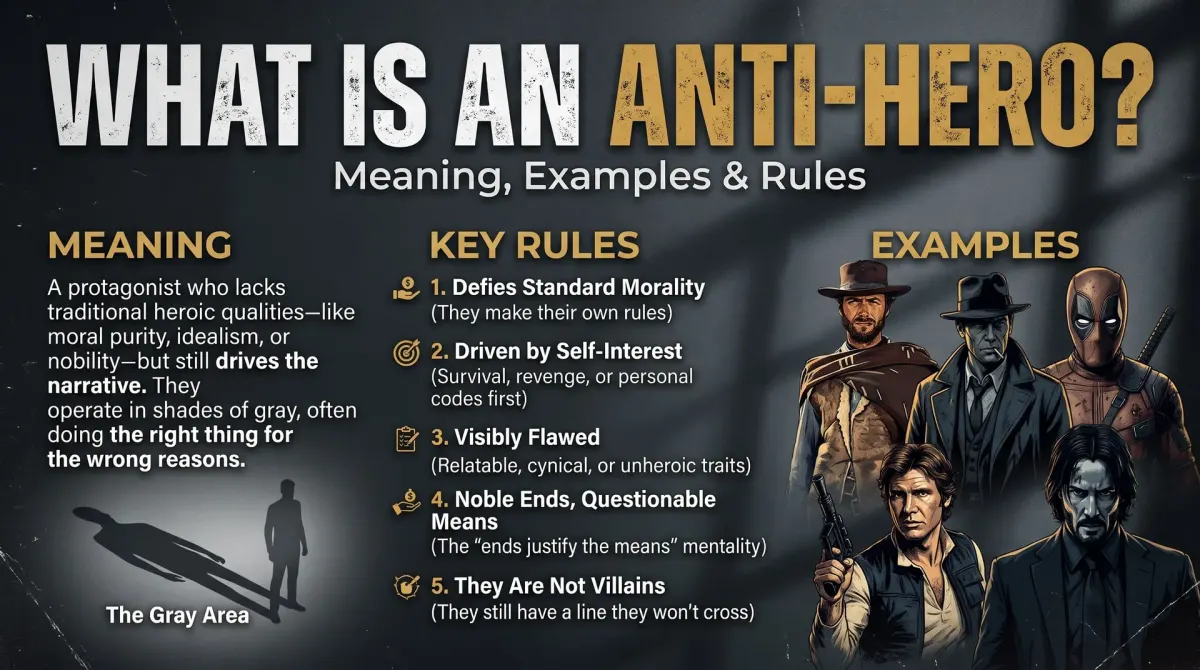
An anti-hero is a protagonist who lacks traditional heroic qualities such as courage, honesty or moral purity. The character may be selfish, cynical, flawed or even ruthless. Readers still follow an anti-hero. They are drawn by a clear goal, a human side and a real struggle.
The prefix "anti" can mislead. The anti-hero is not the opposite of a hero in the sense of being a villain. The anti-hero is still the lead of the story. The character simply lacks the shine of a classic hero.
Merriam-Webster lists the dictionary meaning.
A classic hero is brave, honest and acts for good. An anti-hero may be afraid, lie and act for self. Yet the anti-hero holds the story's center. The plot follows their goal.
The role is about the plot, not about morals. A guide to the protagonist shows how a lead drives a story.
Anti-heroes appear in every form. Novels, films, comics and TV series use them. Modern audiences often like them. Real people are mixed. A lead with faults feels true.
Two ideas help set the anti-hero apart:
- A hero acts for the good of others, often at a cost.
- An anti-hero acts for a personal goal, and the good may be a side effect.
The line can blur. An anti-hero may do something heroic by accident. A hero may do something selfish. The label depends on the pattern, not on one act.
Types of anti-hero
Key takeaway: Anti-heroes range from flawed but decent to ruthless. Pick the type that fits your story.
Writers sort anti-heroes into a few types.
| Type | Core trait | Feel |
|---|---|---|
| Classic | Flawed but decent | Rough charm |
| Pragmatic | Does what works | Cold, practical |
| Unscrupulous | Breaks rules freely | Dark, risky |
More types worth knowing:
- The reluctant anti-hero. Pushed into action, they do not want the role.
- The tragic anti-hero. A good person whose choices lead to ruin.
- The villain protagonist. A character who does evil, but the story follows their view.
- The loveable rogue. A thief or trickster with charm and a code.
The type sets how far you can go. A classic anti-hero can lie but will not hurt the innocent. An unscrupulous anti-hero may cross lines that others will not. Readers accept different levels in different genres.
Genre matters. A crime story may allow a darker lead. A children's story needs a gentler one. Know your readers' limits before you plan the character.
An anti-hero can also change type over time. A rogue may become a true hero. A decent person may slide into darkness. That shift is the arc.
Famous anti-hero examples
Key takeaway: Strong anti-heroes have a clear want, a code of their own and a human side.
Here are examples that many readers and viewers know. Labels vary, so treat these as common readings.
- Walter White in Breaking Bad. A teacher who turns to crime. He starts as a sympathetic man and grows darker.
- Han Solo in Star Wars. A smuggler who acts for money, then proves loyal.
- Raskolnikov in Crime and Punishment. A student who commits murder and wrestles with guilt.
- Scarlett O'Hara in Gone with the Wind. A willful, selfish survivor who still holds the story.
- Holden Caulfield in The Catcher in the Rye. A cynical, troubled teen with a sharp voice.
Notice what these share. Each has a strong want. Each has a code, even if it is odd. Each shows a human side at key moments. These keep readers invested.
An anti-hero often has a moral line they will not cross. It might be harming a child, betraying a friend or killing for pleasure. The line gives the reader something to trust.
Another trait is wit or skill. A sharp mind or a gift makes the lead fun to follow. Readers forgive faults in a character who is good at something.
Finally, many anti-heroes pay a price. They suffer for their choices. Readers feel that justice is at work, which makes the dark moves easier to accept.
The sympathy ledger
Key takeaway: Track flaws and human moments scene by scene to keep readers on the anti-hero's side.
Most articles say "make them relatable" and stop. A sympathy ledger turns that advice into numbers.
For each scene with the lead, mark one of three codes:
- F for a scene that shows a flaw or a wrong act
- H for a scene that shows a human, kind or brave side
- N for neutral
Here is a worked example for a novel with 30 scenes that feature the lead.
- Flaw scenes (F): 14
- Human scenes (H): 10
- Neutral scenes (N): 6
Check the total: 14 + 10 + 6 = 30 scenes.
Now find the shares.
- Flaws: 14 ÷ 30 = about 0.47, or 47 percent
- Human: 10 ÷ 30 = about 0.33, or 33 percent
- Neutral: 6 ÷ 30 = 0.20, or 20 percent
The ratio of human to flaw scenes is 10 ÷ 14 = about 0.71. That means for every 10 flaw scenes, there are about 7 human ones.
Is that enough? There is no fixed target. A darker story may accept a lower ratio. But a lead who shows a flaw in nearly every scene, with few human moments, may lose readers.
Next, check the order. Place human scenes early. In the first 5 scenes, readers need at least 2 H scenes to bond with the lead. Then you can push the character darker.
A simple pattern: open with a human scene, add a flaw, then a human moment that explains the flaw. For example, a thief steals medicine for a sick sister. The act is wrong, but the motive is warm.
Use the ledger after you finish a draft. Mark the scenes and look for runs of five or more F scenes in a row. Break them with an H or an N scene.
Rules for writing an anti-hero
Key takeaway: Give the anti-hero a clear want, a code, a skill and a cost.
Use these rules to keep your lead compelling.
- Give a clear want. Readers follow a goal. The want should be strong and easy to state.
- Give a code. A line they will not cross builds trust.
- Give a skill. Wit, talent or courage in one area earns forgiveness.
- Give a reason. Show why the lead became this way, in small hints.
- Give a cost. Let the character suffer for bad acts.
- Show a bond. One person they care for, such as a child, a friend or a pet, shows the human side.
Be careful with the final act. Readers expect the anti-hero to face the result of their choices. A character who does grave harm and walks away free can feel cheap. A character who pays can feel earned.
Also avoid cruelty for shock. Dark acts need a purpose. Ask what each wrong act reveals about the lead. If it only shocks, cut it.
How to write an anti-hero step by step
Key takeaway: Start with the want, add the flaw, then build the bond and the cost.
Use these steps to plan your lead.
- State the lead's main want in one line.
- Choose the anti-hero type.
- List three flaws and one strength.
- Set a moral line they will not cross.
- Add one person they care about.
- Plan three scenes of cost or loss.
- Run the sympathy ledger on your draft.
Step four is a key piece. The moral line is the anchor for readers. When the lead nears the line, tension rises. When they cross it, the story changes.
Step five gives a reason to hope. If the lead cares for one person, the reader sees a path to change.
Finally, test with a reader. Ask whether they want the lead to win, and why. If they say no, find the missing piece. It may be a clear want, a human moment or a stronger cost.
People Also Ask
What is the difference between an anti-hero and a villain?
An anti-hero is the lead of the story, and readers follow their goal. A villain opposes the lead and usually does evil on purpose. An anti-hero may do wrong, but the story holds their view. A villain protagonist blurs the line, but the story still centers on the character.
Is an anti-hero a hero?
Not in the classic sense. An anti-hero lacks traditional heroic traits such as courage or moral purity. The character may be selfish or cynical. Still, the anti-hero holds the center of the story, and some do heroic things. The label depends on the overall pattern of their choices.
Why do readers like anti-heroes?
Anti-heroes feel real. People are mixed, so a flawed lead rings true. Readers also enjoy the tension of a character who may do right or wrong. A clear want, a code and a human side let readers cheer for the lead. They can do so even when they disapprove of some acts.
Common mistakes
- Making the lead cruel with no human moments.
- Giving no moral line, so readers cannot trust the character.
- Letting the lead escape every cost.
- Using dark acts only to shock.
- Forgetting a clear want.
Your next step: run the ledger
Pick your lead and list the scenes they appear in. Mark each as flaw, human or neutral. Check the ratio of human to flaw scenes and look for long runs of flaw scenes. Add a human moment where needed.
For a smaller test, write a short story with an anti-hero first.